
You make dinner, remember the small things, say the kind words. And your partner shrugs, changes the subject, or gets strangely cold. If you are wondering how to love someone who doesn’t know how to receive love, you are not doing it wrong, and you are not alone.
Here is the short version. People who struggle to receive love are rarely rejecting you. They are protecting themselves from something old: a childhood where love was unreliable, a past betrayal, or a belief that they do not quite deserve it.
The way through is not louder love. It is steadier, smaller, more believable love, given in a form they can actually take in, while you keep your own needs intact.
In this guide you will learn how to recognize the signs, why it happens, a simple framework we call the Four Blocks, exact words to try, the mistakes that make it worse, and when to step back. If you are the one who struggles to receive love, there is a section written for you too.
What does it mean to struggle to receive love?
If you want to know how to love someone who doesn’t know how to receive love, start by understanding what that struggle is. Receiving love is a skill, and it is not the same as being loved. Someone can be adored and still feel unable to let it in. They hear the compliment but cannot believe it. They accept the gift but feel they owe you something. They enjoy closeness for an hour and then feel the urge to flee.
Signs someone can’t receive love
You may recognize a few of these:
- They brush off compliments with a joke or a quick “stop it.“
- They say “you didn’t have to” or “it’s no big deal” to every kind gesture.
- They become suspicious when you are generous. “What do you want?” or “Why are you being so nice?“
- They get uncomfortable, irritated, or distant right after a tender moment.
- They find it easier to give than to take, and may be the person who always helps and never asks.
- They test you, quietly or loudly, to see whether you will leave.
- They say they love you but rarely let you do things for them.
One or two of these does not mean something is wrong. A pattern that repeats across months is what to look at.
It is not the same as not loving you
This is the hardest part to hold onto. A partner who deflects affection can still love you deeply. The difficulty is in letting love land, not in feeling it.
If you want to look at the other side of this, our guide on what right love actually feels like is a good companion read, and signs your partner has abandonment issues covers a related pattern.
Why some people can’t receive love?
There is rarely a single cause. These are the most common, and several often overlap.
Early experiences with love
If love in childhood was unpredictable, conditional, or used as a reward, a person can grow up expecting affection to disappear or to come with a price.
Healthline’s overview of why people push others away points to attachment patterns as a major factor: when a caregiver did not reliably meet a child’s emotional needs, the child may grow into an adult who keeps relationships casual so they can leave when things get intense. That is the avoidant pattern, and our guides on anxious vs avoidant attachment and how to date someone with avoidant attachment go deeper.
Low self-worth
The same Healthline article notes that people who doubt their own worth may expect to be let down, abandoned, or replaced, or may feel they do not deserve a healthy relationship. When you believe you are not very lovable, praise can sound like a mistake.
There is research that helps explain this. Psychologist William Swann developed self-verification theory, which holds that people want others to see them the way they see themselves, even when that self-view is negative.
According to Simply Psychology’s summary of the theory, in one marriage study people with negative self-views were more committed to spouses who appraised them unfavorably. Two cautions matter here. That study was correlational, and the effect mostly applies to self-views held with real certainty.
It is not a rule that everyone with low self-esteem rejects love. But it offers a useful clue: for some people, being praised in ways that clash with how they see themselves feels uncomfortable, not warm.
Past betrayal or loss
Someone who has been cheated on, abandoned, or left without warning may have learned that closeness is what gets taken away. Trust problems after betrayal can make even consistent kindness feel like a setup.
Fear of intimacy
For some people, the problem is not worth but safety. The closer they feel, the more they have to lose, so they pull back. If this sounds familiar, read how to stop being scared of intimacy and why you push people away when you like them.
Why this matters for you?
Knowing the cause helps you stop taking it personally. The cold response to your sweet gesture is usually an old alarm going off, not a verdict on you.
The Four Blocks: how people keep love out
After looking at the common patterns, it helps to name them. We call these the Four Blocks. Most people lean on one or two. Spotting which one your partner uses tells you what kind of love will actually land.
| Block | What it sounds like | What may be underneath | What helps |
|---|---|---|---|
| Deflect | “Oh, stop it.” “It was nothing.” Changes the subject. | Praise feels embarrassing or untrue | Short, specific, low-key appreciation. No spotlight. |
| Doubt | “What do you want?” “You will get bored of me.” | Past betrayal, fear of a catch | Consistency over time. No hidden strings. |
| Discount | “You didn’t have to.” Shrinks your effort. Offers to repay. | Fear of being in debt, or of being a burden | Make receiving easy. Say “I wanted to,” not “you deserve it.” |
| Disappear | Goes quiet, picks a fight, or pulls away after a warm moment. | Closeness feels risky or overwhelming | Steady presence. Let them return without a scene. |
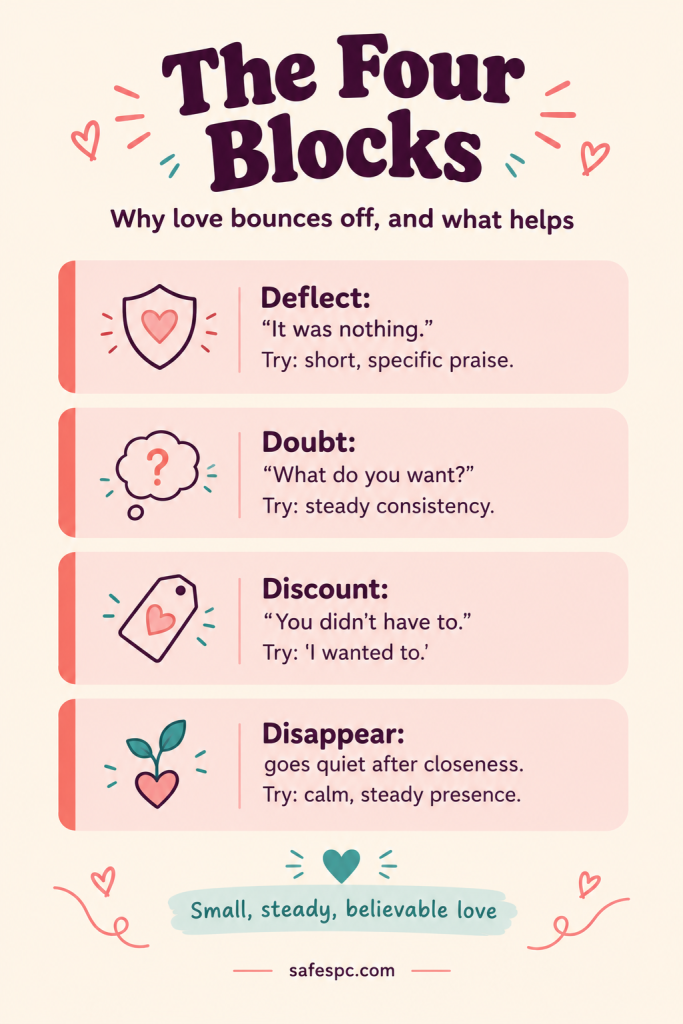
How to find your partner’s main block?
Look at the moment right after you show love. What do they do in the first ten seconds?
- Laugh it off (Deflect)?
- Question it (Doubt)?
- Wave it away (Discount)?
- Or retreat later that day (Disappear)?
Keep notes in your head for a week or two. The pattern usually becomes obvious.
Why a framework helps?
Without a framework, how to love someone who doesn’t know how to receive love can feel like guesswork, and you tend to give more of what is not working.
- If your partner Deflects, grand speeches will make it worse.
- If they Doubt, surprises may feel like a trap.
Matching your love to their block lowers the threat, and a lowered threat is the first thing that lets love in. These four blocks are our own working framework, drawn from the patterns described above, not a clinical model.
Mistakes to avoid when you love someone who doesn’t know how to receive love
These come from good intentions, which is why they are easy to repeat.
- Love bombing. Flooding someone with affection to prove you mean it tends to confirm their fear that something is off. Steady beats intense.
- Taking it personally. If every deflection becomes a wound, your partner ends up managing your feelings as well as their own. That adds pressure.
- Playing therapist. Telling them “this is because of your childhood” can feel like being analyzed. Offer observations once, gently, not as a diagnosis.
- Keeping score. “I did so much for you and you never thank me” turns love into a ledger, which is exactly what a person afraid of owing something dreads.
- Demanding a reaction. Love that requires gratitude, tears, or a matching gesture is not freely given. Let them respond in their own time.
- Testing them. Pulling away to see if they chase, or asking for proof, just recreates the unsafe dynamic.
- Giving ultimatums too early. “Open up or I’m leaving” may feel justified, but it rarely creates safety. A clear boundary after patient effort is different, and we cover it below.
- Over-giving to prove your worth. If you pour in more and more and receive little, resentment grows quietly.
How to love someone who doesn’t know how to receive love: a step-by-step approach
This is the heart of the guide. Think of these steps as a sequence, not a checklist. Go slowly, and expect uneven progress.
Step 1: Lower the volume, raise the frequency
Large gestures can feel like pressure. Small, repeated ones feel safe. A text that says “thinking of you,” a cup of tea made without comment, a hand on their back as you pass. Over weeks, these build a pattern that says love here is ordinary and reliable.
Step 2: Be specific and believable
Vague superlatives (“you are the best person ever“) can bounce off someone with a harsh self-view. Specific, grounded appreciation is easier to believe. Compare these:
- Hard to take in: “You are amazing and perfect.“
- Easier to take in: “I noticed how patiently you explained that to your sister. It made the whole evening calmer.“
Given what self-verification research suggests, praise that fits how the person sees themselves, and points to something real, is less likely to trigger a defence.
Step 3: Make it easy to receive
Remove the debt. Say “I wanted to” instead of “you deserve it.” Skip the dramatic reveal. Do not wait for a thank you. If they offer to pay you back, you can say “Next time you can pick the movie.” Keep it light.
Step 4: Give love in the form they can handle
Some people can accept acts of help but not words. Some can take touch but not public praise. Pay attention to what lands and do more of it. Private is usually easier than public.
Step 5: Be consistent, not perfect
The goal is predictability. If you are warm on Monday and distant on Wednesday, you confirm that love is unreliable. If you are warm most days and honest when you are not, you build trust. Consistency does more than any single gesture.
Step 6: Name what you see, once, gently
You can describe the pattern without blaming. For example:
- “I have noticed that when I say something kind, you tend to joke it away. I am not upset. I just want you to know I mean it.“
- “When we have a really close evening, I sometimes feel you pull back the next day. Is something coming up for you?“
Say it once, then let it rest. Repeating it turns it into criticism.
Step 7: Let them love you their way
People who struggle to receive love often show love through action: fixing your car, remembering your coffee, quietly showing up. Notice and thank them for it. When you receive their love well, you are modeling what receiving looks like.
Step 8: Celebrate small receipts
When they let a compliment stand, say thank you, or ask for a hug, stay calm and warm. Do not make a big deal of it. A quiet “I‘m glad” is enough. The point is to make receiving feel safe, so they do it again.
How to talk about it without a fight?
Conversations about this can easily sound like “you are broken.” Pick the moment carefully and keep it about the two of you, not about their flaws.
Choose the right time
Not right after a deflection, not during an argument, not late at night. A calm moment, side by side (on a walk or a drive) often feels less intense than face to face.
Scripts you can adapt
- Opening: “I want to talk about something because I care about us, not because I’m upset. Is now an okay time?”
- Naming the pattern: “When I try to show you love, it sometimes seems uncomfortable. I wonder if there is a way I can do it that feels better for you.”
- Asking what helps: “What kind of care feels easiest for you to take in?”
- Sharing your side: “When my kindness gets brushed off, I sometimes feel like it does not matter. I know that is probably not what you intend, but I want to be honest about it.”
- Reassuring: “You do not have to change overnight. I just want us to figure it out together.”
Let silence be okay
They may not have words. Someone who has avoided talking about feelings for years rarely produces a perfect answer in the moment. Give them time.
Conversation prompts can help a lot here, and our 100 couple conversation cards offer gentle, low-pressure questions that make opening up easier. For ideas on what your partner may be feeling but not saying, read what your partner wishes they could tell you.
Protect yourself: boundaries and your own needs
Learning how to love someone who doesn’t know how to receive love can be lonely. You can be patient and still have limits.
You cannot love someone into healing
You can create safety, and that matters. But you cannot do someone’s inner work for them. If you find yourself giving and giving to prove that you are safe, notice it. That is a sign you may be losing balance.
Know your own needs
Ask yourself honestly: do I feel loved in this relationship, at least some of the time? Do I get to receive, too? A relationship where one person’s needs are always on hold is not sustainable, however patient you are.
Set clear, kind boundaries
A boundary says what you will do, not what they must do. For example: “I am happy to give you space after a hard day, and I need us to talk about it within a day or two,” or “I will not take part in arguments where we are both shouting, but I will come back when we are calmer.”
When it crosses a line
Difficulty receiving love is not an excuse for cruelty, contempt, control, or abuse. If your partner insults you, isolates you, or makes you afraid, the issue is no longer about receiving love and your safety comes first.
Reach out to a trusted person or a local support service. Our guide on green flags vs red flags in a relationship can help you tell the difference between struggle and harm.
If you are the one who can’t receive love
You may be reading this because the description fits you. That takes courage, and it is a good starting point.
Start small
Practice the simplest response: “Thank you.” No joke, no deflection, no “but.” Try it with one compliment a day. It will feel odd. That oddness is the old pattern, not the truth.
Notice your block
Which one is yours: Deflect, Doubt, Discount, or Disappear? Naming it gives you a half second of choice before you react.
Tell the person who loves you
You do not need a long explanation. “I am working on letting myself receive kindness, so if I seem awkward, it is not about you” can be a huge relief for a partner. As Healthline’s overview notes, explaining your struggles to your partner helps them understand your hesitation.
Go slowly and be gentle with yourself
Healthline’s advice is to build trust gradually and to be self-compassionate, because change takes time. Noticing the pattern is already a big step. If anxiety about being close is a part of it, our guide on how to fix an anxious attachment style offers practical tools.
Consider support
A therapist who works with attachment can help you trace where the pattern came from and build new habits of closeness. Therapy is not a sign that you are broken. It is a good fit when old wounds or attachment patterns are hard to change alone.
What progress looks like, and when to get help?
Change is usually slow and uneven. When you are working out how to love someone who doesn’t know how to receive love, progress is quiet. These are the small signs that things are shifting:
- They pause before deflecting, even if they still deflect.
- They say “thank you” and let it stand.
- They ask for affection, even in a small way.
- They return after pulling away without a long recovery.
- They tell you something vulnerable and do not take it back.
- They let you help without needing to repay.
There is no schedule. Some people notice shifts in a few months, others take much longer, and setbacks are normal, especially under stress.
When to bring in a professional
Consider couples counseling or individual therapy if:
- the pattern is hurting your relationship or your wellbeing,
- there is trauma or deep mistrust involved,
- you keep having the same painful conversation,
- one of you feels stuck despite real effort.
Therapy is not a failure. For many people it is the most direct way to learn to give and receive love more safely.
When to step back
If you have been patient and clear, and your partner has no interest in working on the pattern or makes you feel small and unloved, it is fair to reconsider the relationship. Ending it is not a betrayal of them. Patience is a gift, not an obligation without end.
Frequently Asked Questions
Why can’t some people receive love?
Common reasons include unreliable love in childhood, low self-worth, past betrayal or loss, and fear of closeness. Often more than one applies.
Is this the same as avoidant attachment?
Not exactly. Avoidant attachment is one pattern that can make receiving love hard, but low self-worth and past betrayal can cause the same difficulty in people who are not avoidant. See our guide on anxious vs avoidant attachment.
Can someone who can’t receive love change?
Many people can build the skill with time, safety, and sometimes therapy. Change usually depends on whether the person wants it and has support.
How do you love someone who doesn’t know how to receive love?
Go slowly, give small and specific appreciation, make it easy to accept, stay consistent, and keep your own needs in the picture. The step-by-step section above shows how.
How do I show love to someone who rejects affection?
Go small and steady. Be specific, avoid pressure, make receiving easy, and love them in the form they can take in.
How long does it take?
There is no standard timeline. Look for small signs, such as pausing before deflecting or saying thank you, rather than a date.
Should I stay with someone who can’t receive love?
It depends on whether you feel loved too, whether they are willing to grow, and whether you are safe. If your needs are consistently unmet or you feel afraid, it is reasonable to leave.
What if I am the one who can’t receive love?
Start with small practice, tell your partner what you are working on, and consider talking to a therapist. The section above is written for you.
Is it a sign they don’t love me?
Usually not. Difficulty receiving love and difficulty feeling it are different things. Look at their consistent actions over time.
Love that lands takes time
If you take only one thing from this guide about how to love someone who doesn’t know how to receive love, let it be this: the person you love is not refusing you, they are learning how to feel safe with you. Steady, specific, low-pressure love is how safety grows. Keep your own needs on the table, celebrate small shifts, and give it time.
If you want a gentle way to start deeper conversations, the 100 couple conversation cards are a low-pressure place to begin, and our guide on things that hit different with the right person is a nice reminder of what safe, steady love can feel like.
1 thought on “How to Love Someone Who Struggles to Receive It | Practical Guide”