
How to deal with a breakup alone is a question that hits differently at 2am. There’s no one in the next room to talk to. No roommate to sit with you while you cry. Just you, the silence, and a phone you keep almost picking up.
This isn’t the version of heartbreak movies show you. The one with a crowd of friends showing up with wine and takeout. Sometimes it’s just you, and that’s its own specific kind of hard.
If you’re going through this right now, I want to say something clearly first. Being alone in this doesn’t mean you’re doing it wrong. It doesn’t mean something is broken in you. It just means your healing is going to look different than the version everyone else describes, and that’s genuinely okay.
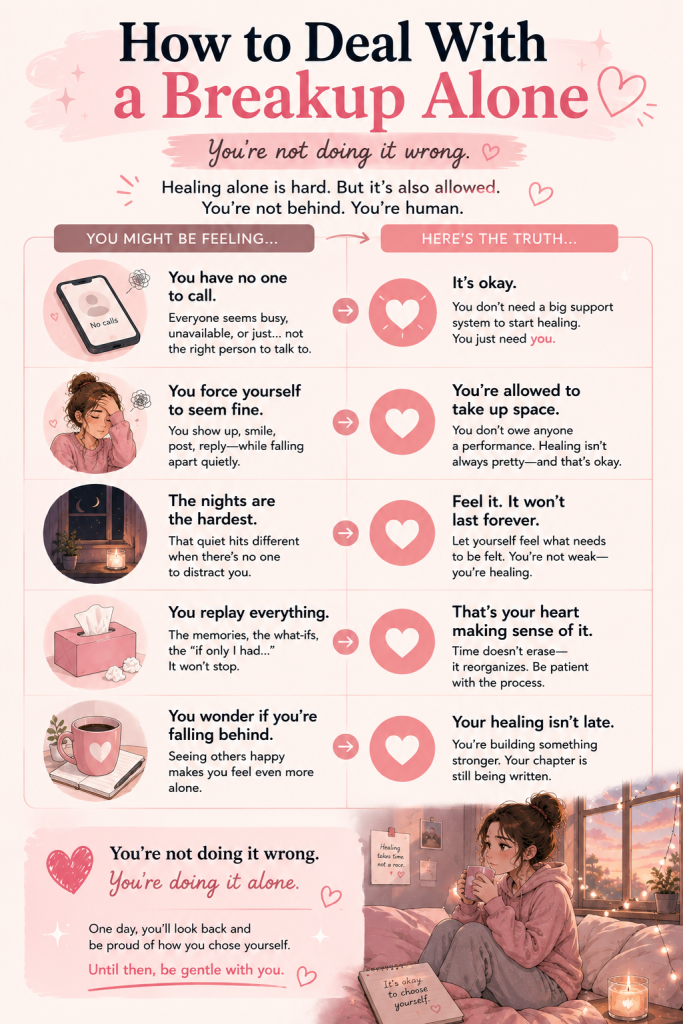
When you don’t have a support system nearby?
Maybe you moved to a new city recently. Maybe your friend group scattered over the years. Maybe your closest people live states away, or your schedule never left room for close friendships to form. Whatever the reason, being genuinely alone during a breakup adds a layer most advice never accounts for.
Most breakup guides assume:
- You have someone to call.
- Lean on your friends, they say.
- Talk it out with people who love you.
That advice isn’t wrong, but it isn’t useful if there’s no one to lean on right now. It can even make things worse, adding guilt on top of grief.
Here’s what actually helps when you’re genuinely on your own.
- Structure becomes your best friend.
- A loose routine, even a small one, gives your days a shape when everything else feels formless.
- Wake up at a consistent time.
- Eat actual meals, even simple ones.
- Get outside once a day, even for ten minutes.
Consider low pressure ways to be around people, even without close friends yet. A coffee shop where you’re a regular. A gym class with familiar faces. An online support space for people going through breakups, where you don’t need history, just honesty. Being around people, even without deep talks, still helps regulate a lonely nervous system.
And if the loneliness feels bigger than the breakup itself, that’s worth naming honestly. A therapist, even a few sessions, can hold space no friend group ever fully replaces.
This isn’t a failure. It’s simply building support where you don’t currently have it.
If you’re a man and no one expects you to be sad
There’s a specific weight to breakups for a lot of men, one rarely talked about directly. The quiet expectation to just be fine. To not make it a big deal. To joke about it, shrug it off, and move on within a week. Because that’s supposedly what men do.
This expectation doesn’t make the pain smaller. It just makes it harder to express, which often makes it last longer underneath the surface. Suppressed grief doesn’t disappear. It usually just goes quiet, showing up later as irritability, numbness, or a strange flatness that’s hard to name.
If this is you, it’s worth deliberately rejecting the pressure to perform okayness. You’re allowed to actually feel this. You’re allowed to tell a friend honestly, even if it feels awkward the first time. Vulnerability isn’t weakness, whatever old messaging might have taught you growing up.
Physical outlets can help too, not as a replacement for feeling things, but alongside it. A hard workout can move stuck emotion through your body when words feel too hard to find yet. Just make sure it’s supplementing real processing, not substituting for it entirely.
Good things to actually do after a breakup
Beyond survival mode, there are genuinely good things worth doing. Not to distract yourself, but to actively support your own healing.
- Reconnect with an old hobby you dropped somewhere along the way.
- Revisit music, shows, or interests that were entirely yours, not shared with the relationship.
Consider small, low stakes social steps, even without an existing friend group. Reply to that acquaintance who invited you somewhere once. Say yes to something you’d normally decline out of habit.
New connection often starts smaller and more awkwardly than people expect it to.
How to heal from a breakup without losing yourself covers this rebuilding process in more depth. It’s especially useful for the identity side of healing. That’s the part solitude tends to make more noticeable, especially when figuring out how to deal with a breakup alone.
If it ended on good terms, and that’s confusing too
Sometimes the hardest breakups aren’t the messy ones. Sometimes it’s the one that ended calmly, mutually, without a villain to be angry at. There’s a strange kind of grief in that, missing someone you have no real reason to resent.
Without anger to fuel you forward, the loneliness can feel even quieter. There’s no dramatic story to tell people, just a sad, gentle ending that doesn’t come with an obvious next step. That doesn’t make it any less real, or any less worth processing fully.
Nobody hurt anyone here. What might help more is simply permission. You’re allowed to grieve something good that still had to end.
The honest bottom line
How to deal with a breakup alone ultimately comes down to one thing.
Building support in whatever form is actually available to you right now. Structure, small connection, honest expression, and patience with a slower, quieter kind of healing. None of it needs an audience to be valid or real.
If the silence feels unbearable some nights, the power of silence after a breakup explains why. That discomfort is often doing more good than it feels like in the moment. You’re not failing at this. You’re just doing it the hard way, without a crowd around you. That takes its own kind of quiet strength.

I’m Patricia – a writer, a wife, and the kind of person who feels just about everything at full volume. I live in Manhattan, but I don’t write about the fairytale version of romance. I write about the real stuff: the miscommunications, the long-term commitment, and the tiny, everyday decisions it takes to keep a relationship thriving. I’m just a fellow wildheart trying to put honest words to how love actually feels from the inside.