
The power of silence after a breakup is something I learned the hard way. After my last serious breakup, I did everything wrong first. I texted. I over-explained. I sent the message I immediately regretted, then another one trying to clarify the first one. Every bit of silence from him felt unbearable, so I kept filling it, again and again, hoping one more message would finally make things feel resolved.
Nothing got resolved. It just got messier.
It wasn’t until I finally stopped, not out of strategy, but out of sheer exhaustion, that something actually started to shift. That’s when I first understood what people mean by the power of silence after a breakup. It’s not a trick. It’s not about punishing anyone. It’s something much more useful than that.
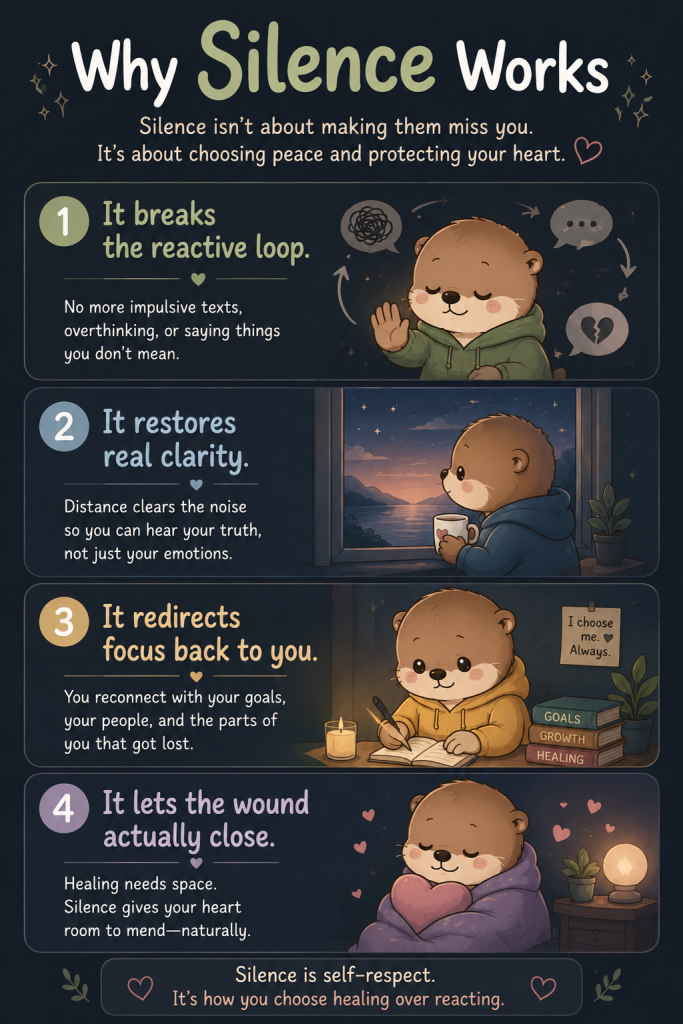
Silence isn’t about winning, it’s about stopping the bleeding
A lot of people hear “the power of silence” and assume it’s a manipulation tactic, a way to make an ex chase you, or a strategic move to seem unbothered. That’s not actually what makes it powerful, and framing it that way usually backfires anyway, because it keeps your attention fixed on their reaction instead of your own healing.
The real power of silence is much simpler. Every message, every check in, every attempt to keep a thread of contact alive after a breakup reopens the wound slightly before it’s had any chance to close.
Silence isn’t about controlling their response. It’s about finally letting your own healing start.
It interrupts a cycle that keeps you stuck
Post-breakup contact often follows a familiar, painful loop. You reach out, hoping for some kind of closure or reassurance.
You get a response that either reopens hope or reopens hurt. Either way, you’re pulled right back into emotional intensity you were trying to move past.
Silence breaks this loop by removing the trigger entirely.
Without new information to react to, without a fresh message to analyze for hidden meaning, your mind is finally forced to start processing what already happened instead of staying in a holding pattern, waiting for the next update.
It gives you back information you can’t get while in contact
This might be the most underrated part. While you’re still in regular contact with an ex, it’s almost impossible to get real clarity, you’re too emotionally activated, too hopeful, too reactive to their every move.
Silence creates enough distance for your own thinking to actually settle.
People often report that clarity about the relationship, what actually happened, what they actually want, whether the relationship was as good as they were remembering, only really arrives once real space has passed.
Contact keeps that clarity out of reach, no matter how many conversations you have trying to find it.
It rebuilds your sense of self, not just your feelings about them
Constant contact after a breakup keeps your emotional world centered entirely around them, still checking their responses, still shaped by their mood, still orienting your day around whether they’ve reached out.
Silence redirects that energy back toward you, your routines, your friends, your own interests, simply because there’s no longer an open thread pulling your attention elsewhere.
This is really what people mean when they say silence is powerful. Not that it changes the other person. That it slowly gives you yourself back.
How to actually do it, without white knuckling through it
Knowing silence helps is one thing. Actually holding it is another, especially in the early weeks when the urge to reach out can feel almost physical.
- Remove easy access points first. Muting or unfollowing isn’t petty, it’s practical. Seeing their updates constantly makes silence far harder to maintain than it needs to be.
- Redirect the specific urge, don’t just suppress it. When the impulse to text hits, it usually means you’re craving connection or reassurance in that moment. Instead of suppressing the urge entirely, redirect it toward a friend, a journal entry, or even just sitting with the feeling for a few minutes before deciding whether to act on it.
- Expect it to feel worse before it feels better. The first stretch of silence is often the hardest, since it removes the temporary relief that contact used to provide. This doesn’t mean it’s not working, it usually means it’s working exactly as intended.
- Don’t confuse silence with pretending you’re fine. Silence toward your ex doesn’t mean silence about your feelings. Keep talking to friends, a therapist, or even just yourself honestly about how hard this actually is. The silence is specifically about them, not about suppressing your emotions altogether.
When silence isn’t the right call
Silence isn’t a universal rule for every breakup. If there are shared practical matters that genuinely require communication, coparenting, shared finances, logistics, those conversations still need to happen, ideally kept brief and businesslike rather than emotionally loaded.
Silence here isn’t about total avoidance, it’s about cutting off the emotionally driven, hope-fueled contact that keeps reopening the wound.
What silence actually gives you
This is really the whole power of silence after a breakup, it isn’t cold, and it isn’t about winning anything. It’s about interrupting a cycle that keeps you stuck in someone else’s orbit long after the relationship has ended, and giving your own mind and heart the actual space they need to heal.
It’s uncomfortable at first, sometimes deeply so. But it tends to be one of the few things that genuinely works, not because it changes them, but because of what it quietly gives back to you.

I’m Patricia – a writer, a wife, and the kind of person who feels just about everything at full volume. I live in Manhattan, but I don’t write about the fairytale version of romance. I write about the real stuff: the miscommunications, the long-term commitment, and the tiny, everyday decisions it takes to keep a relationship thriving. I’m just a fellow wildheart trying to put honest words to how love actually feels from the inside.
1 thought on “The Power of Silence After a Breakup (And Why It Works)”