
The 5 C’s of dating give you a simple way to evaluate a relationship. Not just relying on how it feels in the moment. Feelings shift week to week. A structured framework doesn’t. That’s exactly why this one has quietly circulated through relationship advice for years, without any single viral moment behind it.
What are the 5 C’s of dating, exactly?
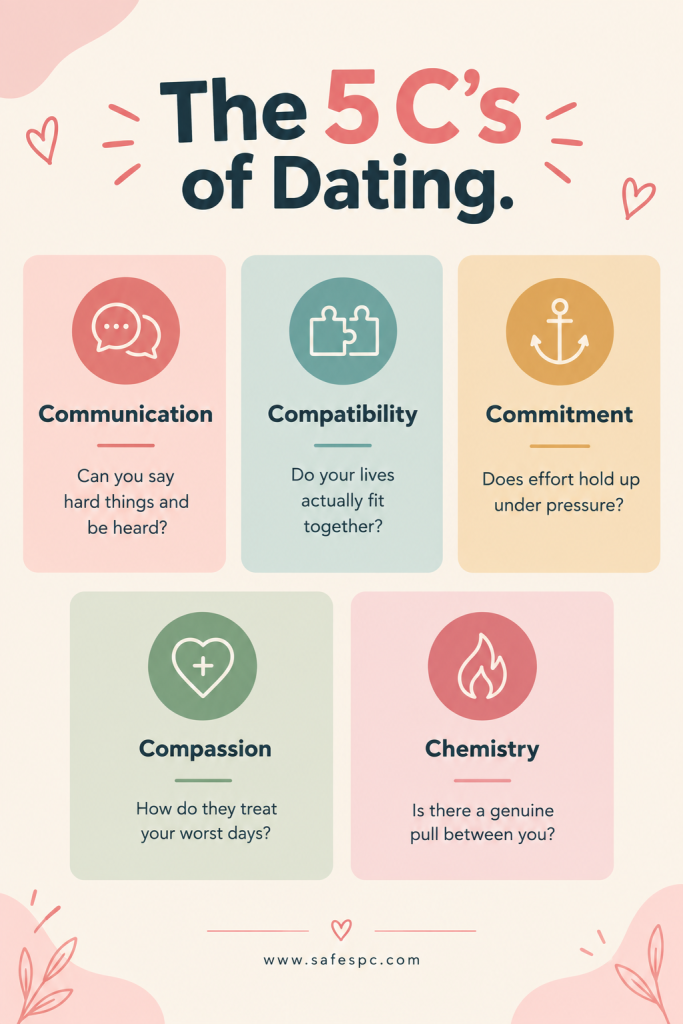
The 5 C’s of dating are Communication, Compatibility, Commitment, Compassion, and Chemistry. Together, they cover both the emotional spark of a relationship and the practical structure underneath it. Most relationship problems trace back to a weakness in one of these five areas. Often even when the actual argument seems to be about something else entirely.
Worth knowing upfront, sources don’t fully agree on the exact five. Some versions swap in Confidence or Consistency instead of Compassion. The core idea stays consistent across every version though. A lasting relationship needs both feeling and function, not just one or the other.
The psychology behind why these five traits matter
Relationship researchers have long identified similar core pillars using different language. The Gottman Institute’s research on relationship stability consistently points to communication quality and genuine friendship as the strongest predictors of long-term success, not passion alone. The 5 C’s of dating essentially package decades of relationship science into five memorable words.
This matters because early dating tends to overweight one C specifically. Chemistry. The spark feels undeniable, so it gets treated as sufficient proof on its own.
Real research consistently shows chemistry without the other four tends to burn out fast. The other four without chemistry rarely gets off the ground in the first place. You need enough of all five, not an excess of just one.
This overweighting isn’t really a personal failing. It’s simply how attention naturally works early on. Chemistry produces an immediate, physical signal. The other four C’s only reveal themselves gradually, through repeated interactions over weeks and months. It takes deliberate effort to notice the quieter four. Especially while the loud fifth one is still commanding most of your attention.
Communication, the how.
Communication is more than talking often. It’s whether both people can actually say hard things and be heard without the conversation falling apart.
- Can you disagree without it turning into contempt?
- Can you raise a need without over-explaining or apologizing for having one at all?
Watch for the difference between contact and real communication specifically. Texting all day doesn’t automatically mean you’re actually connecting.
A relationship with constant light contact but no real depth is still missing this C. That’s true even if it looks busy and active from the outside.
Compatibility, the lifestyle fit.
Compatibility asks a different, more practical question. Do your actual daily lives, values, and long term goals genuinely fit together? This isn’t about liking the same shows. It’s about whether your visions for a good life run in compatible directions.
Two people can have incredible chemistry and still be deeply incompatible on the things that matter most long term.
- Where you want to live?
- Whether you want children.
- How you each handle money?
These questions rarely feel urgent early on, which is exactly why they get skipped until they cause real friction later.
Commitment, the follow through.
Commitment is the C most visible in actions, not words. Anyone can say they’re serious about a relationship. Commitment shows up in what actually gets prioritized when something else competes for the same time or attention.
Watch whether commitment holds steady during inconvenient moments, not just easy ones.
- Does effort continue during a busy week, or a hard month?
- Does it hold up during a stretch where the relationship isn’t the most exciting thing happening?
Consistency under mild pressure reveals real commitment far more reliably than any grand romantic declaration does.
Compassion, the heart.
Compassion is often the quietest of the five C’s of dating. It’s one of the easiest to overlook while chemistry and excitement dominate attention early on. It shows up in how someone treats you on your worst days, not just your best ones.
Does your partner respond to your struggles with genuine care, or with impatience and subtle judgment?
Compassion also includes self awareness. Noticing when you’ve hurt someone and actually repairing it. Rather than expecting things to just smooth over with time alone.
Chemistry, the spark.
Chemistry is the C people notice first and trust the most, often more than it actually deserves. It’s the physical and emotional pull that makes someone feel exciting to be around. It matters genuinely, but it’s also the most unreliable predictor of the five on its own.
Chemistry can exist with someone who’s ultimately incompatible, uncommitted, or even unkind. That’s precisely why it needs the other four C’s around it. Chemistry alone tells you almost nothing about whether a relationship can actually last once the initial intensity settles down.
How the 5 C’s of dating work together, not separately?
The real value of the 5 C’s of dating isn’t found in any single pillar. It’s in noticing which ones are strong and which are quietly missing. A relationship can look successful on the surface while genuinely lacking two or three of these five areas entirely.
Try a simple honest exercise.
- Rate your current relationship, or a person you’re dating, from one to five on each C individually.
Wherever the score drops noticeably lower, that’s usually the real source of the friction. Even when it doesn’t feel that way on the surface at first.
Common mistakes people make with the 5 C’s of dating
Treating chemistry as the deciding vote: Chemistry feels the strongest and most immediate. That makes it tempting to let it override real concerns in the other four areas. This is one of the most common reasons people stay in relationships that clearly aren’t working elsewhere.
Assuming all five will simply appear naturally over time: Compatibility and commitment specifically tend to require active building and honest conversation. They don’t just develop passively the way chemistry sometimes does with almost no effort at all.
Using the framework to judge a relationship too early: A brand new connection won’t have fully demonstrated commitment or true compatibility yet. Those genuinely take real time to observe properly. The 5 C’s of dating work best as an ongoing lens, not a one-time test administered on the third date.
How the 5 C’s of dating pair with other frameworks?
If you’re already using structured approaches to dating, this framework layers naturally alongside them.
The 3-3-3 rule of dating gives you specific checkpoints for when to evaluate a relationship. The 5 C’s of dating give you exactly what to actually evaluate once you get there.
Once a relationship moves past evaluation and into something established, a different framework takes over.
The 777 rule for long distance relationships shifts the focus toward active maintenance. Used together, these frameworks cover deciding, evaluating, and sustaining a relationship at each of its major stages.
Frequently Asked Questions – FAQs
What are the 5 C’s of dating?
The 5 C’s of dating are Communication, Compatibility, Commitment, Compassion, and Chemistry. Together, these five core pillars predict whether a relationship can genuinely last.
Which of the 5 C’s matters most?
No single one outweighs the others reliably. Chemistry gets the most early attention, but research consistently shows communication and compatibility matter more for long term satisfaction.
Can a relationship survive if one of the 5 C’s is missing?
It’s possible short term, but a consistently missing pillar tends to create recurring friction eventually. Most lasting relationships show reasonable strength across all five areas, not perfection in any single one.
Are the 5 C’s of dating the same in every source?
Not exactly. Most versions include Communication, Compatibility, Commitment, and Chemistry consistently. The fifth spot occasionally shifts between Compassion, Confidence, or Consistency depending on the source.
How do I use the 5 C’s of dating in an existing relationship?
Rate your relationship honestly on each of the five. Then have a direct conversation about whichever area scored lowest. Naming a specific gap tends to be far more useful than vague dissatisfaction alone.
Do the 5 C’s of dating apply to long term marriages too, not just new relationships?
Yes, and arguably even more so. Long term relationships can quietly lose ground in one or two of the five C’s over the years. Neither partner fully notices until it’s become a real pattern. Revisiting the framework periodically works well even decades into a relationship.
The bottom line
The 5 C’s of dating work because they cover both feeling and function at once. Chemistry gets you interested. Communication, compatibility, commitment, and compassion are what keep you together. That’s what happens once the initial spark settles into something quieter and more ordinary.