
The 7 stages of dating give you something most relationships never get. An actual map. Not a guarantee, and not a strict schedule. Just a rough sense of where you are, and what tends to come next. That alone tends to lower the anxiety of “am I overthinking this” more than people expect.
A quick honest note before the stages themselves
Relationship researchers don’t fully agree on the exact number of stages. Some models describe 4. Others describe 5, or even 20 in the most detailed versions. The 7 stages of dating framework sits in the middle. Detailed enough to be genuinely useful. Simple enough to actually remember and apply.
No couple follows this perfectly in order. Some skip a stage entirely. Others move backward temporarily during a hard season, then move forward again. Treat the 7 stages of dating as a general shape, not a rigid checklist to complete in sequence.
This matters more than it might seem. People who expect a perfectly linear path often panic the first time a relationship stalls or slides backward. They assume something has gone fundamentally wrong.
In reality, movement back and forth between stages is one of the most consistent findings across relationship research. It’s not an exception to the pattern, it’s part of it.
Stage 1, attraction
This is the spark. Eyes meet, chemistry hits, and your brain floods with dopamine. These are the same chemicals involved in early infatuation more broadly. Everything about the other person feels slightly more interesting than it probably objectively is.
This stage usually starts around the first meeting or first date. It ends once the initial chemical high settles and you start seeing someone more realistically.
Nothing is wrong if this fades. That fading is actually necessary for the next stage to begin.
Stage 2, the talking stage
This is where getting to know each other actually happens. Frequent texting, early conversations, testing basic compatibility before real investment begins. Most talking stages last somewhere between two weeks and three months.
Watch the direction here more than the duration.
- A talking stage that’s actually progressing includes real questions, growing comfort, and movement toward an actual date.
- One that’s stalled looks like the same shallow exchanges repeating for months. No real momentum builds underneath them.
Stage 3, casual dating
This covers the first few actual dates, roughly one to four, where you’re testing real chemistry in person. Not just over text. Both people are typically still putting their best foot forward here. Flaws stay mostly hidden, sometimes without either person fully realizing it yet.
This stage is genuinely useful for gathering real information. Notice reliability, basic communication style, and whether attraction holds up once you’re actually spending time together. Not just messaging back and forth.
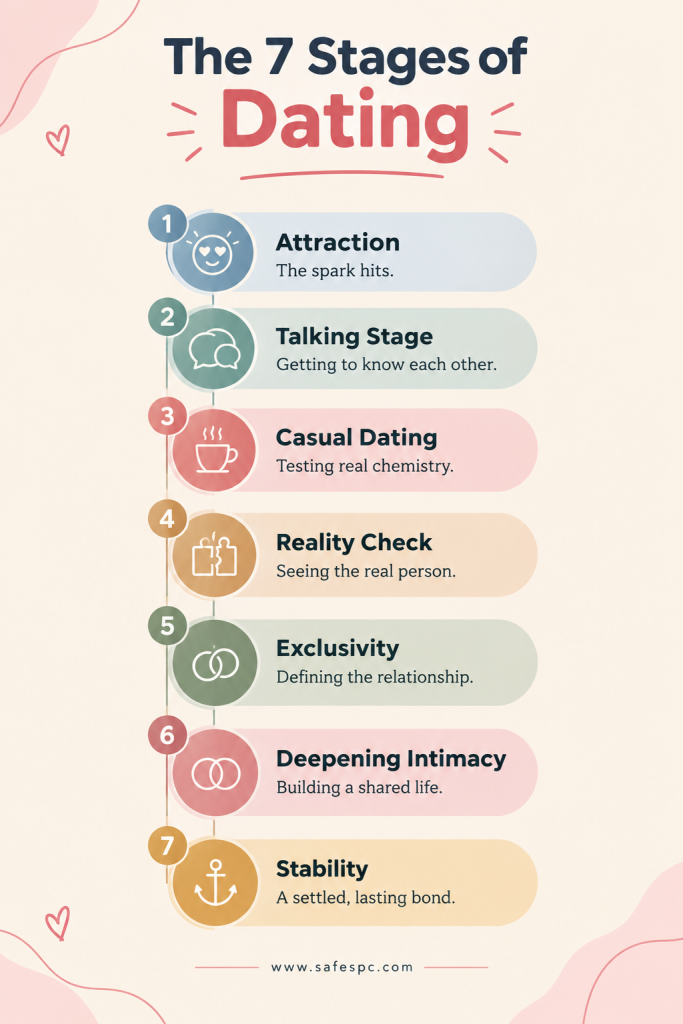
Stage 4, the reality check
This is the stage most people aren’t warned about. It catches almost everyone off guard the first time. The honeymoon high fades. You start seeing the real person, flaws included, not just the polished version from the first few dates. Small disagreements start surfacing for the first time.
How you both handle this stage matters enormously for everything that follows.
- Couples who navigate it honestly tend to build real trust here.
- Couples who avoid it, or panic at the first sign of imperfection, often repeat the same pattern next time.
This stage often surprises people specifically because nothing about it feels dramatic from the outside. There’s no single argument or betrayal to point to. Just a quieter, more ordinary version of someone starting to show through.
That ordinariness is actually the entire point. It’s the first honest look at who you’re really dating, once the performance of early dating naturally wears off.
Stage 5, exclusivity
This is where casual dating evolves into something deeper, usually marked by an actual conversation. Where is this going. Are we exclusive. This pivotal moment is often called the DTR talk, short for define the relationship. It typically happens around the two to three month mark.
If you’re well past three or four months with no version of this conversation happening, that’s worth attention. Talking stage vs situationship vs relationship covers exactly what that lingering ambiguity tends to signal.
Skipping this stage entirely doesn’t usually mean the relationship is somehow more secure without it. More often, it means both people are avoiding a conversation neither one wants to risk.
Clarity here tends to protect the relationship, not threaten it. That holds even when the conversation itself feels nerve wracking beforehand.
Stage 6, deepening intimacy
Once exclusivity is established, deeper integration begins. Meeting friends and family. Building routines together. Navigating differences honestly instead of politely avoiding them. Appreciating their traditions while they make space for yours. Real problem solving skills get built here, ones that carry into every stage after this.
This stage often includes what researchers call a power struggle phase. Learning how to stay yourself while genuinely being part of a pair. This tension is normal, not a warning sign, as long as it gets worked through together rather than avoided.
This is also typically the longest of the 7 stages of dating. It often stretches from a few months to well over a year. There’s no shortcut through it. The relationship needs real, accumulated shared experience to move through this stage fully, not just time passing on a calendar.
Stage 7, stability and long-term commitment
This final stage of the 7 stages of dating shifts the relationship into something central and stable. Trust deepens. Communication gets easier, even during disagreements. Shared goals and a genuine sense of being on the same team replace the earlier uncertainty entirely.
This doesn’t mean conflict disappears. It means conflict stops feeling threatening to the relationship’s foundation. The 777 rule for long distance relationships offers a useful structure for maintaining this stability once it’s reached.
Common mistakes people make with the 7 stages of dating
Rushing an earlier stage to reach commitment faster: Skipping the reality check stage by avoiding conflict entirely doesn’t actually prevent problems. It just delays them until they resurface later, usually with higher stakes attached.
Assuming backward movement means failure: A couple in the stability stage can slide back into reality-check-style conflict during a stressful year. That’s not regression. Relationships aren’t linear. Temporary backward movement doesn’t erase the progress already made.
Treating the exact timeline as universal: Long distance relationships and friendships that turn romantic often compress or stretch these stages. So do connections between people who already knew each other well. The order matters more than the exact timing attached to each one.
How the 7 stages of dating pair with other frameworks?
If you’re already using structured tools to navigate dating, this framework layers naturally underneath them. The 3-3-3 rule of dating gives you specific checkpoints for pausing and evaluating. The 7 stages of dating give you the broader map those checkpoints sit within.
The 5 C’s of dating works well here too, since different C’s tend to matter more at different stages. Chemistry dominates stage one. Communication and compassion become essential by stage four. Commitment and compatibility carry the relationship through stages six and seven.
Frequently Asked Questions – FAQs
What are the 7 stages of dating?
They are attraction, the talking stage, casual dating, the reality check, exclusivity, deepening intimacy, and long-term stability.
How long does it take to go through all 7 stages of dating?
There’s no fixed timeline. Some couples move through the early stages within weeks. Stages six and seven can genuinely take years to fully develop and settle.
Is it normal to skip a stage entirely?
Yes, this happens often. Couples who already know each other well, or who start as friends first, often move through certain stages faster. Some skip them almost entirely.
What if a relationship moves backward through the stages?
This is common, especially during stressful periods. It doesn’t necessarily mean the relationship is failing. What matters more is whether the couple works back toward stability together afterward.
Which stage of dating is the hardest?
Most people find the reality check stage hardest, since it’s the first real test after the initial excitement fades. It requires facing genuine imperfection for the first time.
Do all couples experience the 7 stages of dating in the same order?
No. Some couples skip stages, combine them, or revisit earlier stages during hard seasons. The 7 stages of dating describe a common pattern, not a rigid law every relationship must obey exactly.
The bottom line
The 7 stages of dating aren’t a rulebook, and no relationship follows them perfectly. What they offer is context. A way to understand that friction and even backward movement are normal parts of building something real. Not signs that something has gone wrong. Knowing roughly where you stand tends to make the whole process feel far less disorienting.