
There’s a specific kind of tired that comes from loving someone through a hard season. Not the dramatic kind of hard, like a big betrayal or a breakup level crisis. The quieter kind. Where they’re withdrawn, short tempered, or just not themselves, and you’re not entirely sure how to reach them anymore.
I’ve been on both sides of this. I’ve been the person who was hard to love during a depressive stretch, and I’ve been the one trying to keep loving someone who felt distant and prickly for reasons that weren’t fully clear.
If you’re in that second position right now, here’s what actually helps, from someone who’s lived through both sides of it.
First, separate the person from the season
This is the most important shift to make early. Someone going through grief, burnout, depression, anxiety, or a rough patch is often not acting like themselves. The irritability, the distance, the shorter fuse, these are usually symptoms of what they’re carrying, not a shift in who they fundamentally are.
This doesn’t mean excusing harmful behavior. It means holding two things at once. This is hard right now, and this isn’t who they are at their core. That distinction changes how you respond to the hard moments.
Stop trying to fix it immediately
When someone we love is struggling, the instinct is to jump straight to solutions. Have you tried this. Maybe you should. What if you just.
Most of the time, this lands as pressure, not help.
People who are struggling usually need to feel understood before they’re ready to hear solutions.
Try leading with presence instead. Something as simple as, that sounds really hard, tends to land better than five suggestions in a row.
Lower your expectations temporarily, not permanently
During a hard season, someone might not have the capacity to show up the way they normally would. Less communication. Less energy for date nights or effort. Shorter patience than usual.
It helps to mentally separate this from your baseline expectations of the relationship. This is temporarily lower capacity, not a new normal you have to silently accept forever.
Naming that difference to yourself helps you stay patient without feeling like you’re lowering your standards permanently.
Ask directly what kind of support they actually need
We often assume we know what someone needs based on what we would want in their position. But support needs vary a lot person to person.
Some people want to talk it through. Others want distraction. Some need space before they need conversation at all.
A simple, direct question works better than guessing. Do you want me to just listen, or help you think through this, or just be here while you go quiet for a bit.
Giving them the option removes a lot of guesswork and miscommunication.
Protect a little space for yourself too
Loving someone through a hard season is genuinely draining if you pour into it without limits. You’re allowed to have a hard day too. You’re allowed to ask for a break in the caregiving role occasionally and to lean on other people in your life during this stretch, not just carry it all silently.
This isn’t selfish.
Burnout from one sided caretaking is one of the most common reasons relationships crack under pressure, not because love wasn’t real, but because it wasn’t sustainable.
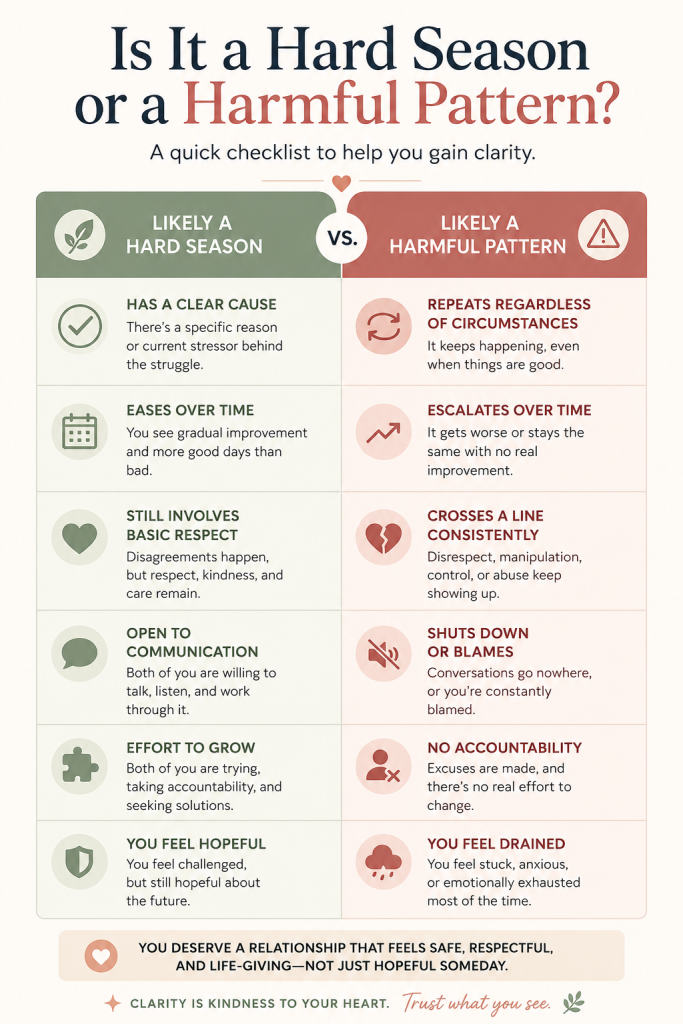
Watch for the difference between a hard season and a harmful pattern
This distinction matters a lot, and it’s easy to blur when you’re emotionally invested. A hard season usually has an identifiable cause, a rough job loss, grief, a health scare, and it tends to shift over weeks or months, even if slowly.
A harmful pattern looks different.
- It repeats regardless of circumstances.
- It escalates instead of easing.
- It involves treatment that consistently crosses a line, not just moodiness or distance.
If what you’re navigating fits this second description more than the first, that’s not something patience alone resolves, and it’s worth talking to someone outside the relationship for perspective.
Small things that genuinely help
- Show up consistently, even in small ways, without needing acknowledgment every time.
- Say, I’m not going anywhere, out loud, even if it feels obvious to you.
- Let them have an off day without immediately asking what’s wrong.
- Keep a little humor alive where appropriate, without forcing positivity onto a hard moment.
- Check in on yourself regularly, not just on them.
None of this fixes a hard season instantly. It just makes it survivable for both of you, together, instead of one person quietly carrying it alone.
The hard truth about loving someone through a rough patch
Some seasons genuinely test whether love is built on more than good times. That’s not a flaw in the relationship. That’s simply what depth requires.
The version of love that only shows up when things are easy was never built to last through the parts of life that actually need it most.
If you’re in a hard stretch right now, patient, boundaried, honest love is still love, even on the days it doesn’t feel romantic at all.

I’m Patricia – a writer, a wife, and the kind of person who feels just about everything at full volume. I live in Manhattan, but I don’t write about the fairytale version of romance. I write about the real stuff: the miscommunications, the long-term commitment, and the tiny, everyday decisions it takes to keep a relationship thriving. I’m just a fellow wildheart trying to put honest words to how love actually feels from the inside.