
A woman once told me she married her husband without feeling that dramatic, movie style spark. Her family had introduced them. He was kind, stable, and clearly interested. She liked him well enough, but she wasn’t sure if what she felt counted as love.
Ten years later, she describes their relationship as one of the deepest connections she’s ever had. Somewhere in those years, without a single dramatic turning point, liking someone well enough turned into loving them completely.
So, can you actually learn to love someone? The honest answer is yes, more often than we’re told, but not in the way most people expect.
Attraction and love are not the same thing
This is the piece most people miss. Attraction is largely automatic. It happens fast, driven by chemistry, timing, and instinct. Love is different. Love is built through repeated experience, shared vulnerability, and time spent actually knowing someone.
You cannot force attraction that isn’t there at all. But you absolutely can grow love with someone you’re mildly interested in, respect, and are willing to invest time in.
That’s not settling. That’s simply how love often works for a lot of people, especially outside the fairy tale version we’re taught to expect.
What actually builds love over time
If you’re starting from liking someone rather than being swept off your feet by them, here’s what genuinely moves things toward love.
- Shared experiences, especially difficult ones. Love often deepens faster through hard moments handled together than through easy, pleasant ones. Going through a stressful situation as a team builds trust quickly.
- Consistent small moments of care. Big romantic gestures are memorable, but love is mostly built in small repeated actions. Remembering how someone takes their coffee. Checking in after a rough day. These add up more than people expect.
- Vulnerability, given a little at a time. Love grows when people let each other see behind the curtain. Fears, insecurities, embarrassing stories. Each small reveal, met with acceptance instead of judgment, deepens the bond a little more.
- Time, simply time. This sounds obvious, but people underestimate how much of love is just repetition. The more moments you accumulate with someone, the more your brain and body start to associate safety and familiarity with them.
What you cannot force
Learning to love someone is not the same as forcing yourself to stay in something that consistently feels wrong. If someone repeatedly disrespects you, disregards your needs, or makes you feel small, no amount of time will turn that into healthy love.
It usually just deepens harm instead. The difference matters.
Growing love with someone decent, who treats you well, even if the spark started small, is realistic. Trying to manufacture love for someone who consistently hurts you is not love in progress. It’s a pattern to walk away from.
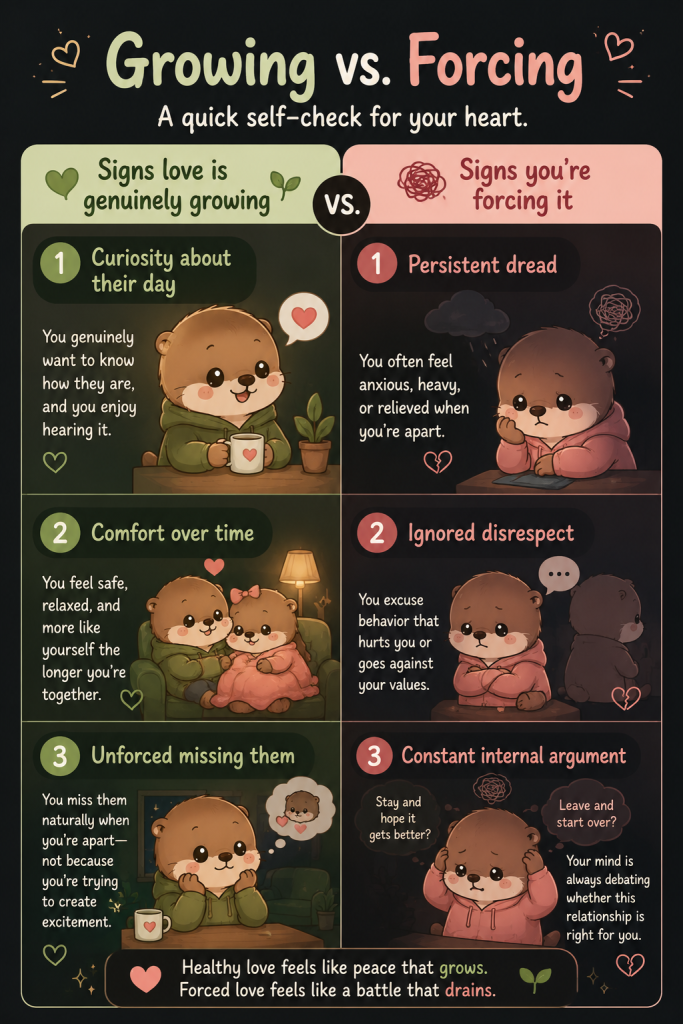
Signs it’s actually working
If you’re genuinely growing toward loving someone, here’s what it tends to look like along the way.
- You find yourself thinking about their day, not out of obligation, but out of real curiosity.
- Time with them starts to feel comfortable instead of effortful.
- You notice yourself wanting to protect their feelings, even in small ways.
- Physical affection starts to feel more natural, even if it wasn’t instant at first.
- You catch yourself missing them when they’re not around, in a quiet, unforced way.
None of this needs to happen overnight. If you’re seeing small movement in this direction over weeks or months, that’s usually a sign love is genuinely building, not being faked.
Signs it’s probably not
On the other hand, if months have passed and you still feel a persistent sense of dread, discomfort, or forcing yourself through interactions, that’s worth paying attention to.
Learning to love someone should feel like a gradual warming, not a constant internal argument with yourself.
There’s a difference between nerves easing into comfort and genuine incompatibility being ignored because you feel like you should make it work.
So, can you learn to love someone?
Yes, in most cases, if the foundation is respect, safety, and mutual effort. Love is less of a lightning strike and more of a slow accumulation, built through shared time, vulnerability, and small consistent care.
What you can’t do is force love into existence with someone who repeatedly treats you poorly. That’s not a slow burn. That’s a warning sign wearing a patient face.
If you’re standing at the start of something that feels calm rather than electric, don’t assume that means it’s wrong. Sometimes calm is simply where real love quietly begins.

I’m Patricia – a writer, a wife, and the kind of person who feels just about everything at full volume. I live in Manhattan, but I don’t write about the fairytale version of romance. I write about the real stuff: the miscommunications, the long-term commitment, and the tiny, everyday decisions it takes to keep a relationship thriving. I’m just a fellow wildheart trying to put honest words to how love actually feels from the inside.