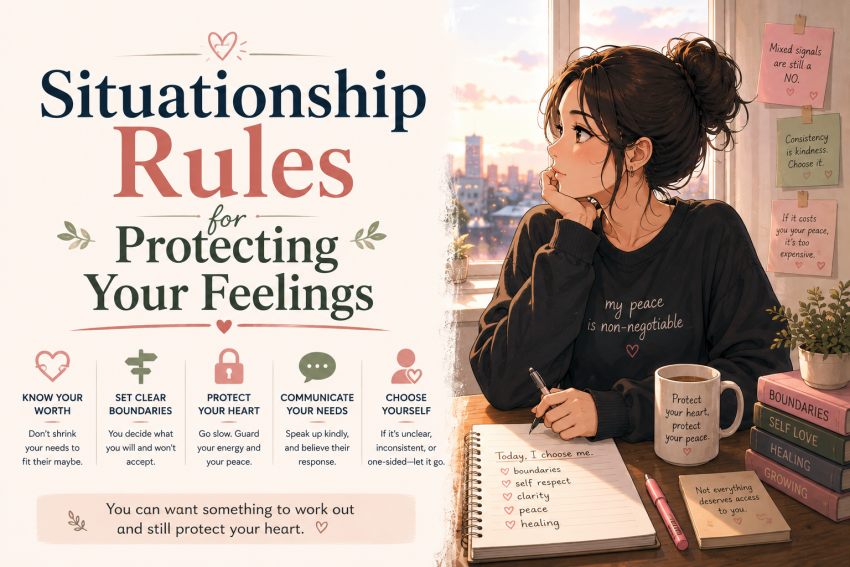
Situationship rules usually get framed around logistics, how often you’ll see each other, whether you’re exclusive, what to call things if someone asks. Those questions matter, but they’re not actually the ones that protect you emotionally while you’re in the middle of an undefined connection.
The rules that genuinely matter are the ones that guard your wellbeing while the ambiguity plays out, since situationships, by design, offer far less structure and security than a defined relationship provides.
If you’re currently in one, or considering entering one, these are the rules worth taking seriously, not the surface level ones about scheduling, but the deeper ones about protecting your own emotional footing along the way.
Skipping these tends to be exactly why situationships hurt more than breakups when they eventually end, the emotional exposure that these rules are meant to guard against builds up quietly in the background the whole time.
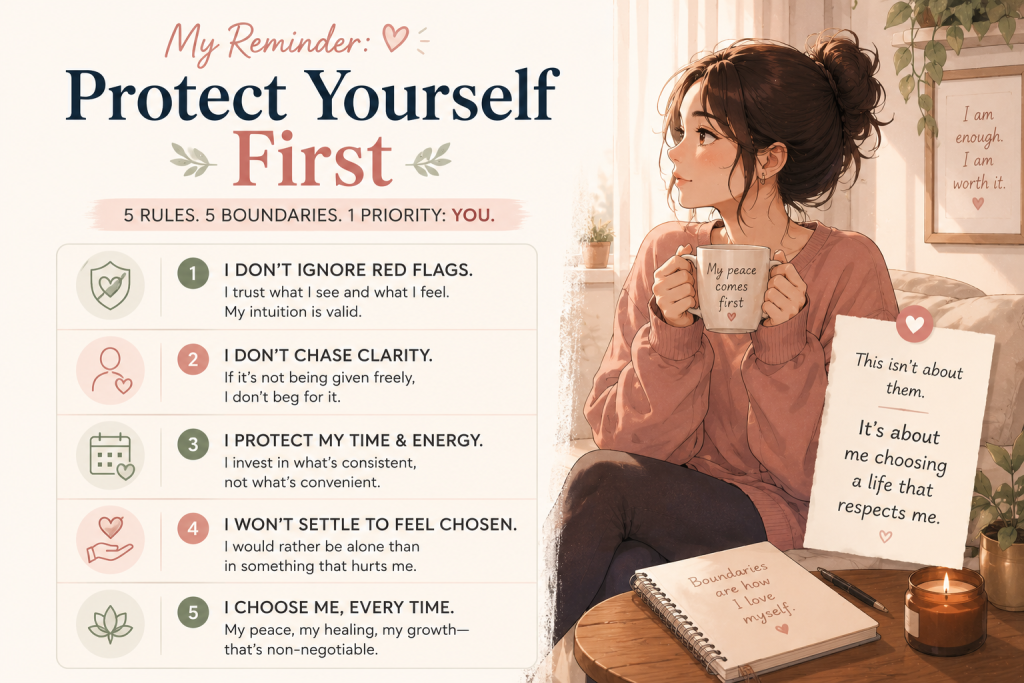
Rule one: Know your own limits before you need them
It’s much easier to set an emotional boundary before you’re in a moment that tests it than to figure one out in real time while your feelings are already tangled up in the situation. Before things progress much further, get honest with yourself about what you genuinely can and can’t tolerate.
- Can you handle inconsistent communication without spiraling?
- Can you hear about them seeing other people without it quietly eating at you.
- Can you keep your own life and interests fully intact, rather than reorganizing your schedule and mood entirely around their availability.
Knowing these limits ahead of time gives you something solid to check back against later, rather than discovering your actual boundaries only after they’ve already been crossed repeatedly.
A lot of pain in situationships comes not from the ambiguity itself, but from ignoring early signals that a personal limit was already being pushed past.
Rule two: Don’t perform indifference you don’t actually feel
One of the most common and most damaging situationship habits is pretending to be far more casual than you actually feel, out of fear that showing real investment will scare the other person away.
This might work temporarily, but it usually just delays an inevitable reckoning, and it keeps you disconnected from your own honest experience the entire time. Performing indifference doesn’t make the underlying feelings disappear, it just pushes them underground where they tend to build quietly instead.
A healthier version of this rule involves checking in with yourself regularly about how you’re actually feeling, not the version you’re presenting to them, but the real one.
If genuine feelings are developing and the arrangement isn’t accounting for that reality, pretending otherwise for the sake of keeping things easy usually costs more in the long run than it saves.
Rule three: Keep your life fully your own
A situationship should never become the organizing center of your entire life, your mood, your schedule, your sense of self worth.
Protecting your feelings means actively maintaining your friendships, your hobbies, your career goals, and your independent identity throughout, rather than letting an undefined connection quietly absorb all your emotional bandwidth.
This isn’t about pretending not to care, it’s about making sure your entire wellbeing isn’t hostage to something inherently uncertain by design.
People who navigate situationships most successfully tend to be the ones who keep a full, rich life running alongside the situationship, rather than the ones who orient their entire week around whether or not this one person is available.
This buffer protects you significantly if things end unexpectedly, since your sense of identity and daily fulfillment was never entirely dependent on the outcome.
Rule four: Revisit the arrangement regularly, not just once
A situationship isn’t a one time agreement that stays static forever. Feelings shift, circumstances change, and what felt fine two months ago might feel genuinely unsustainable now.
Build in regular, honest check ins with yourself about whether the current arrangement still actually works for you, rather than assuming the original terms are permanently binding regardless of how things evolve internally.
This also applies to communicating with the other person.
If your feelings or needs shift, saying so clearly, even if it risks changing the dynamic, protects you far more than silently adjusting your own expectations downward indefinitely just to preserve a status quo that no longer genuinely serves you.
If what’s shifted is that you now want more than the situationship currently offers, how to turn a situationship into a relationship walks through exactly how to raise that honestly.
Can a situationship be healthy?
Yes, genuinely, when both people are honest, communicative, and equally comfortable with the lack of definition. A healthy situationship tends to involve open conversation about what each person wants, mutual respect for each other’s time and boundaries, and an absence of manipulation or one sided emotional labor.
The unhealthy version usually involves one person quietly hoping for more while performing casualness, inconsistent effort that leaves one partner anxious and uncertain, or a refusal to have an honest conversation even when one person clearly wants something different.
The presence of ambiguity by itself doesn’t automatically make something harmful.
What actually determines whether a situationship is healthy is whether both people are genuinely on the same page about what it is, and whether that alignment gets revisited honestly as feelings and circumstances evolve over time.
Rule five: Have an honest exit plan in mind
Even if things are going well right now, it helps to know in advance roughly what would make you walk away.
- Maybe it’s a certain amount of time passing without any real progress toward clarity
- Maybe it’s a specific kind of inconsistency you’re not willing to tolerate indefinitely
- Maybe it’s simply noticing that your own investment has grown well beyond what the arrangement can currently hold.
Deciding this in advance, while you’re thinking clearly, protects you from staying far longer than genuinely serves you, out of hope alone.
Situationship rules, at their core, aren’t really about controlling the other person or forcing a particular outcome. They’re about staying honest with yourself throughout an inherently uncertain arrangement, so that whatever happens next, defining the relationship, ending it, or simply continuing as is, happens because it’s actually right for you, not because you lost track of your own needs somewhere along the way.
Coming back to these situationship rules regularly, rather than setting them once and forgetting them, is what actually keeps them useful over time.

I’m Patricia – a writer, a wife, and the kind of person who feels just about everything at full volume. I live in Manhattan, but I don’t write about the fairytale version of romance. I write about the real stuff: the miscommunications, the long-term commitment, and the tiny, everyday decisions it takes to keep a relationship thriving. I’m just a fellow wildheart trying to put honest words to how love actually feels from the inside.