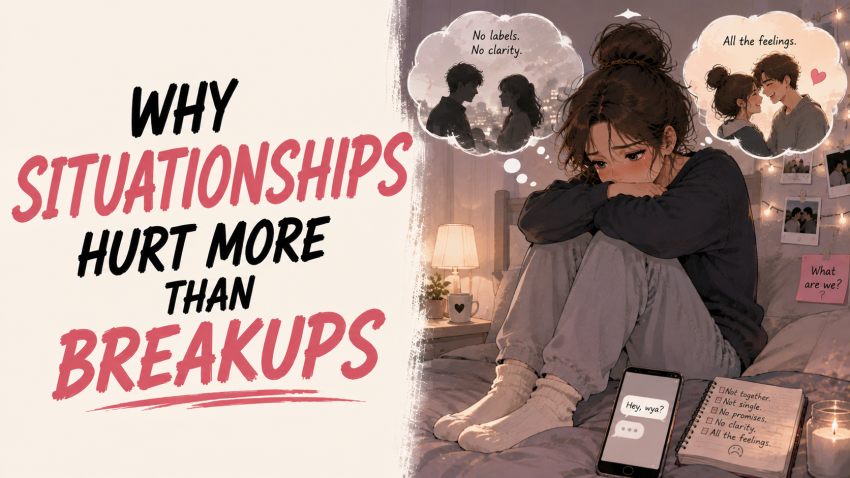
Why situationships hurt more than breakups is a question a lot of people quietly wonder about but rarely say out loud, mostly because it sounds strange on the surface. How can something that was never officially a relationship hurt worse than the actual end of one.
And yet, if you’ve lived through it, you already know the answer in your body before your mind can fully explain it. The ache is real, even though the relationship technically never had a name, and that gap between how much it hurts and how little it was supposed to mean is exactly where this particular kind of pain lives.
Before going further, it helps to pause and check where you actually stand. A quick way to tell if you’re in a situationship at all is to ask yourself a few honest questions.
- Have you been seeing this person regularly for more than a couple of months without ever having a real conversation about what you are to each other.
- Do you feel a small flinch of anxiety every time someone asks if you’re dating anyone.
- Are you meeting their friends, spending holidays near each other, or building small routines together, all without either of you ever calling it a relationship.
If most of that sounds familiar, what you’re navigating is very likely a situationship, and the confusing grief that comes with losing one is a real, well documented experience, not something you’re imagining or overreacting to.
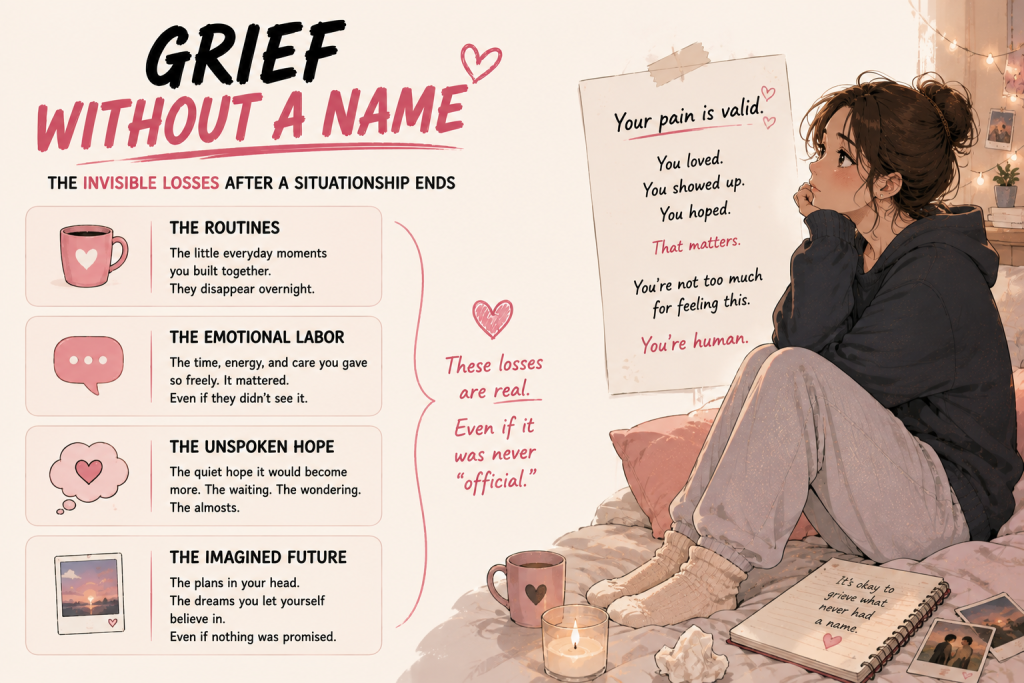
Grief without a name is disorienting in a specific way
When an actual relationship ends, there’s a whole social script available to you. Friends know to check in. You’re allowed to say “we broke up” and have people immediately understand the weight of that sentence.
There’s a shared cultural understanding of what a breakup deserves in terms of comfort, space, and support. A situationship offers none of that.
When it ends, there’s often nothing to point to, no official title, no anniversary, no agreed upon relationship to mourn, which leaves you grieving something real while simultaneously being unsure whether you’re even allowed to call it grief at all.
This disorientation compounds the pain rather than softening it.
Instead of processing the loss directly, a lot of energy gets spent second guessing whether the loss is even valid, whether you’re allowed to be this upset over something that was “just casual,” whether people would understand if you actually explained how much it hurt.
That extra layer of self doubt, on top of the original heartbreak, is part of why situationships hurt more than breakups in ways that catch people off guard every time.
The ambiguity itself becomes exhausting long before the ending
Even before a situationship ends, the not knowing tends to wear on people in a way that a defined relationship simply doesn’t.
In an official relationship, uncertainty usually centers around specific, answerable questions, whether to move in together, how to handle a disagreement, what the future looks like. In a situationship, the uncertainty is more foundational than that.
You don’t know if you’re allowed to expect consistency. You don’t know if bringing up your feelings will scare the other person off entirely. That constant low grade uncertainty is emotionally taxing in a way that accumulates slowly, long before any actual ending happens.
By the time a situationship does end, you’re often not just grieving the loss of the person, you’re also releasing months of held tension, unspoken hope, and quiet self editing that built up while trying to seem chill enough to keep the connection alive.
That accumulated weight tends to hit all at once, which is part of why the pain can feel disproportionately heavy compared to the amount of “official” time you actually spent together.
A lot of that accumulated weight can be avoided ahead of time, which is exactly what situationship rules for protecting your feelings are built to help with, setting boundaries early rather than absorbing all of it silently until the end.
You were likely doing more emotional labor than you got credit for
Situationships often ask a lot from people without offering the reciprocal security a relationship provides.
You might have been checking in on their day, supporting them through hard weeks, showing up consistently, essentially performing the emotional labor of a partner, all while holding back the parts of yourself that wanted more, out of fear it would end things.
This imbalance is rarely acknowledged, even by the person going through it, because there was no official title attached to justify how much you were actually giving.
When it ends, that invisible labor doesn’t just disappear without a trace.
It often surfaces as a specific kind of resentment or confusion, a feeling of having invested real care into something you weren’t even allowed to call a relationship, which makes the loss feel simultaneously significant and somehow illegitimate at the same time.
There was no closure built into the structure
Breakups, however painful, usually come with some kind of closing conversation, even an unsatisfying one. Situationships often end through fading, ghosting, or a vague mutual drift, with no clear moment where either person actually says what happened or why.
That lack of closure leaves a lot of unanswered questions hanging indefinitely, which the mind tends to keep circling back to, trying to construct an ending that was never actually given.
Without that closure, healing takes a different shape. There’s no clear moment to point to as “when it ended,” which makes it harder to mark the beginning of moving forward.
This is one of the most practical reasons why situationships hurt more than breakups tend to linger longer than people expect, the absence of a defined ending keeps the nervous system in a low grade holding pattern well past when the connection has actually stopped.
What actually helps
- Naming the loss honestly, even without an official title to attach to it, tends to be the first real step forward.
- Telling a friend, “this wasn’t a relationship but it still really hurt,” and letting that be enough, without needing to justify the pain further, often does more to speed healing than trying to minimize what happened.
Grief doesn’t require an official status to be legitimate, and giving yourself permission to feel the full weight of it, rather than downplaying it because it was “just a situationship,” tends to be what actually allows the healing to begin.
If part of what’s hurting is the sense that you could have pushed for clarity sooner, how to turn a situationship into a relationship is worth reading for next time, since knowing the signs earlier tends to prevent this same ambiguity from repeating itself.
How long do situationships last?
There’s no fixed timeline, since situationships vary widely depending on the people involved and the circumstances that shaped them.
Some last a few weeks before naturally fading, while others stretch on for a year or more, especially when both people are getting enough out of the arrangement to keep showing up without ever formally defining it.
On average, many situationships tend to reach a turning point somewhere between two and six months in, the point where the initial excitement settles and the lack of clarity starts to feel more uncomfortable than exciting.
What determines the actual length usually has less to do with time itself and more to do with how long both people are willing to tolerate the ambiguity before needing an answer one way or the other.

I’m Patricia – a writer, a wife, and the kind of person who feels just about everything at full volume. I live in Manhattan, but I don’t write about the fairytale version of romance. I write about the real stuff: the miscommunications, the long-term commitment, and the tiny, everyday decisions it takes to keep a relationship thriving. I’m just a fellow wildheart trying to put honest words to how love actually feels from the inside.