
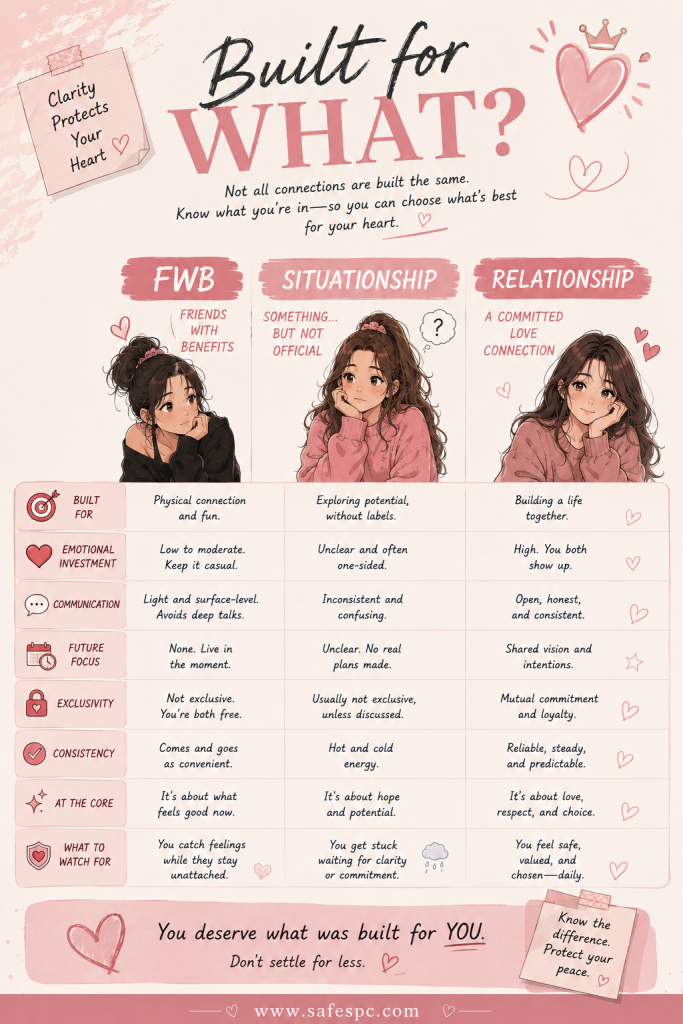
FWB vs situationship vs relationship confuses people because all three can look identical from the outside. Regular contact, physical closeness, real conversation. Untangling FWB vs situationship vs relationship comes down to one thing. What each arrangement was actually built to provide in the first place.
FWB, built for physical closeness without emotional expectation
Friends with benefits is designed around one clear agreement, physical intimacy without romantic commitment. The emotional boundary is usually explicit from the start, or at least assumed to be understood by both people involved.
The defining feature isn’t the sex itself, it’s the intentional limit placed around emotional investment. Both people, ideally, have agreed not to develop deeper feelings. If those feelings do arise, the agreement is to keep them separate from the arrangement. Situationship vs relationship covers the deeper psychology of undefined arrangements, if that emotional ambiguity sounds more like what you’re navigating.
Situationship, built on unspoken emotional drift
A situationship isn’t designed around any single agreement, that’s actually its core problem. It often starts as something casual, sometimes even beginning as FWB. It then drifts into emotional territory without either person formally updating the terms.
This is where FWB and situationships most often get confused.
An FWB arrangement can quietly become a situationship the moment real feelings enter. The surface behavior stays exactly the same. Nobody announces the shift, which is exactly why it goes unnoticed for so long.
Relationship, built on mutual commitment
A relationship is the only one of the three built around an explicit, mutual agreement. Both people have named what they are, agreed on exclusivity, and committed to working through conflict. Neither one walks away at the first sign of friction.
This is the meaningful difference underneath all the surface similarities. FWB is built around a boundary. A situationship has no built structure at all. A relationship is built around a mutual promise, spoken clearly, by both people.
How to tell which one you’re actually in
1. Ask what was actually agreed on at the start. FWB usually has an explicit conversation about boundaries. Situationships usually don’t. Relationships have an explicit conversation about commitment.
2. Notice whether feelings have shifted since then. If an FWB arrangement now includes jealousy or wanting exclusivity, the original agreement no longer reflects reality. That’s a situationship now, whether it’s been named or not.
3. Check how the other person responds to emotional conversations. Relationships welcome them. Situationships often deflect them. FWB arrangements may treat them as a boundary violation, even when the feelings are genuinely valid.
4. Look at what happens after conflict. A relationship works through it. A situationship often ends at the first real disagreement. An FWB arrangement may simply end the physical component and go quiet entirely.
What to do if the lines have blurred for you?
Get honest with yourself first about what changed. If you started as FWB and now want more, name that shift plainly. Do this even just to yourself, before bringing it to the other person. Confusion is much harder to communicate than a clear, specific want.
Raise it directly rather than hoping they’ll notice the shift on their own. Something like, “this started casual for me, but it doesn’t feel that way anymore.” Adding “I want to be honest about that” respects both the original agreement and your current reality.
Expect one of three outcomes, and prepare yourself for each. They might feel the same way and want to define things. They might not be ready, but be willing to talk honestly about it. Or they might prefer to keep things as originally agreed. That’s a valid answer too, even if it’s not the one you hoped for.
How to turn a situationship into a relationship covers this exact conversation in more depth. It includes how to raise it without pressure or over-explaining.
Why this confusion isn’t a personal failure?
Feelings don’t always respect the boundaries we set at the start of something. Starting an arrangement with clear intentions doesn’t guarantee those intentions will hold as real connection builds. Noticing the shift is actually a sign of self awareness, not a sign you did something wrong.
The bottom line
FWB vs situationship vs relationship comes down to what each one was built to hold. A physical boundary, no structure at all, or a mutual promise. Knowing which one you’re actually in is the first real step. That’s true even when admitting it feels uncomfortable, and even before you know what you want to do next.