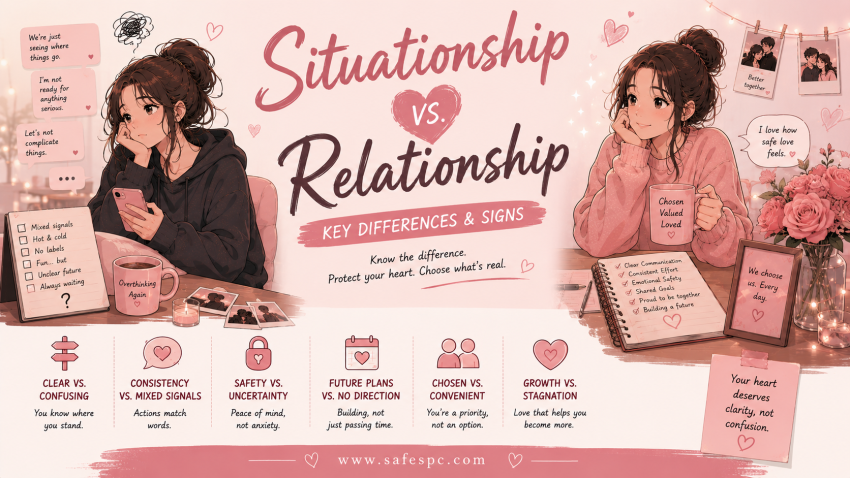
A friend once described her situationship vs relationship confusion to me like this. “We do everything a couple does, except the part where he actually says I’m his.” That sentence stuck with me. It captures exactly what makes this so disorienting. All the emotional weight of a relationship, none of its safety.
If you’re trying to figure out which one you’re actually in, you’re not overthinking it. This confusion is common enough that psychologists study it directly. Understanding the mechanics behind it makes the whole thing far less maddening.
Why situationships exist in the first place?
Situationships aren’t new, but they’ve become far more common with dating apps. Part of this comes from genuine fear. Naming a relationship makes it real, and real things can end badly. Staying undefined feels like protection against that risk.
There’s also a generational shift toward valuing independence longer before committing. Many people delay defining relationships not out of malice. Commitment now competes with career timelines, personal healing, and a longer runway before marriage feels expected. Situationships often form in that in-between space, not from bad intentions, but from mismatched readiness.
Psychologists sometimes describe this as ambiguous relationship loss. It’s a term normally used for grief without a clear ending, applied here to relationships without a clear beginning.
Without a defined status, both people interpret the same behaviors differently. That’s exactly where most situationship pain comes from.
The key differences, side by side
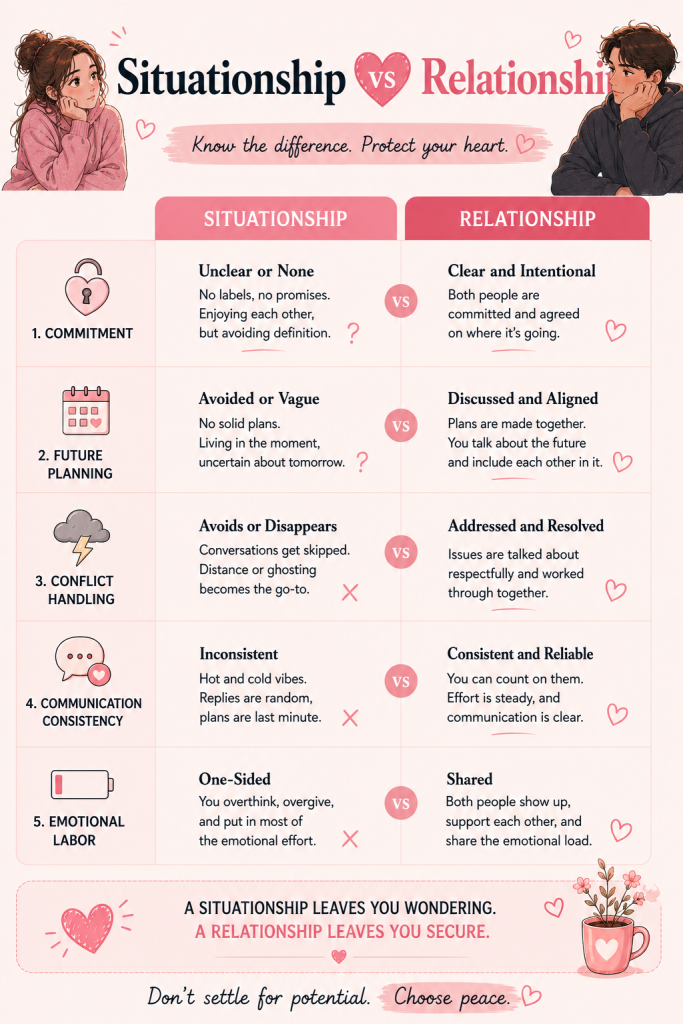
A relationship is defined by mutual, spoken commitment. A situationship runs on assumed, unspoken understanding that can shift depending on who you ask. In a relationship, both people have agreed on exclusivity. In a situationship, exclusivity is often assumed by one person and left open by the other.
- Relationships involve future planning together, trips, holidays, meeting family. Situationships tend to stay present focused, rarely extending past the next hangout.
- Relationships weather conflict through direct conversation. Situationships often dissolve at the first sign of friction, since neither person has committed enough to fight for it.
Emotional labor tends to flow one direction in a situationship, usually toward whoever wants more clarity. A relationship distributes that labor more evenly between both people. This imbalance is often the clearest tell, even before either person consciously notices it.
Signs you’re in a situationship, not a relationship
- You’ve never had an explicit conversation about what you are to each other.
- Plans get made last minute rather than in advance.
- You’re unsure if you’re allowed to call them your partner in front of other people.
- Communication is inconsistent, warm for days, then quiet without explanation.
- You’re meeting their friends casually but haven’t been introduced as anything specific.
- Bringing up the future makes the mood shift or the conversation change entirely.
Signs you’re actually in a relationship
- You’ve had a real conversation about exclusivity, and you both know where you stand.
- Your calendars include each other for things weeks or months out.
- Conflict gets addressed directly instead of avoided or ghosted through.
- You’re introduced clearly, as a partner, not left ambiguous in social settings.
- Communication stays reasonably consistent, even during busy stretches.
- The relationship includes both of you in decisions, not just one person’s convenience.
A quick situationship vs relationship self-check
Ask yourself these questions honestly.
- Have we ever directly discussed what this is, using clear words, not hints?
- Do I know for certain whether we’re exclusive, or am I assuming it?
- Am I included in plans made more than two weeks in advance?
If you answered no to most of these, you’re very likely in a situationship.
This is true regardless of how it feels day to day. Feelings can be completely real inside a situationship. What’s missing isn’t emotion, it’s structure and mutual clarity.
What to actually do with this information?
1. Get specific about what you want first. Before addressing the other person, write down exactly what you’re missing. More clarity. Exclusivity. A defined title. Vague dissatisfaction is much harder to act on than a specific, named want.
2. Choose the right moment to raise it. Pick a calm, low pressure moment, not mid conflict or late at night when emotions run higher. Try something like, “I’ve really enjoyed this, and I’d like to know where we actually stand.”
3. Watch the response, not just the words. Someone who values you will engage with the question honestly. This holds even if the answer isn’t immediately what you hoped for. Repeated deflection is answering you too, just without saying it out loud.
4. Set yourself a real timeline. Give the situation a defined window, something like four to six weeks, rather than an open ended one. This protects you from staying in limbo indefinitely out of hope alone.
5. Decide your walk away point in advance. Know, before the conversation happens, what response would actually change things for you. Deciding this while calm protects you from talking yourself into settling in the moment.
This affects both people, not just the one wanting more
It’s easy to frame situationships as one person’s problem, usually whoever wants more. But the person avoiding definition is often protecting themselves too.
Past hurt, fear of loss, or genuine uncertainty about their own readiness all play a role. Naming that doesn’t excuse avoidance, but it does explain it.
How to turn a situationship into a relationship goes deeper into this exact conversation. It includes more scripts for actually having it well.
The bottom line
Situationship vs relationship ultimately comes down to one thing. Whether both people have actually agreed on what they’re building, out loud, together.
Ambiguity isn’t inherently wrong for a short season, but it isn’t sustainable indefinitely for anyone who wants real security. You deserve clarity, and asking for it is never too much.

I’m Patricia – a writer, a wife, and the kind of person who feels just about everything at full volume. I live in Manhattan, but I don’t write about the fairytale version of romance. I write about the real stuff: the miscommunications, the long-term commitment, and the tiny, everyday decisions it takes to keep a relationship thriving. I’m just a fellow wildheart trying to put honest words to how love actually feels from the inside.