
What does ghosting mean in psychology is a question that comes up right after it happens to you. One day, contact is normal. The next, total silence, no explanation, no closing conversation. It’s one of the most common heartbreaks in modern dating, and one of the least understood.
The basic definition first
Understanding what does ghosting mean in psychology starts with a simple definition. Ghosting is ending all communication with someone abruptly, without any explanation. It’s never acknowledged once it happens. It differs from a slow fade or a direct breakup this way. No gradual reduction, no closing conversation, just silence.
How common is ghosting, really?
If you’ve been ghosted, you’re far from alone. Multiple dating surveys over the past decade find something consistent. Roughly one in four adults report having ghosted someone, and an even larger share report being on the receiving end. Dating apps specifically seem to increase the frequency. The low barrier to starting contact also lowers the perceived stakes of ending it silently.
This matters because it reframes the experience. Ghosting isn’t a rare, personal punishment reserved for you specifically. It’s a widespread, culturally reinforced habit. Dating apps have made it easier than ever to default into, often without much conscious thought behind it.
The 5 stages of being ghosted
1. Disbelief. The first stage is usually confusion, not hurt. You reread old messages, check if something technical went wrong, and assume there’s a reasonable explanation waiting.
2. Justification. Next comes the mental defense of them. They’re busy. Their phone broke. Something must have happened. This stage protects you from the harder truth for a little while longer.
3. Anger. Once justification runs out, frustration sets in. This stage often includes replaying the relationship and searching for a clue you missed. It carries a real sense of disrespect.
4. Self-doubt. This is usually the hardest stage. The silence gets turned inward. Questions surface about your own worth, what you did wrong, or whether you were simply too much.
5. Acceptance. Eventually, the silence stops needing an explanation to be real. This stage isn’t about being fully over it. It’s about no longer waiting for an answer that isn’t coming.
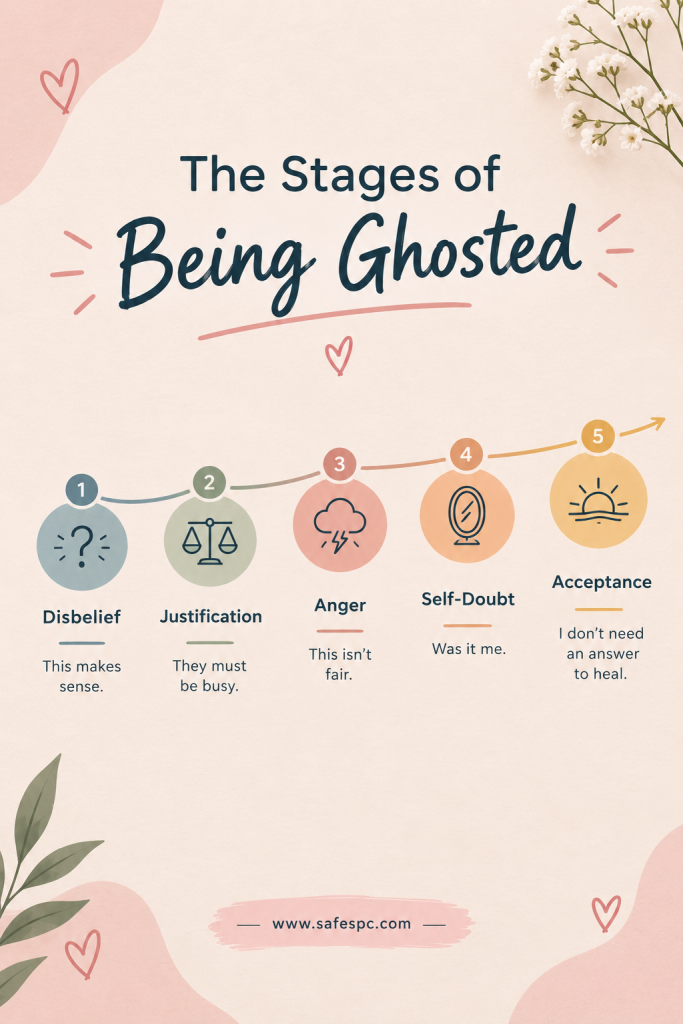
These stages rarely move in a clean, single pass. It’s common to bounce between anger and self-doubt more than once before genuine acceptance settles in. Grief researchers have long noted something important here. Stage-based models describe a general direction, not a strict schedule, and ghosting grief follows that same messy, non-linear pattern.
How does the ghoster feel after ghosting someone?
This surprises people. Research on avoidant coping and conflict avoidance suggests many ghosters feel genuine relief immediately, followed later by guilt they rarely act on. The relief comes from escaping a conversation they found too uncomfortable to have.
Some ghosters barely think about it again, having mentally closed the door the moment they stopped responding. Others carry quiet guilt for a long time. But the discomfort of addressing it late usually wins out over any motivation to reach back out.
There’s also a documented pattern called moral disengagement. People mentally minimize the harm of their own avoidant behavior to protect their self image. A ghoster might tell themselves “we weren’t that serious anyway.” This holds even when the other person experienced real attachment, simply because that story is easier to live with.
What does ghosting tell you about a person?
Ghosting says far more about someone’s relationship with discomfort than it says about your value. It reveals a preference for avoidance over confrontation, even when confrontation would be kinder. It often reflects someone who hasn’t learned how to exit a situation with real accountability.
This doesn’t mean every ghoster is a bad person in every area of life. Many people who ghost are perfectly kind in lower stakes contexts. Ghosting specifically shows where their conflict tolerance runs out, not their entire character.
It’s also worth noting that ghosting tends to correlate with certain attachment patterns. Particularly avoidant attachment, where emotional closeness itself feels threatening. Someone with this pattern may genuinely like a person and still disappear the moment things start to feel real. That realness is precisely what triggers their retreat.
Why this hurts as much as it does?
Uncertainty is genuinely harder on the nervous system than clear rejection. A clean breakup gives you something to process. Ghosting gives you an open question instead. The mind tends to keep circling back to it long after the other person has moved on.
Psychologists sometimes call this ambiguous loss. It’s a term originally used for grief without a clear resolution, like a missing person case. Applied to ghosting, it explains why closure feels so hard to reach on your own. There’s no event to grieve, just an absence that never gets formally acknowledged.
What to actually do with this understanding?
Stop searching for the explanation, since it was never really about a missing piece of information. Write your own closing line instead of waiting for theirs. Try, “I’ll never know why, and I’m allowing that to be enough.”
Give yourself permission to grieve something that was never formally ended. This might mean telling a friend plainly, “this wasn’t a relationship, but it still really hurt.” You don’t need to justify the size of the feeling to anyone, including yourself.
Consider writing an unsent letter, saying everything you’d want to say if they were actually listening. This isn’t about delivering it. It’s about giving the unresolved feelings somewhere to go besides looping endlessly in your head.
Signs someone is breadcrumbing you and what is orbiting in dating cover two related patterns worth knowing. Both are useful if what you’re experiencing isn’t quite full silence.
The bottom line
What does ghosting mean in psychology, at its core? One person’s discomfort outweighing their sense of responsibility to you. It’s a real, valid loss, even without a defined ending. You’re allowed to grieve it fully. You’re also allowed to stop waiting for a door that was never going to reopen.
2 thoughts on “What Does Ghosting Mean In Psychology? The Painful Truth Behind It”