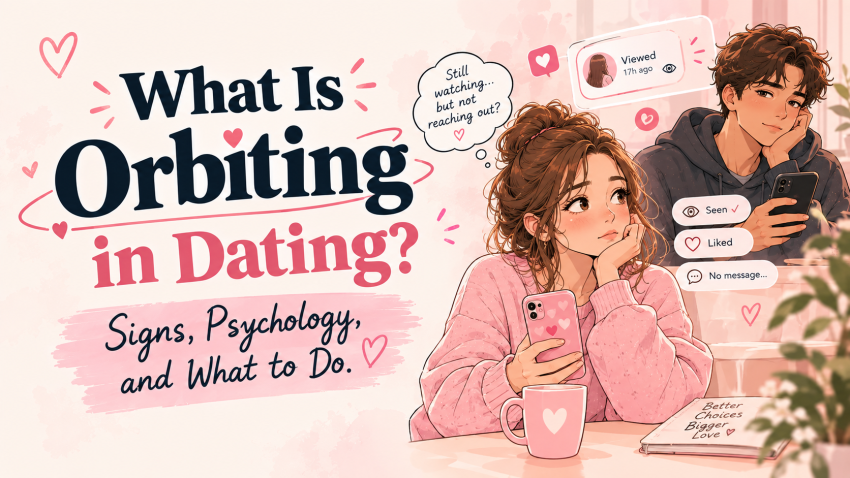
They stopped texting weeks ago. No explanation, no closure, just silence. And yet somehow, they liked your story an hour after you posted it. That contradiction is exactly what is orbiting in dating. If it’s ever happened to you, you already know how unsettling it feels.
What is orbiting in dating, actually?
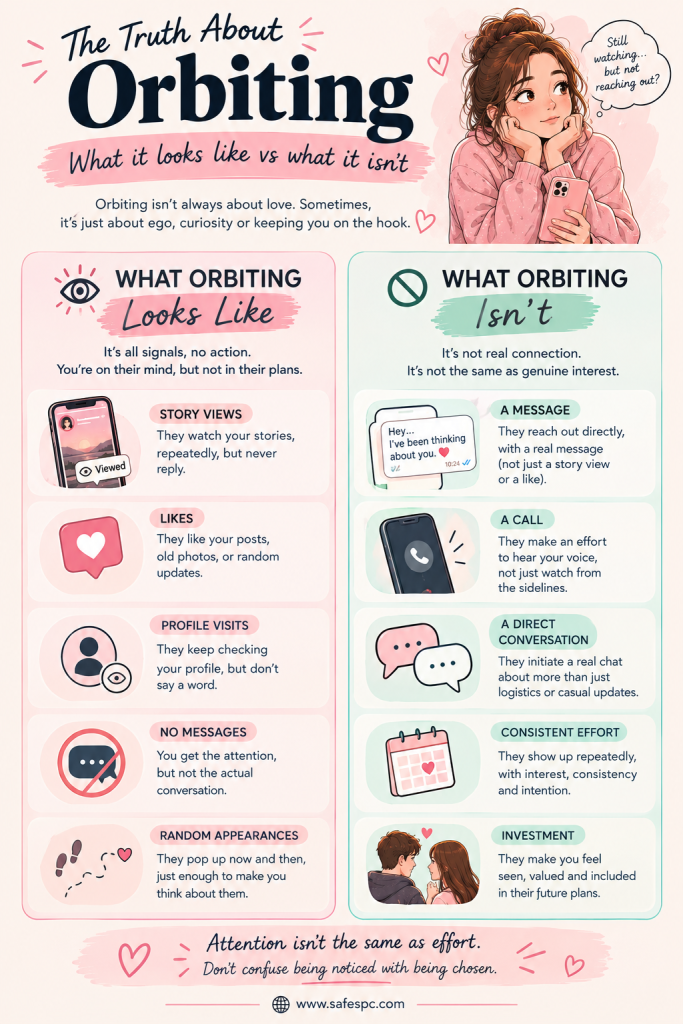
Orbiting is when someone who has otherwise disappeared from your life keeps quietly watching from a distance. They stop texting, calling, and making plans. But they still view your stories, like your posts, or leave the occasional reaction on something you shared. They’ve exited the relationship without exiting your orbit entirely.
The term captures something real about how modern dating works. Full disappearance used to mean total silence. Now, someone can vanish from your inbox while still circling your social presence. Close enough to be seen, far enough to avoid any actual conversation.
Signs someone is orbiting you
The clearest sign is a mismatch between effort and presence. They’ve gone quiet in every direct channel, texts, calls, real conversation, but they’re still active on your content specifically. A like here, a story view there, just enough to register on your radar.
Timing often gives it away too. The activity tends to spike right after you post something, or right around a moment you’d expect to feel forgotten. It rarely comes with any message attached, no comment, no DM, just a quiet, wordless presence.
Another sign is the complete absence of follow up. If they genuinely wanted back in, engagement would eventually lead somewhere, a message, a check in, an actual conversation. Orbiting stays purely passive, month after month, with no intention of ever becoming anything more direct.
The psychology behind orbiting
Orbiting usually isn’t random, and it’s rarely as calculated as it can feel from the outside. A few real psychological patterns tend to drive it, often without the orbiter fully realizing what they’re doing.
Avoiding the discomfort of full closure. Ending contact completely can feel more final, and more guilt inducing, than most people want to sit with. Staying loosely visible lets someone avoid a clean goodbye while still technically being gone.
A quiet need for validation. Watching your content, even passively, offers a small hit of connection. It comes without any of the effort or risk of real conversation. It’s a low cost way to still feel involved in your life, even from the sidelines.
Keeping the door open, just in case. Some orbiters genuinely aren’t sure they’re done. Staying visible preserves the option to re-enter later, without committing to anything now. This isn’t necessarily manipulation, sometimes it’s just unresolved uncertainty playing out passively.
Fear of feeling replaced or forgotten. For some, orbiting is less about you and more about their own fear of becoming irrelevant in your life. Watching from a distance quietly protects their ego, even if it offers you nothing in return.
None of these motives make orbiting a healthy behavior. They just explain why it happens so often without any obvious cruelty behind it.
What to actually do about it?
1. Name what’s happening clearly, at least to yourself. Say it plainly. “They’ve disappeared from real contact but are still watching from a distance.” Naming it removes the confusion that keeps you checking for meaning in a like that has none.
2. Resist reading meaning into passive engagement. A story view isn’t a message. A like isn’t an apology. Treat passive activity as exactly what it is, low effort and low commitment, not a secret signal worth decoding.
3. Remove the temptation to check. If their activity keeps pulling your attention, mute or unfollow for a while. This isn’t dramatic, it’s practical. The power of silence after a breakup covers why removing access points like this genuinely speeds up moving forward.
4. Don’t engage to test them. Posting specifically to see if they’ll react keeps you both stuck in the same passive loop. So does liking their content back to see what happens. Real clarity comes from direct contact, not indirect signals traded back and forth.
5. If you want real closure, ask for it directly. Send one honest message if you genuinely need an answer. Something like, “I’ve noticed we’ve gone quiet, and I’d rather know where things stand than guess.” Their response, or lack of one, will tell you what the likes never could.
6. Redirect the energy elsewhere. Every minute spent interpreting someone’s passive activity is a minute not spent on people who are actually present. Orbiting thrives on your attention. Withdrawing that attention is often the fastest way to move past it.
If you’re the one doing the orbiting
If this pattern sounds like something you do, it’s worth a moment of honest reflection too. Ask yourself what the watching is actually giving you. Consider what it’s costing the other person by keeping them in a strange, wordless limbo. A clean, honest exit, even a brief one, tends to be kinder than a quiet, permanent orbit.
Breadcrumbing runs on a similar underlying fear, just with slightly more active contact involved. If orbiting sounds familiar, that pattern might too.
The bottom line
What is orbiting in dating, really, comes down to presence without commitment. Someone choosing to stay just visible enough to avoid a real goodbye. It says far more about their own discomfort with closure than it says about your worth. You’re allowed to want more than a like from a distance. And you’re allowed to stop waiting for one to mean something it doesn’t.
1 thought on “What Is Orbiting in Dating? Signs, Psychology, and What to Do”