Something feels off, but you can’t quite name it. Maybe it’s how they check out emotionally the second things get serious. Maybe it’s the opposite: how tightly they hold on, how a canceled plan turns into a full-blown crisis, how “I need space tonight” gets received like a breakup announcement. You love them, and you also feel like you’re constantly managing something you don’t fully understand.
If you’ve been quietly Googling “signs your partner has abandonment issues” at 11pm trying to make sense of a pattern that doesn’t add up, this post is built to answer everything underneath that question: what it actually looks like, how it affects a relationship over time, whether it’s on you to fix, and exactly what to do the next time it gets triggered.
Does this sound like your partner?
Abandonment issues rarely look like someone announcing “I’m afraid you’ll leave me.” They show up sideways, in behavior that’s easy to misread as something else entirely:
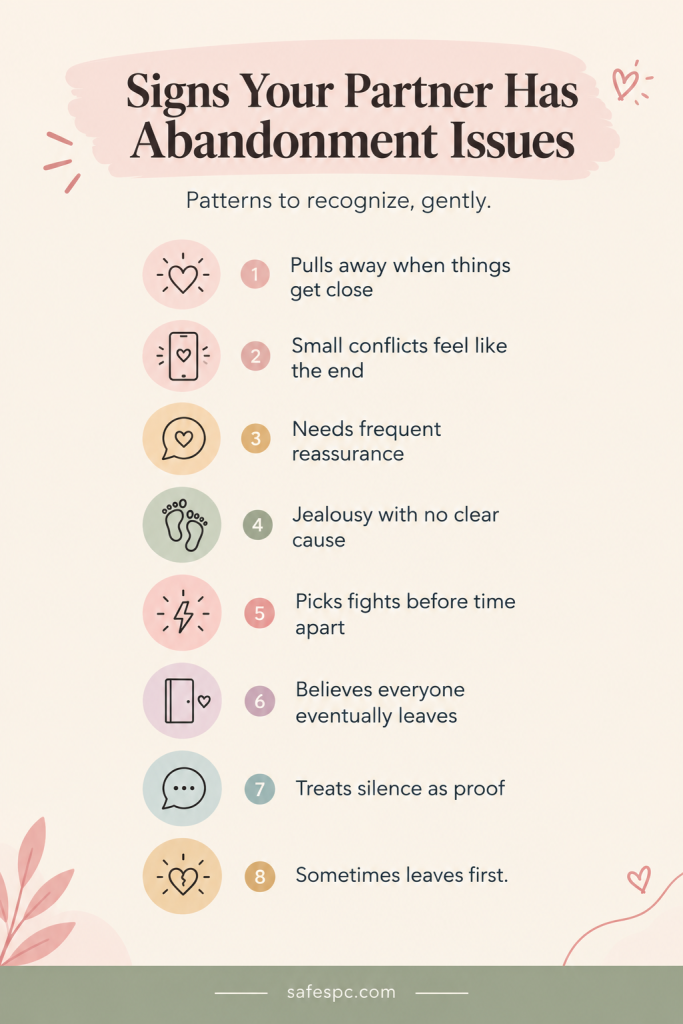
- They pull away right when things start feeling close, almost like closeness itself is the threat.
- A small conflict escalates fast, as if disagreement equals the relationship ending.
- They need frequent reassurance that you’re not upset, not losing interest, not planning to leave.
- Jealousy or possessiveness shows up disproportionate to anything you’ve actually done.
- They pick fights right before a trip, a milestone, or time apart, almost preemptively.
- They’ve told you, directly or indirectly, that everyone eventually leaves.
- Silence or a canceled plan gets treated like proof, not an inconvenience.
- They sometimes leave first, in small ways, before you get the chance to.
That last one surprises people. Abandonment issues don’t only produce clinginess. For a lot of people they produce the opposite: distancing, preemptive withdrawal, testing you to see how much you’ll tolerate before they get hurt first. Both patterns come from the same root fear, just aimed in opposite directions.
What causes abandonment issues?
Almost always, it traces back to an early experience of loss or unreliability. Not necessarily dramatic loss.
- Sometimes it’s a parent who was physically present but emotionally unpredictable.
- Sometimes it’s an actual departure. A divorce, a death, a parent who left and didn’t come back.
- Sometimes it’s a formative relationship later in life that ended abruptly or was betrayed without warning.
What all of these share is the same lesson: closeness isn’t safe to fully trust, because it can disappear without notice. The nervous system adapts by staying on alert for exactly that, permanently, long after the original loss.
This is close cousin territory to anxious attachment, and the two often overlap, though abandonment fear can run deeper and show up even in an otherwise securely attached person who lived through a specific loss.
It’s worth naming clearly that fear of abandonment sits on a spectrum. For many people it’s a wound that shows up in specific ways in close relationships and responds well to the steps below. For a smaller number of people, it’s one identifiable feature of something more clinical. The National Institute of Mental Health notes that intense fear of abandonment is a core feature of borderline personality disorder, alongside other traits like unstable self-image, intense mood swings, and a pattern of unstable relationships.
One trait alone, especially just this one, isn’t a diagnosis, and this post isn’t a tool for labeling your partner. But if fear of abandonment shows up alongside several of those other traits consistently, that’s worth naming to a professional rather than trying to manage alone.
How abandonment issues affect relationships?
Left unaddressed, this pattern tends to create a specific, exhausting cycle rather than a single one-time problem.
- The reassurance loop stops working: Reassurance helps in the moment, but it doesn’t resolve the underlying fear, so it needs to be given again and again, more and more often, with diminishing returns each time. The partner giving it can start to feel like nothing they say ever actually lands.
- Small things get treated as tests of the whole relationship: A late reply, a tired mood, a need for space. In a securely attached relationship these are just Tuesday. Here, each one risks becoming evidence for a much bigger, scarier story.
- Self-fulfilling distance can develop: Ironically, the fear of being left can push a partner to create real distance, either through pulling away first to protect themselves or through behavior intense enough that it exhausts the other person into actually leaving. The fear ends up manufacturing the exact outcome it was trying to prevent.
- The supporting partner can quietly burn out: Constant reassurance-giving, walking on eggshells around certain topics, and managing another person’s fear on top of your own needs is a real, sustained weight. Left unaddressed, resentment tends to build even in someone who deeply loves their partner and wants to help.
- Genuine intimacy can stay just out of reach: Paradoxically, a relationship organized around the fear of loss often prevents the very security that would resolve it. Real closeness requires some tolerance for uncertainty, and that’s precisely what this pattern struggles to allow.
How to love a partner with abandonment issues?
Be consistent more than you are perfect. You will not always say the right thing. What matters more is predictability. Following through on small commitments, texting back when you said you would, being reachable in the way you said you’d be. Consistency, over time, is what actually rewires the fear, far more than any single reassuring conversation.
Give reassurance freely, but don’t make it your only tool. A simple, unprompted “I’m not going anywhere” costs you nothing and does real work. But pair it with encouraging your partner’s own capacity to self-soothe, so you’re not the sole source of their sense of safety. That’s not sustainable for you and it doesn’t actually build their security long-term. If the reassurance-seeking shows up specifically around texting, this breakdown of text-message overthinking gives your partner language and tools for that specific trigger.
Don’t take distancing personally, and don’t take clinginess personally either. Both are fear wearing a different outfit. Responding to either with defensiveness usually confirms the exact fear driving it. Responding with calm curiosity tends to defuse it.
Name the pattern together, outside of a triggered moment. On a calm day, not mid-conflict, say something like: “I’ve noticed that when I need space, it seems to bring up something bigger for you. Can we talk about that?” This turns a repeating source of conflict into a shared problem you’re both working on, instead of a fight you keep having.
Hold your own boundaries anyway. Loving someone with abandonment issues doesn’t mean abandoning your own need for space, friendships, or normal independence. Consistently protecting your own boundaries, calmly and without punishment, actually teaches the nervous system something crucial: that a partner can hold a boundary and still stay. That’s often the exact lesson the original wound never got to learn.
Encourage, don’t force, outside support. You can be a genuinely stabilizing presence. You can’t be their therapist. If the pattern is significant, gently and repeatedly encouraging professional support does more long-term good than trying to be their entire treatment plan yourself.
What to do when abandonment issues are triggered?
In the moment, whether it’s your partner spiraling or you noticing the pattern activate in real time:
1. Slow the moment down before responding to the content of it: A triggered response often isn’t really about the specific thing said. Underneath “you don’t care about me” is usually “I’m scared you’re going to leave.” Responding to the fear underneath, rather than defending against the accusation on the surface, changes the entire conversation.
2. Name what’s happening, gently, together: “I think this might be the abandonment fear talking right now, not necessarily what’s actually true.” Said with warmth rather than as a dismissal, this can interrupt the spiral for both of you.
3. Offer a concrete, specific reassurance rather than a vague one. “I’m not going anywhere” helps. “I’m not going anywhere, and I’m free to talk tonight at 8, let’s finish this then” helps more, because it gives the nervous system something concrete to hold onto instead of just words.
4. Give it time before deciding anything permanent. Big decisions made mid-trigger, on either side, tend to be regretted later. Agree in advance, during a calm moment, that neither of you will make a big relationship decision while either person is activated.
5. Debrief afterward, once things are calm. What triggered it, what helped, what didn’t. This is where the real long-term progress happens, not in the moment itself.
Is this abandonment issues, or something you’re mislabeling?
One caution worth naming clearly: “abandonment issues” has become a popular, catch-all explanation online, and it’s worth checking that it’s the right one before you build months of accommodation around it. A partner who is simply inconsistent, avoidant by preference rather than by wound, or genuinely uninterested can look similar on the surface to a partner with real abandonment fear.
The difference usually shows up in self-awareness and effort:
- Someone with genuine abandonment issues, once it’s named gently, usually recognizes it in themselves, feels some shame about the intensity of their own reaction, and wants to work on it.
- Someone who’s just inconsistent or checked out tends to deflect, minimize, or treat the conversation itself as the problem.
If it’s the second pattern, the steps in this post won’t fix it, because there’s nothing underneath to heal. That’s worth being honest with yourself about, even when it’s the harder answer.
Common mistakes people make
- Diagnosing a partner from a blog post or a TikTok video. It’s useful language for understanding a pattern. It’s not a clinical assessment, and leading with a label rather than an observation tends to make a partner defensive rather than open.
- Becoming the sole source of their security. It feels loving in the short term and becomes unsustainable, and sometimes even resentment-inducing, in the long term.
- Walking on eggshells indefinitely. Permanently avoiding anything that might trigger a reaction doesn’t resolve the fear, it just avoids ever building tolerance for it. Growth requires some manageable exposure to the discomfort, not total avoidance of it.
- Using the pattern to excuse controlling or punishing behavior. Abandonment fear explains a reaction. It doesn’t excuse guilt-tripping, punishing distance, or controlling behavior. Compassion for the root cause and accountability for the behavior can, and should, coexist.
When to seek professional support?
If the pattern significantly disrupts daily functioning, involves intense anger, self-harm, or behavior that feels genuinely destabilizing rather than just anxious, that’s a sign this goes beyond what a supportive partner can address alone. Attachment-focused therapy is the right first step for most cases. Where other traits are present alongside the abandonment fear, such as an unstable sense of self or extreme mood swings, a clinician can help clarify what’s actually going on and what treatment fits.
Frequently Asked Questions
What are the main signs your partner has abandonment issues?
Look for a pattern rather than a single moment: disproportionate reactions to small distance, a need for frequent reassurance, jealousy without a clear cause, or preemptive withdrawal right when things get close.
How do abandonment issues affect relationships long-term?
Left unaddressed, they tend to create cycles of reassurance-seeking that stop working over time, tests disguised as small conflicts, and sometimes the exact distance the fear was trying to prevent in the first place.
How do I love a partner with abandonment issues without losing myself?
Consistency and calm reassurance help enormously, but they need to be paired with your own boundaries. A partner learning that you can hold a boundary and still stay is often more healing than constant accommodation.
What should I do the moment abandonment issues get triggered?
Slow down, respond to the fear underneath rather than the accusation on the surface, and avoid making any big decisions until both people are calm. Debrief later, once things have settled.
Can abandonment issues be fixed, or is this permanent?
It’s very often workable, especially with self-awareness, a consistent partner, and time. It’s not usually something that disappears completely overnight, but the intensity and frequency can genuinely improve.
The bottom line
Signs your partner has abandonment issues are rarely as obvious as “I’m scared you’ll leave.” They show up as distance, jealousy, testing, or a need for reassurance that never quite runs out. None of that makes your partner broken, and it doesn’t make managing it entirely your job either. The goal isn’t to eliminate the fear completely. It’s to build enough consistency and honesty between you that the fear slowly stops running the relationship.