
They sent “hey” three hours ago. You replied within two minutes. Now it’s been forty-five, the three dots appeared and disappeared twice, and you’ve read your own message back so many times you’ve started wondering if “hey, how was your day 🙂” was somehow too much. Or too little.
You’ve drafted and deleted a follow-up text four times. You know, rationally, that this is insane. It doesn’t feel insane. It feels like the most important text of your life. If you’ve ever screenshotted a message to a friend just to ask “wait, is this weird?”, you already know what it’s like to overthink every text message before you’ve even hit send. This post is for you.
Overthinking texts isn’t a personality quirk or a sign you’re “too much.” It’s a pattern with a real cause, and more importantly, a real off-ramp.
This post covers why it happens, what it’s actually a symptom of, how to tell the difference between anxious overthinking and an actual red flag, and exactly what to do the next time you’re staring at your phone at midnight.
Does this sound like you?
A quick gut check, because “overthinking” gets used loosely. This isn’t just “I think about texts sometimes.” It’s a specific, recognizable loop:
- You reread your own sent message, searching for a tone you didn’t mean to imply.
- A short reply (“k,” “lol,” “yeah”) feels like a verdict, not a normal text.
- You time their replies against yours, and draw conclusions from the gap.
- You’ve asked a friend to interpret a text that, out of context, is completely neutral.
- You’ve rewritten a message five times to remove anything that could be “read wrong.“
- Silence doesn’t feel like silence. It feels like something is being decided about you.
- You’ve felt relief so intense at a reply that it’s almost embarrassing.
If most of that’s familiar, keep reading. This is a full, honest answer, not a “just relax” platitude.
The Psychology: Why do I overthink every text message?
Texting is uniquely built to feed this pattern, for a reason that has nothing to do with something being wrong with you: it strips out almost every cue your brain normally uses to read a situation.
- No tone of voice
- No facial expression
- No timing context you can actually verify.
Research on written communication backs this up directly, a well-known study on written-message tone found that intended tone is misread roughly half the time, with most people confidently unaware they’d gotten it wrong. A perfectly neutral “ok” in person comes with a smile attached.
In a text, it’s just two letters, and an anxious brain will fill that missing context with the worst available explanation because uncertainty, to an anxious nervous system, feels more dangerous than bad news. At least bad news is something you can respond to. Uncertainty just hangs there.
A few things tend to be running underneath the surface at the same time:
- Intolerance of uncertainty: Some people can sit with “I don’t know what that meant” and let it stay unknown. Others can’t, the not-knowing itself is the uncomfortable part, more than whatever the actual answer turns out to be. Overthinking is often an attempt to resolve that discomfort by mentally simulating every possible answer, even though none of the simulations are real.
- Negative interpretation bias: When information is ambiguous, an anxious mind doesn’t guess randomly, it tends to default to the most threatening available interpretation. A short reply becomes disinterest before it’s considered as “they were just driving,” even though the second explanation is statistically far more common.
- Attachment activation: For a lot of people, this pattern is really about attachment, not texting itself. If you tend to read anxious in relationships more broadly, texting is often where it shows up first and most intensely, because it’s low-context and constant. The phone becomes the place the nervous system checks for proof that it’s safe.
- Past experience doing exactly what it’s supposed to do: If you’ve been ghosted, love-bombed then gone cold on, or lied to over text before, your brain isn’t malfunctioning when it gets vigilant about texting, it’s pattern-matching to something that actually happened once. That’s not irrational. It’s just outdated as a permanent setting.
What is overthinking everything a symptom of?
This is worth answering honestly, because a lot of people searching this are quietly wondering if something is “wrong” with them. Text-message overthinking specifically tends to show up alongside a handful of things, and it’s rarely just one:
- Anxious attachment. The most common driver in a relationship context, a nervous system calibrated early on to treat inconsistency as dangerous, so it stays alert for it, including in an inbox.
- General or relationship-specific anxiety. Overthinking is rumination’s favorite home, and rumination is a core feature of anxiety, not a character flaw. It shows up in texting because texting gives it constant, low-stakes material to work with.
- Past relational trauma. Betrayal, infidelity, or a relationship that was genuinely inconsistent can leave a residue that shows up as hypervigilance around communication specifically, even with a completely different, trustworthy person.
- Low self-worth. Sometimes the underlying question isn’t “what did they mean” but “do I actually deserve a warm response,” and every ambiguous text becomes a referendum on that deeper, older question.
- Relationship OCD (ROCD) tendencies. For a smaller subset of people, this crosses from anxious habit into something closer to intrusive-thought territory needing certainty so badly that reassurance never actually lands, and the checking becomes compulsive rather than occasional. The International OCD Foundation’s overview of relationship OCD is a good next read if this section feels uncomfortably familiar. If reassurance only ever quiets the anxiety for minutes before it returns, that distinction matters, and it’s worth naming to a therapist specifically.
None of these are a diagnosis you can make from a blog post, and they’re not mutually exclusive. But naming the actual root is what makes the fix work — self-soothing helps an anxious pattern, but it won’t touch something closer to OCD, and it’s worth being honest with yourself about which one this looks like.
What is a red flag in texting? (And what isn’t one)
This is the part most advice on overthinking skips, and it might be the most important section in this post: sometimes the anxiety is correctly detecting something. Not every uneasy feeling about a text is anxious attachment talking. Learning to tell the two apart is more useful than any grounding technique.
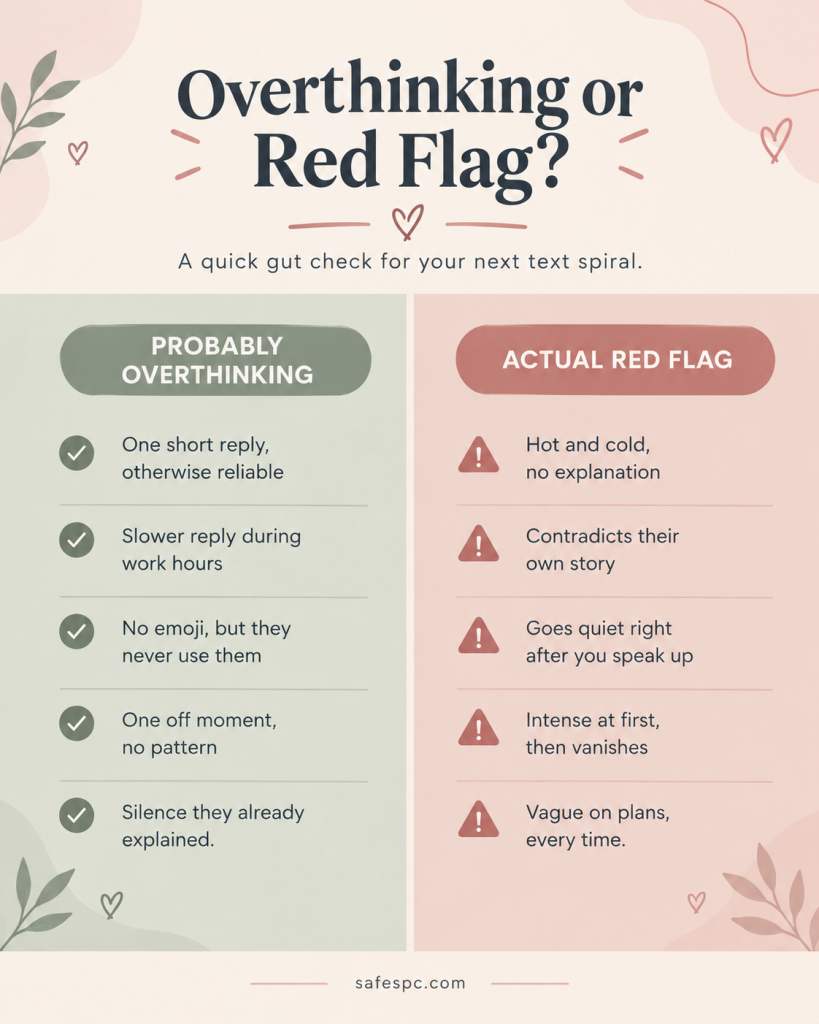
Actual red flags in texting look like:
- A consistent pattern of hot-and-cold: warm and attentive for days, then cold or distant with no acknowledgment of the shift.
- Contradicting themselves about where they were, who they were with, or what they said before.
- Response patterns that change specifically around accountability: fast replies normally, sudden silence right after you raise a concern.
- Love-bombing early (constant contact, intense declarations) that sharply drops off once you’re invested.
- Being consistently vague about basic plans or follow-through, in a way that leaves you never quite sure where you stand.
- Getting defensive or dismissive when you calmly name that a pattern is bothering you.
What is almost always overthinking, not a red flag:
- A single short reply from someone who is otherwise consistent.
- A slower response during work hours, when they’ve been reliable outside of them.
- Neutral punctuation, or lack of an emoji, from someone who doesn’t text expressively as a rule.
- One instance of something that felt “off,” with no pattern behind it.
- Silence that’s already been explained (they told you they had a busy day, a family thing, a deadline).
The dividing line is almost always pattern versus single instance, and actual inconsistency versus your own uncertainty tolerance. One ambiguous text from a consistent person is texting. A repeated pattern of inconsistency from anyone is data, and no amount of self-soothing should talk you out of noticing it.
How to stop overthinking every text: the in-the-moment plan
For when you’re actively mid-spiral, staring at the screen, phone in hand:
1. Name it before you act on it. “This is my anxiety reading into ambiguity, not necessarily what’s actually happening.” You don’t have to fully believe it. Just interrupt the automatic pilot.
2. Set a 20-minute rule before you re-read or re-send anything. Put the phone down, physically leave the room if you can. Most of the urgency fades measurably within twenty minutes — that’s not willpower, that’s just how the initial anxiety spike naturally works.
3. Separate what you know from what you’re predicting. “They haven’t replied in 40 minutes” is a fact. “They’re losing interest” is a story your brain built on top of the fact. Say both out loud, separately, and notice how different they sound.
4. If you must do something, write it, don’t send it. Draft the message you’re tempted to send. Reread it in twenty minutes. It’ll usually tell you whether it came from a real need or from the spiral.
5. Ask yourself the pattern question. “Has this specific person given me an actual reason to worry, or is this how I feel about ambiguity in general?” That single distinction does most of the diagnostic work.
How to stop overthinking every text: the long-term fix
The in-the-moment steps manage a spike. These build the underlying tolerance so the spikes get smaller and further apart over time.
- Build tolerance for unanswered gaps on purpose. Let a text sit unread by you for a while when you don’t urgently need to reply. Notice the discomfort without fixing it immediately. This is the same mechanism as exposure therapy, the anxiety needs repeated evidence that an unanswered gap doesn’t lead to disaster.
- Ask directly instead of decoding. Replace “let me analyze what they meant” with “let me just ask.” A simple “hey, everything okay? Didn’t want to read too much into the quiet” resolves in one message what an hour of spiraling never will.
- Keep an evidence log. When the anxious story turns out to be wrong (which, over time, it usually does), write it down. Anxious overthinking has a habit of forgetting every time it was wrong and remembering every time something did go badly. The log corrects that memory bias with your own real history.
- Get curious about your own texting style first. Sometimes the anxiety is partly fed by a mismatch: a short, dry texter dating someone who reads short and dry as cold. Understanding your own baseline is part of correctly reading someone else’s.
- Address the root, not just the symptom. If this consistently traces back to attachment patterns, the deeper work on anxious attachment will move the needle on texting anxiety far more than any texting-specific trick, because texting was never really the actual problem.
Common mistakes people make trying to fix this
- Asking for constant reassurance instead of building tolerance. It brings relief for minutes, not resolution. The anxious pattern stays fully intact underneath it.
- Involving a group chat in every ambiguous text. Crowd-sourcing interpretation of a two-word message usually amplifies the story rather than resolving it, more people, more possible interpretations, more anxiety, not less.
- Treating “I stopped overthinking this one text” as proof it’s fixed. One calm moment doesn’t undo a longstanding pattern. Progress here looks like a gradually shrinking spiral, not a single clean win.
- Ignoring real red flags because you’re focused on “not overreacting.” The opposite mistake matters too, someone who’s worked hard on not overthinking can talk themselves out of noticing something that’s actually a pattern. Calibration, not suppression, is the goal.
When to consider professional support
- If the checking becomes compulsive rather than occasional
- If reassurance never actually resolves it
- If you’re rereading messages dozens of times a day
- If it’s affecting sleep, work, or how present you can be in the relationship.
This has likely crossed from an anxious habit into something a therapist should be involved in. Attachment-focused therapy and, where the pattern looks more compulsive than anxious, an OCD-specialized therapist familiar with ROCD, are the two most relevant paths depending on which pattern fits.
Frequently Asked Questions
Why do I overthink every text message my partner sends?
Texting removes tone, facial expression, and context, leaving an anxious mind to fill the gap with its most threatening guess. It’s often tied to attachment patterns, past relational experience, or general anxiety rather than anything specific to that relationship.
Is overthinking texts a sign of anxiety or something more serious?
For most people, it’s a form of anxious rumination tied to attachment or uncertainty intolerance. If reassurance never actually resolves the anxiety and the checking feels compulsive, it may be closer to relationship OCD, which is worth naming to a therapist specifically.
How do I know if I’m overthinking or if it’s a real red flag?
Look for pattern versus single instance. Consistent hot-and-cold behavior, contradictions, or defensiveness when you raise a concern are real signals. A single short or delayed reply from an otherwise consistent person is almost always overthinking.
How do I stop overthinking a text I already sent?
Give it twenty minutes before rereading it. Separate the fact (what you actually said) from the story (what you’re afraid it implied). Most of the urgency fades within that window on its own.
Can overthinking texts ruin a relationship?
It can, mostly through the behaviors it triggers, testing, going quiet to see if they notice, or repeatedly seeking reassurance, more than through the overthinking itself. Addressing the pattern directly protects the relationship it’s aimed at protecting.
The bottom line
Overthinking every text isn’t a flaw in your character, and it isn’t proof that something’s wrong with the relationship either. It’s usually a nervous system trying to resolve uncertainty the only way it currently knows how, by simulating every possible bad outcome until one of them feels safe to prepare for. The fix isn’t caring less. It’s building enough tolerance for not-knowing that a silent phone can just be a silent phone again.
6 thoughts on “Why Do I Overthink Every Text Message? (Real Reasons)”