
You’ve typed and deleted the same three sentences more times than you’d admit. Too harsh, then too soft, then it reads like you’re asking permission instead of saying what you mean. There’s a version of this message that exists in your head where it comes out clean and kind and final, and every attempt at writing it down falls short of that version.
Here’s the thing most advice on this skips: the perfect wording isn’t actually the hard part. The hard part is that you’re trying to be clear and kind at the same time, and some part of you still worries those two things cancel each other out.
They don’t. If you’re still working out whether to end it at all, rather than how, that’s a separate question worth settling first. If you’re already past that and just need the words, below are the actual scripts, for the actual situations, built so you can say exactly what you mean without it turning into a conversation you didn’t want to have.
What “nice” actually means here?
A lot of people confuse nice with soft, and soft is often where situationship endings go wrong. Softness leaves room for interpretation, and interpretation is how you end up having this exact conversation again in three weeks.
Nice means something more specific: honest, warm in tone, and final in substance. You can care about someone’s feelings and still be unambiguous. In fact, research on how people actually navigate ending relationships backs this up directly.
A study on relationship dissolution published in the Western Journal of Communication found specific communication strategies that reduce anxiety and hurt feelings on both sides, and none of them involved softening the message into vagueness. One approach the researchers found effective was checking whether the other person had noticed the same shift before naming what needed to happen, something like asking if they’d felt things changing too, before following it with a clear statement. Clarity, it turns out, is the kind thing, not the harsh thing.
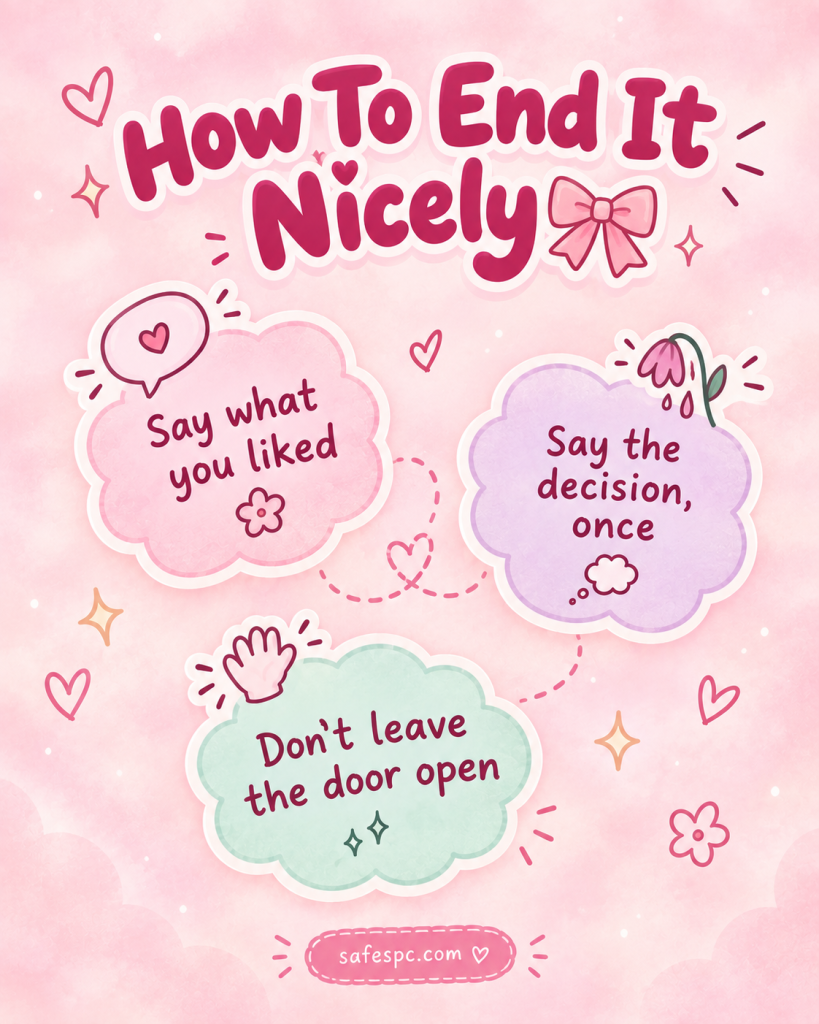
The anatomy of a message that actually works
Every script below follows the same three-part shape, because this shape is what makes an ending land as kind instead of cold, and final instead of open-ended.
- One, name what you appreciated, briefly. Not a resume of the relationship, just one honest sentence. This isn’t about softening the blow. It’s about telling the truth, since most situationships did have something real in them worth naming.
- Two, state the decision plainly, once. No “I think maybe,” no “I’ve been feeling like.” Say the actual thing: this isn’t working for me, I want to stop this. One clear sentence beats three hedged ones.
- Three, don’t reopen a door you didn’t mean to leave open. No “but who knows,” no “maybe down the line.” If you mean it’s over, let the message sound like it’s over.
Everything below is a variation on that shape, adjusted for the specific relationship you’re ending it with.
How to End a Situationship Over text, when there’s no deeper complication
“I’ve been doing some thinking, and I don’t think this is working for me the way it’s set up right now. I’ve enjoyed parts of this, genuinely, but I don’t want to keep going without more than what we have. I think it’s best if we stop here. I wish you well.”
Short version, if you want it tighter:
“I’ve really enjoyed getting to know you, but I don’t think this is what I need right now. I’m going to step back from this. Take care of yourself.”
How to End a Situationship with an Avoidant?
This one needs a slightly different approach, because an avoidant partner is likely to meet directness with withdrawal rather than discussion, which can make the conversation feel like it’s going nowhere. The move here is to remove the need for them to respond at all, which paradoxically makes it easier for them to actually hear you.
“I don’t need you to respond to this right away, or really at all if you’d rather not. I’ve realized I want something with more clarity and consistency than what we’ve had, and I don’t think that’s the direction this is going. I’m going to step back. No hard feelings, I just need something different.”
If they do respond defensively or minimize it, you don’t owe a debate. How to date someone with avoidant attachment goes deeper into reading this pattern if you want to understand why they handle endings this way, but understanding it doesn’t obligate you to manage their reaction for them.
How to end a situationship with an ex you drifted back into something with?
This one carries old history, which means the message usually needs one extra line acknowledging that weight, or it can land as colder than you intend.
“I think we both know what this has turned into, and I don’t think going back to this version of us is good for either of us. I don’t regret trying, but I think we need to actually let this be over this time, not halfway. I hope you’re doing well.”
How to end a situationship with a friend?
Ending a situationship with a friend carries a second risk the others don’t: losing the friendship along with it. Naming that directly tends to protect it.
“I want to be honest that what’s been happening between us lately isn’t something I want to keep doing, and I think continuing it risks the friendship, which actually matters more to me. Can we go back to just being friends, for real this time, not as a placeholder?”
How to end a situationship gracefully, in person?
If you’re doing this face to face, the same three-part shape applies, just spoken instead of typed. A few things make it land better in person specifically: say it early in the conversation rather than building up to it, keep your explanation to one or two sentences rather than a long justification, and resist the urge to fill every silence. A pause after you’ve said it isn’t a mistake to fix. It’s the other person having a real reaction, which they’re entitled to.
“I wanted to talk in person because I think you deserve that. I’ve realized I want something different than what this has been, and I don’t think it’s fair to either of us to keep going without more. I’m ending this, and I mean that kindly, but clearly.”
Phrases that don’t actually end anything
A few lines sound like an ending but quietly aren’t, and they’re worth cutting on sight, because they’re the fastest way to end up having this exact conversation again.
“I think we should take a break” leaves the door fully open and usually gets read that way. “I just need some space” states a feeling, not a decision. “Maybe we’re better as friends for now” buries the actual message under “for now.” If you mean it’s over, the message needs to sound like it’s over, even if softened in tone.
If they push back after you’ve sent it
Some version of “can we talk about this” or “I think you’re overreacting” often comes back, especially if the situationship ran on ambiguity to begin with. You don’t need to re-argue your decision. One calm repeat usually does more than a longer explanation:
“I hear you, and I’m not upset with you. I’ve just made up my mind on this, and I’d rather not go back and forth about it.”
If they keep pushing after that, you’re allowed to simply stop responding. You already said the clear thing once. You don’t owe it twice.
The actual words matter less than you think once you’ve decided. What matters is that you said the true thing plainly, let it be final, and didn’t spend three more weeks managing someone else’s read of a sentence you already meant. That part, the deciding, is usually the real work. The message is just where it finally gets to leave your head and become real.
Want a script for every version of this conversation?
The 7-Day Situationship Exit Plan includes eight exit scripts and a clean exit checklist, plus a vault of 50+ more scripts for the moments after. Get the situationship exit scripts here.