There’s a particular kind of unease that doesn’t come from one bad night or one missed call. It’s quieter than that, a feeling that builds slowly over weeks, the sense that something about this has started drifting even though you couldn’t point to the exact moment it happened.
You’ve read the “signs it’ll last” lists before, nodded along at the good ones, and still felt that same low hum of doubt underneath. This post is for that feeling specifically, not the panic of a single bad fight, but the longer, harder question of whether the drift you’re sensing is real.
Here’s the useful thing to know before anything else: not every uneasy feeling in a long distance relationship means it’s failing. Research on these relationships has found something genuinely counterintuitive, which makes the real signs worth separating carefully from the false alarms.
The decline that isn’t actually failure
Long distance relationships lean on a psychological effect called idealization, filling the gaps created by distance with a generous, often slightly inflated picture of your partner and the relationship. It’s a big part of why trust in long distance relationships often runs higher, not lower, than people expect.
But idealization isn’t permanent, and when it softens a little, which it naturally does over time, it can feel like something is going wrong even when nothing actually is. You’re not necessarily watching the relationship decline. You might just be watching an inflated picture settle into a more accurate one, which is uncomfortable, but isn’t the same thing as failure.
That distinction matters, because the real research on what actually predicts long distance relationships ending points somewhere more specific than a vague feeling of drift.
What actually predicts it ending, according to the research?
The same research found something that sounds backwards at first: long distance couples were often more stable than geographically close couples while they remained apart, but significantly more likely to break up once the distance actually closed.
This reframes the whole question in a useful way. The most dangerous pattern in a long distance relationship often isn’t visible while you’re still apart. It’s building quietly in two specific places:
- How long the stretches between real visits have become?
- How much the picture in your head has drifted from what actually happens when you’re together?
A relationship with infrequent visits and a heavily idealized mental picture can feel completely fine right up until proximity tests it, which is exactly why “it feels fine” isn’t always a reliable signal on its own.
The Real Signs a Long Distance Relationship Isn’t Going to Work
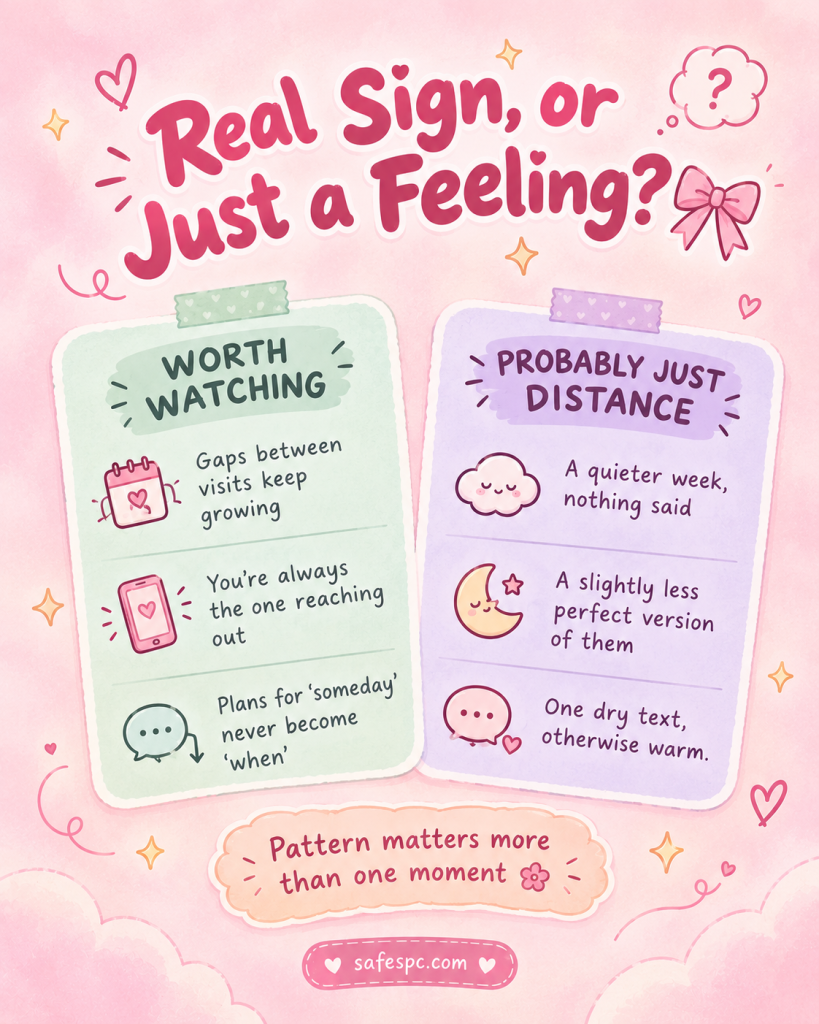
Signs about the future: No real plan to close the distance, ever, not even a loose one.
- Conversations about “someday” that never turn into conversations about “when.”
- A visit schedule that’s gotten longer between trips rather than shorter, without either of you naming that shift out loud.
These matter more than almost anything else on this list, because a long distance relationship without any eventual endpoint is structurally different from one working toward something, even if both currently feel emotionally fine.
Signs about effort: Relationship researchers describe specific behaviors, openness, reassurance, shared planning, that actively maintain a relationship rather than just letting it coast. In a long distance relationship, these can’t happen by accident the way they sometimes do when two people share a home.
When maintenance becomes consistently one-sided, one person initiating calls, remembering plans, carrying the emotional weight of staying connected, that imbalance tends to compound rather than resolve on its own.
Signs about honesty: A widening gap between what gets shared and what actually happened. Vagueness about plans, people, or time that didn’t used to be there. This is different from ordinary privacy. It’s a specific shift toward managing what the other person knows rather than simply living your life and reporting it.
Signs about emotional availability. Conversations that have quietly flattened into logistics, what did you do today, how’s work, with the deeper check-ins that used to happen fading out.
How to trust your partner in a long distance relationship covers the difference between tested trust and idealized trust in more depth, and a flattening of real conversation is often the first visible symptom of idealized trust starting to crack under its own weight.
Is it them, is it this relationship, or is it the distance itself?
This distinction rarely gets made clearly, and it matters.
- Sometimes the signs above point to a specific partner handling distance badly, inconsistency, dishonesty, disappearing effort.
- Sometimes they point to something true about this particular pairing rather than either person individually, a values mismatch about the future that distance has simply delayed confronting.
- And sometimes, honestly, neither partner is doing anything wrong, and the real answer is that long distance as a format isn’t something you personally can sustain, regardless of who’s on the other end of it.
That’s not a character flaw in either of you. It’s closer to a dealbreaker than a red flag, a mismatch in what you need rather than evidence someone failed you.
Getting this distinction right changes what you do next.
A problem with the person calls for a direct conversation about specific behavior. A problem with the relationship calls for an honest conversation about whether your futures actually point the same direction.
A problem with the format calls for something harder: admitting that no amount of effort from either of you fixes a structure that doesn’t work for how you’re built, which has nothing to do with how much you love them.
What the research actually suggests doing with this?
Given that infrequent visits and extreme idealization are the specific combination tied to later instability, the most useful move isn’t vague reassurance seeking. It’s concrete: look honestly at how long the gaps between visits have actually gotten, not how they feel, but the real calendar math, and look honestly at whether the picture in your head has started drifting from what you actually know about this person’s daily life, moods, and flaws.
If both of those have quietly drifted in the wrong direction, that’s worth naming directly rather than waiting for a feeling to resolve itself. If only one has, you likely have more room than the vague unease is telling you.
If what you’re seeing lines up clearly with genuine dishonesty rather than ordinary distance-related drift, signs your partner has abandonment issues and what is ghostlighting are worth checking against directly, since those patterns call for a different response than anything in this post.
There’s no checklist that replaces actually sitting with the honest version of this question. But between a feeling you can’t quite name and a decision you’re not ready to make, there’s real, specific information available, in the length of the gaps between you, in who’s been doing the reaching, in how closely the person in your head still matches the one on the other end of the call. That information was always more trustworthy than the unease alone. It was just easier to ignore.
1 thought on “Signs a Long Distance Relationship Isn’t Going to Work”