
Things not to do after a breakup rarely feel like mistakes while you’re doing them. Most of them feel like relief, a way to numb the ache, get closure, or regain some sense of control over a situation that suddenly feels completely out of your hands. That’s exactly what makes them worth naming clearly, because the damage usually isn’t obvious until weeks later, looking back.
Here’s the honest list, not the polished version, the one built from actually watching people, myself included, learn these the hard way.
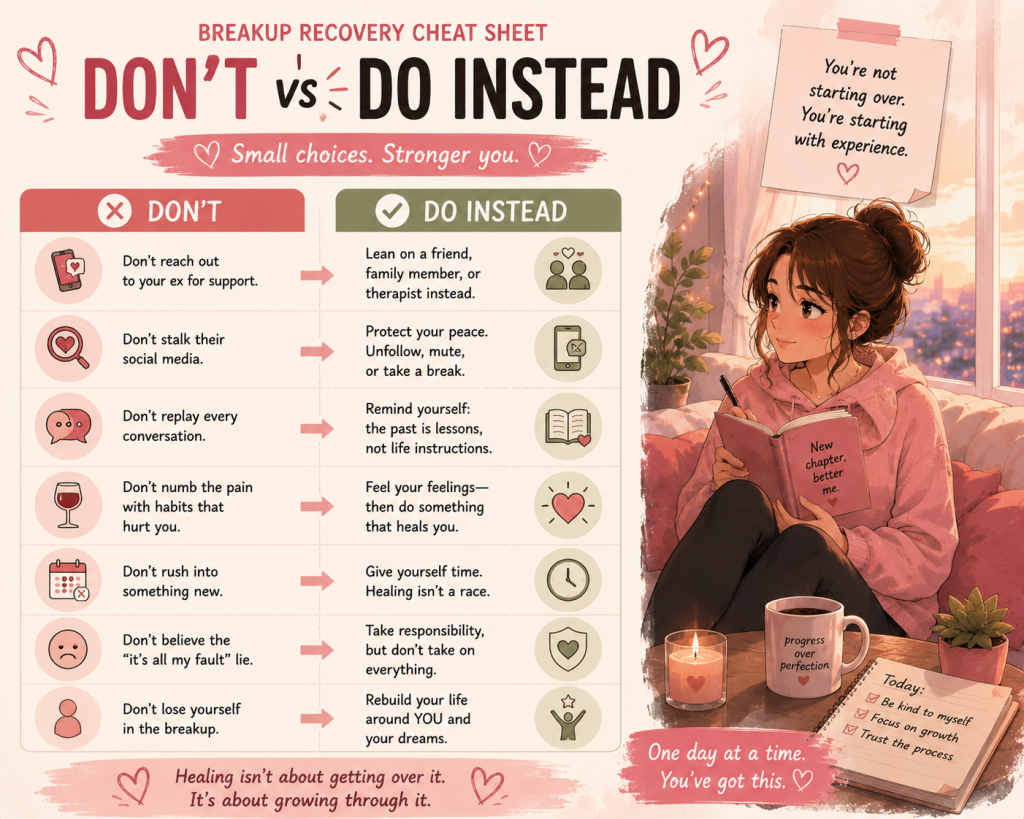
Don’t make major decisions in the first few weeks
Quitting your job, moving cities, getting a dramatic new look, deleting years of photos in one furious late night session, all of these can feel like powerful, decisive moves in the immediate aftermath. Most of the time, they’re pain wearing the costume of clarity.
Give yourself real distance before making anything permanent, since decisions made from raw emotion rarely age well once the initial intensity settles.
Don’t rely on your ex for emotional support
This one sounds obvious, but it happens constantly.
Reaching out during a hard moment because they’re the person who’s always understood you best keeps the emotional relationship alive long after the actual relationship has ended, and it consistently reopens wounds that were just starting to close.
If cutting contact entirely feels harder than it should, the power of silence after a breakup breaks down exactly why it works and how to actually hold it. If you need support, that’s what friends, family, or a therapist are for, not the person you’re trying to heal from.
Don’t jump into a rebound to avoid the discomfort
New attention can feel like proof you’re desirable, distraction from the pain, or evidence that you’ve moved on faster than expected.
But a relationship entered specifically to avoid sitting with grief tends to short circuit real healing, and it’s usually not fair to the new person either, who’s unknowingly standing in for unprocessed feelings that have nothing to do with them.
Don’t build a case against them in your head
Replaying every flaw, every wrong they ever did, cataloguing reasons they were terrible, can feel protective, like it’s helping you get over them faster. Often it just delays real processing by keeping your entire focus locked on them instead of gradually shifting back toward your own life.
It’s possible to acknowledge real problems in the relationship without needing to build an ongoing prosecution case in your mind.
If this pattern feels familiar, signs you’re not over your ex goes deeper into why this specific habit tends to show up.
Don’t stay in constant contact “as friends” right away
Immediately transitioning to a close friendship, especially while feelings are still raw, usually isn’t the mature move it’s often framed as. It’s more often a way to avoid the full weight of the loss by keeping a version of the relationship alive under a different label.
Real friendship, if it’s meant to happen, tends to work better once genuine space and healing have actually occurred first.
Don’t perform being fine for an audience
Posting deliberately happy content, loudly announcing how great you’re doing, or working overtime to make sure everyone knows you’re unaffected, often isn’t actually about being fine.
It’s frequently a way of managing how the breakup looks from the outside, sometimes even hoping your ex sees it. This tends to delay real processing in favor of maintaining an image, which usually costs more energy than it’s worth.
Don’t isolate yourself completely
The opposite extreme carries its own risk. Withdrawing entirely from friends, cancelling plans indefinitely, and processing everything alone in your head can quietly deepen a low mood rather than easing it.
Support doesn’t require constantly talking about the breakup, sometimes it’s just being around people who care about you while you work through it in your own time.
Don’t skip the parts that actually hurt
It’s tempting to stay busy enough that you never really have to sit with the loss directly.
But feelings that get avoided rather than processed don’t disappear, they usually resurface later, often at less convenient moments, sometimes in future relationships that have nothing to do with the original breakup.
This is one of the quieter things not to do after a breakup, since avoidance rarely looks like a mistake until much later. Letting yourself actually feel it, even when it’s uncomfortable, tends to be faster in the long run than any distraction technique.
What to do instead
Most of the things not to do after a breakup share the same root cause, trying to escape discomfort instead of moving through it. The healthier version usually looks slower, and considerably less dramatic. Give yourself real time before big decisions. Lean on people who aren’t your ex. Let yourself feel the hard parts without needing to perform anything for an audience, online or otherwise. None of this feels as immediately satisfying as the shortcuts, but it tends to actually work. Once you’ve got these avoided, signs you’re healing from a breakup are usually the next thing to start noticing.

I’m Patricia – a writer, a wife, and the kind of person who feels just about everything at full volume. I live in Manhattan, but I don’t write about the fairytale version of romance. I write about the real stuff: the miscommunications, the long-term commitment, and the tiny, everyday decisions it takes to keep a relationship thriving. I’m just a fellow wildheart trying to put honest words to how love actually feels from the inside.