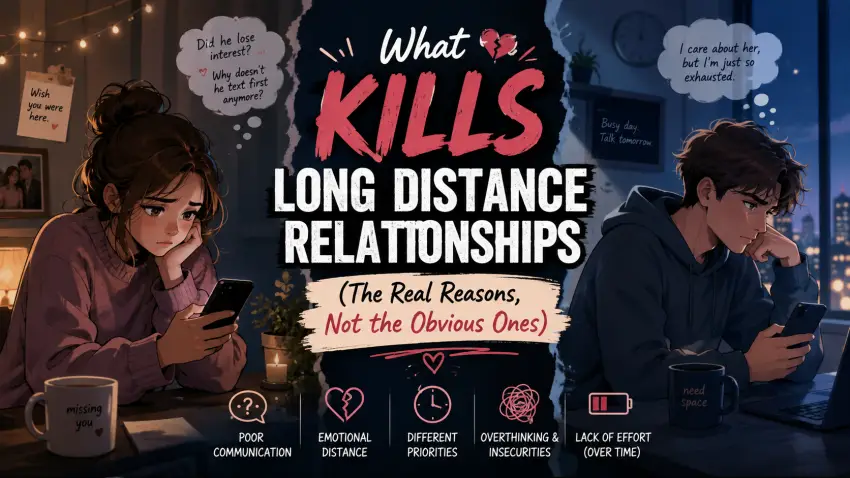
Ask most people what kills long distance relationships, and they’ll say “the distance.” It’s the easiest answer, and it’s rarely the true one.
Distance doesn’t end relationships on its own. It just removes the things that used to paper over problems that were already there, physical closeness, shared routines, the easy repair that happens when you’re in the same room. What’s left exposed underneath is usually what actually kills the relationship. Here’s what that tends to look like, based on the patterns that show up again and again.
Assuming effort will stay automatic
In the beginning, effort feels effortless. You want to talk constantly, you make time without thinking about it, the distance barely registers because the excitement carries you through it.
That excitement fades for everyone eventually, and that’s normal.
What kills relationships is assuming the early effort was ever supposed to be permanent without intention behind it.
Once the novelty wears off, effort has to become a choice, not a feeling. Couples who skip that transition often mistake the fading excitement for fading love, when really, it’s just the point where deliberate effort needs to take over from natural momentum.
Letting communication shrink without naming it
Conversations that once lasted hours slowly shrink into quick check ins. This happens gradually enough that neither person consciously decides to pull back, it just quietly becomes the new normal.
The danger isn’t the shrinking itself, life gets busy, that’s understandable.
The danger is when nobody names it out loud. Silence about a shift like this reads as disinterest even when it’s really just distraction.
elationships that survive this phase are usually the ones where someone says something like, I’ve noticed we’ve been more surface level lately, can we fix that, instead of quietly letting the gap widen.
Avoiding conflict because it feels too hard over distance
Conflict is already uncomfortable in person. Over distance, without body language or the option to just sit together until things soften, it can feel unbearable. So a lot of couples start avoiding it entirely, letting small irritations go unspoken to keep the peace.
This feels protective in the moment, but it’s one of the most reliable relationship killers over time.
Unspoken resentment doesn’t disappear, it accumulates quietly until it either explodes disproportionately or curdles into distance and indifference.
Couples who make it through long distance stretches tend to get better at conflict, not avoid it. They learn to have hard conversations by phone or video, even when it’s uncomfortable, instead of deferring every hard topic until a visit.
No shared plan for the future
This might be the single biggest predictor of failure. Long distance relationships without a real sense of an eventual endpoint, someone moving, a shared timeline, some direction toward closing the gap, tend to quietly lose momentum over time.
Without that shared plan, the relationship can start to feel like it’s circling instead of progressing.
Even if nothing specific goes wrong, the lack of forward motion wears people down. It’s not that couples need an exact date locked in from month one, but there needs to be a shared, ongoing sense of working toward something, or the distance starts to feel indefinite in a way that’s hard to sustain.
Letting insecurity go unaddressed
Distance removes visibility. You don’t see who your partner spends time with, you don’t witness the small context behind a delayed reply, and left unaddressed, that gap tends to get filled with anxious assumptions.
What kills relationships here isn’t jealousy itself, some insecurity is normal. It’s when it goes unspoken and starts showing up sideways, through passive aggressive comments, excessive checking, or quiet withdrawal instead of a direct conversation.
Couples who handle this well tend to name the insecurity honestly rather than let it fester into resentment or controlling behavior.
One person doing all the emotional labor
In a lot of failing LDRs, one partner is the one initiating calls, planning visits, bringing up concerns, and keeping the relationship’s emotional temperature steady, while the other coasts. This imbalance is exhausting long before it’s ever named out loud, and by the time it is named, resentment has usually already taken root.
Relationships need both people actively maintaining them, especially across distance, where nothing happens automatically the way it might in person.
If you notice you’re the only one initiating consistently, that’s worth raising directly and early, not quietly absorbing indefinitely.
Comparing the relationship to an idealized in-person version
This one is subtle. It’s easy to romanticize what things would be like if you weren’t apart, imagining a version of the relationship with none of its current friction, only the good parts. When reality doesn’t match that fantasy, disappointment creeps in, even though the fantasy was never realistic to begin with.
Every relationship, distance or not, involves friction, boredom, and ordinary days. Holding your actual relationship up against an idealized, distance-free version of it sets an impossible standard that quietly breeds dissatisfaction.
What actually protects against all of this
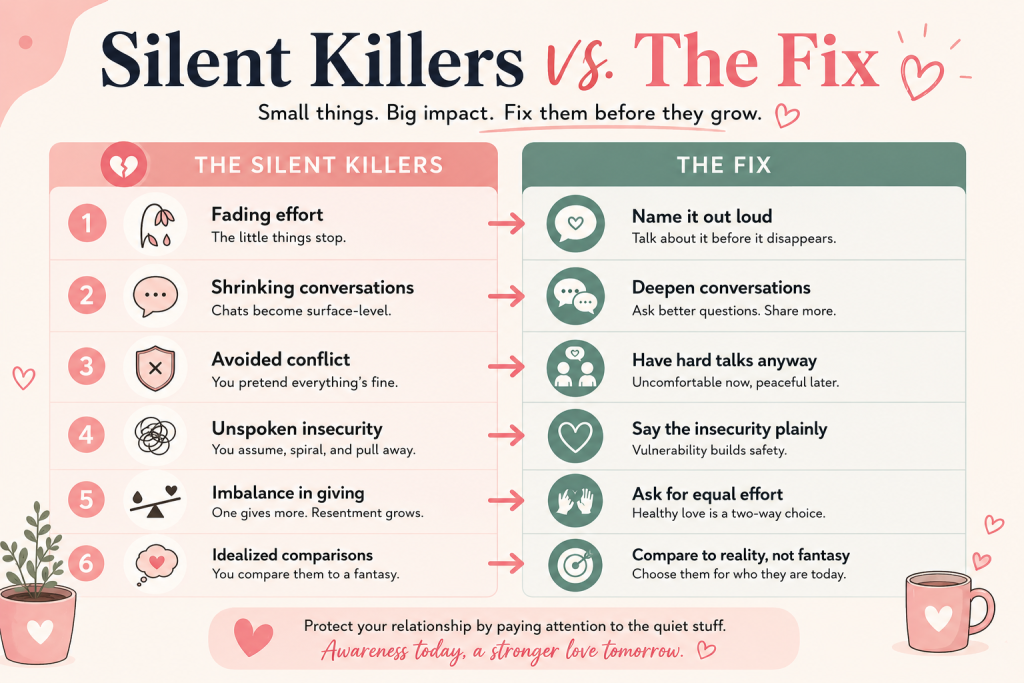
Most of what kills long distance relationship comes down to the same root cause, letting things go unspoken.
- Fading effort
- Shrinking conversations
- Avoided conflict
- Unaddressed insecurity
- Imbalance.
None of these are fatal on their own if they’re named honestly and addressed together. They only become fatal when they’re left to quietly accumulate in silence.
If you’re in a long distance relationship right now and recognizing a few of these patterns, that’s not a verdict on whether it’s going to work. It’s useful information, and the couples who last are usually the ones willing to look at these patterns honestly instead of assuming the distance itself is to blame.

I’m Patricia – a writer, a wife, and the kind of person who feels just about everything at full volume. I live in Manhattan, but I don’t write about the fairytale version of romance. I write about the real stuff: the miscommunications, the long-term commitment, and the tiny, everyday decisions it takes to keep a relationship thriving. I’m just a fellow wildheart trying to put honest words to how love actually feels from the inside.
1 thought on “What Kills Long Distance Relationships (The Real Reasons, Not the Obvious Ones)”