
How to know if you’re being ghosted usually starts with a nagging feeling before real proof. A reply that used to come in minutes now takes days. You’re not imagining it, and there are clear signs worth checking against, not just anxious guessing.
The clearest signs you’re being ghosted
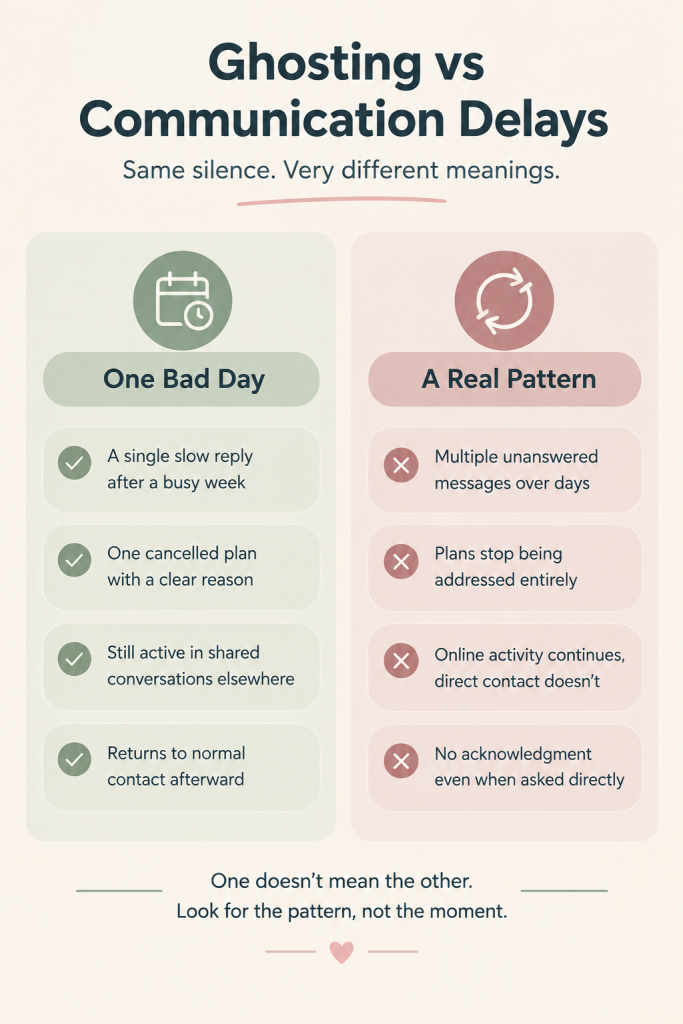
Messages go unanswered for days, with no prior pattern of this kind of delay. Their online activity continues normally elsewhere while direct contact to you stays completely silent. Plans that were previously confirmed simply stop being addressed.
There’s no explanation offered, even a bad one. A single unanswered text after a busy week isn’t ghosting. Repeated silence with no acknowledgment, stretching well past a normal delay, is the real signal worth trusting.
Another reliable sign is a sudden absence of future talk. Someone who was previously discussing upcoming plans, weekend ideas, or distant hypotheticals goes completely quiet on that front. No transition, no reason given, no attempt to reschedule anything.
Is it normal to be ghosted after 3 months of dating?
Unfortunately, yes. Three months is enough time to build real attachment. It’s not necessarily enough time for someone to develop the skills needed to end things directly. Longer timelines reduce the odds slightly, but they don’t eliminate them.
In fact, some research suggests emotional avoidance actually increases as investment grows. A direct conversation starts to feel higher stakes the more established the connection becomes.
The very thing that should make someone brave enough to talk it through can instead push them toward disappearing.
The different types of ghosting behaviors
- Full ghosting is complete, sudden silence with no gradual decline.
- Soft ghosting is a slow fade instead of a sudden stop.
- Intermittent ghosting cycles between silence and normal contact repeatedly.
- Cloaking, the most extreme version, adds blocking across every platform too.
Knowing which pattern you’re experiencing changes how confidently you can trust what’s happening. Each type carries a slightly different likely explanation underneath it. All of them share the same underlying avoidance at their core.
What is meant by ghosting someone, exactly?
At its core, ghosting means ending contact abruptly without acknowledgment or explanation. It’s the complete absence of a closing conversation, not just a busy week or a slow response here and there.
The defining feature isn’t the silence itself, it’s the total lack of any attempt to explain or end things directly.
Will a guy ghost you if he likes you?
Yes, this happens more often than people expect. Genuine interest reduces the likelihood somewhat, but it doesn’t guarantee someone will handle an ending well. Liking someone and communicating clearly are two entirely separate skills.
Some people ghost specifically because they liked someone more than expected. The intensity of that feeling triggered a fear response rather than genuine disinterest. This doesn’t make the silence any less painful. But the story you tell yourself about your own worth doesn’t have to be the explanation.
How to respond to ghosting?
1. Stop sending follow up messages after the third one. Additional messages rarely change the outcome and mostly extend your own waiting period. If three genuine attempts get no response, treat the silence as your answer.
2. Resist checking their activity repeatedly. Watching their online presence for clues keeps you emotionally tied to something. A situation already resolved by their behavior, whether or not they’ve said so directly.
3. Write your own closing statement. Try, “I won’t get an explanation, and I’m choosing to stop waiting for one.” This gives you the ending they didn’t provide.
4. Redirect your energy toward people who show up. Every bit of attention spent decoding silence is attention not spent on someone actually available to reciprocate it.
5. Give yourself an actual timeline to stop checking. A full week of no profile checking, cold turkey, breaks the habit faster than easing off gradually.
Why the uncertainty itself is the hardest part?
Most people assume the pain of ghosting comes from rejection itself. Often it’s actually the unresolved nature of it that hurts more.
Humans generally cope better with clear, even painful, information than with an open loop that never gets closed. This is part of why writing your own closing statement matters so much. It gives your mind something definite to hold onto instead of an endless question mark.
What ghosting tells you about a person?
Ghosting reflects someone’s comfort with avoidance over confrontation. It says very little about your actual worth. It says quite a lot about their own conflict tolerance. What does ghosting mean in psychology breaks this down further, including the specific stages people move through afterward.
When to actually reach out one more time
There’s a narrow exception worth naming honestly. If the relationship was genuinely significant and the silence is completely out of character, one calm message is reasonable. Something like, “I wanted to check in since this feels really out of character, hope you’re okay.” Beyond that single message, continued attempts tend to shift from reasonable concern into a pattern that keeps you stuck.
The bottom line
How to know if you’re being ghosted comes down to a clear pattern, not a single bad day. Silence with no explanation, repeated over time, with no acknowledgment at all. That’s how to know if you’re being ghosted for certain. Once you do, the healthiest move is accepting the silence as your answer.
2 thoughts on “How to Know If You’re Being Ghosted: The Honest Signs You Shouldn’t Ignore”