
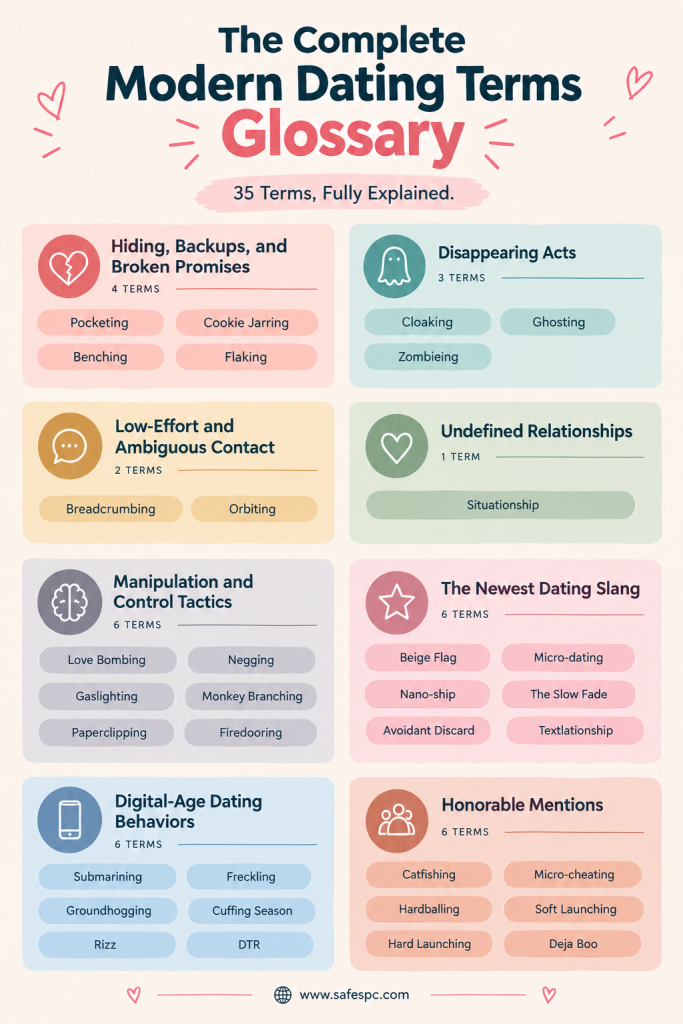
Modern dating terms and meanings change fast enough that most people feel a little behind. You hear a word in a group chat, nod along, and quietly wonder what it actually means. This glossary fixes that properly. Not a one-line definition and a shrug, but real psychology, honest signs, and what to actually do.
Most glossaries stop at a definition. This one goes further, because naming a pattern only helps if it actually changes how you respond to it. Entries are grouped by category below. New terms get added as they emerge, so bookmark this rather than searching for it again next month.
Category: Hiding, Backups, and Broken Promises
These modern dating terms describe someone keeping you at a controlled distance. Hiding you from their life, keeping you as an option, or never showing up the way they said they would.
1. Pocketing, also called stashing
What it means. Pocketing is when someone dates you consistently but keeps you completely hidden from their friends, family, and social media. You exist in the relationship, just invisible to everyone around them.
The psychology behind it. This usually comes from uncertainty, not malice. Someone may be unsure if the relationship will last. They may be embarrassed about circumstances they haven’t explained, or quietly keeping the door open to other options.
Signs you’re being pocketed. You’ve never appeared on their social media despite months of dating. You haven’t met friends or family, and plans to do so keep getting pushed back. They take calls privately or seem tense when your name comes up around others.
What to do about it. Ask directly, early, rather than waiting for it to resolve on its own. Try, “I’ve noticed I haven’t met your friends yet, is there a reason for that.” Give it a real timeline. Treat continued hiding past a few months as a genuine answer, not a misunderstanding.
2. Cookie jarring
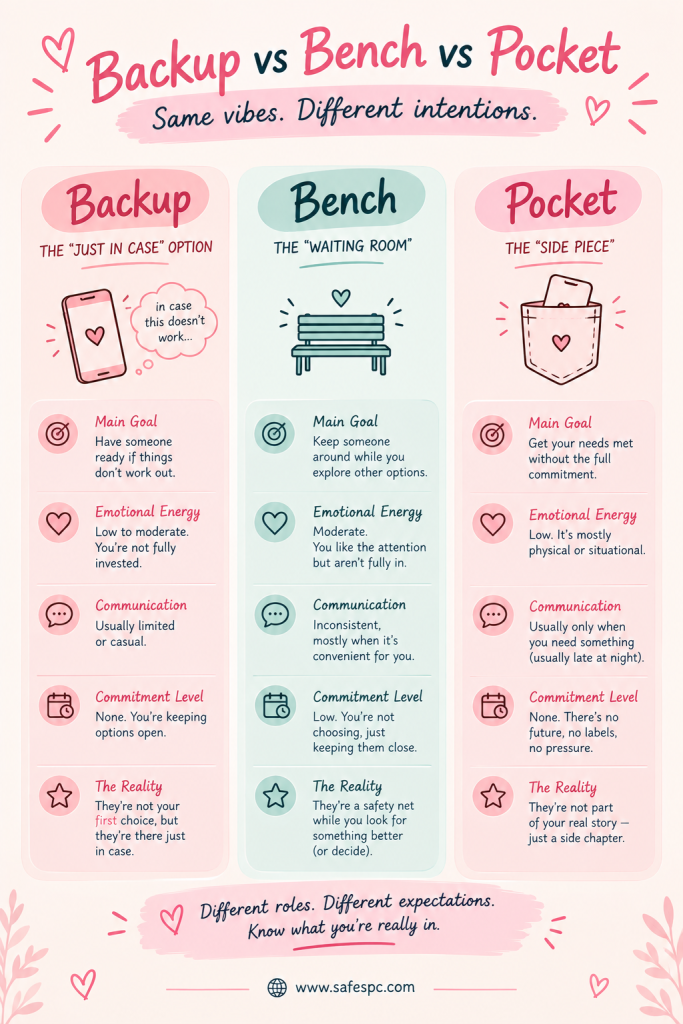
What it means. Cookie jarring is keeping someone as a backup option while actively pursuing someone else you actually want. You’re the jar they dip into when the real pursuit stalls out.
The psychology behind it. This behavior is often deliberate, rooted in a need for guaranteed validation. Keeping a backup taps into what psychologists call intermittent reinforcement, since there’s always a fallback if the primary pursuit fails.
Signs you’re being cookie jarred. Contact spikes right after their other pursuit seems to cool off. You’re treated warmly but never prioritized for real plans. They avoid defining the relationship despite consistent contact over time.
What to do about it. Watch the pattern of when attention increases, not just that it does. If warmth reliably follows their other relationships falling through, that timing tells you everything. Stop being available on short notice, and ask directly for consistency.
3. Benching
What it means. Benching is keeping someone on standby while actively dating multiple other people. It’s similar to cookie jarring, but usually involves several options rather than one specific alternative.
The psychology behind it. Benching often comes from a fear of commitment paired with genuine indecision. Someone isn’t sure who they want, so they keep several people warm rather than making a real choice.
Signs you’re being benched. Plans stay vague and rarely get confirmed in advance. Communication is warm but inconsistent, with no clear pattern. You sense, without proof, that you’re not the only person receiving this treatment.
What to do about it. Ask for a defined status directly rather than competing quietly for attention. Try, “I’d like to know if we’re exclusive, or if you’re still exploring other options.” This forces clarity instead of leaving you guessing indefinitely.
4. Flaking
What it means. Flaking is repeatedly cancelling plans at the last minute. It usually comes with vague or inconsistent excuses. It becomes a clear pattern this way, not just bad luck.
The psychology behind it. Chronic flaking often reflects low prioritization rather than genuine circumstance. Life gets in the way for everyone occasionally, but repeated flaking usually means something else consistently ranks higher.
Signs someone is a flaker. Plans get cancelled more often than they happen. Excuses feel generic or slightly inconsistent between instances. Rescheduling attempts get met with vague enthusiasm but no real follow through.
What to do about it. Name the pattern directly after the second or third instance, not the fifth. Try, “This is the third time plans have fallen through, is this going to keep happening.” Their answer, and their behavior afterward, tells you what you need to know.
Category: Disappearing Acts
These modern dating terms describe the specific ways people vanish from contact. Everything from a slow fade to complete, permanent digital erasure.
5. Cloaking
What it means. Cloaking is an extreme version of ghosting. Someone doesn’t just stop responding. They block you across every platform at once, sometimes canceling plans right before you were set to meet. Among modern dating terms and meanings covering disappearance, this is the most extreme.
The psychology behind it. Cloaking often comes from conflict avoidance taken to its furthest extreme. Sometimes it reflects a genuine change of heart paired with real discomfort about facing that honestly. Blocking removes any chance of confrontation entirely.
Signs you’ve been cloaked. You’re blocked across multiple platforms simultaneously, not just unresponsive on one. This often happens right before or after a planned meeting. There’s no gradual fade, the disappearance is sudden and total.
What to do about it. Resist the urge to find another way to reach them, a new account, a mutual friend, anything. Cloaking is one of the clearest signals someone can send. Respect it as final, and redirect your energy toward people who show up.
Category: Dishonesty and Misrepresentation
These modern dating terms and meanings cover the ways people misrepresent themselves, their intentions, or their circumstances. This usually happens early, before enough trust exists to know better.
6. Kittenfishing
What it means. Kittenfishing is presenting a slightly exaggerated or outdated version of yourself on a dating profile. Old photos, inflated job titles, or a personality that doesn’t quite match reality in person.
The psychology behind it. This usually comes from insecurity rather than intent to deceive. Dating apps create pressure to appear as appealing as possible. Small exaggerations can feel low stakes in the moment, even though they undermine trust later.
Signs you’ve been kittenfished. Photos look noticeably outdated or heavily filtered compared to how someone looks in person. Their described job, height, or lifestyle shifts once you actually meet. Their in-person personality feels flatter than their online presence suggested.
What to do about it. Address it directly but without immediate judgment, since minor exaggeration is extremely common. Try, “You mentioned X online, but it seems different in person.” This opens an honest conversation rather than silently writing someone off.
7. Ghosting
What it means. Ghosting is suddenly cutting off all contact with someone. No explanation, no goodbye, just silence that never gets addressed.
The psychology behind it. Ghosting is mostly about avoiding discomfort, not delivering a verdict on someone’s worth. Research on the psychology of ghosting shows avoidant attachment and conflict-avoidant styles drive most of it. The person disappearing is usually escaping their own discomfort, not making a statement about you.
Signs you’re being ghosted. Messages go unread or unanswered for days with no prior pattern of this. Plans that were previously confirmed suddenly stop being addressed. Their online activity continues normally while direct contact stays silent.
What to do about it. Stop checking for a response that isn’t coming. Write your own ending rather than waiting for theirs. Try, “this says more about their comfort with hard conversations than it says about me.” A fuller guide is coming soon, covering the specific stages people move through after being ghosted.
8. Zombieing
What it means. Zombieing is when someone who ghosted you resurfaces later, casually, as if the disappearance never happened. A “hey stranger” text months after total silence is the classic example.
The psychology behind it. This usually isn’t random. It often reflects a lull in someone’s other options, or simple boredom. Genuine remorse for how they left things is rarely the real driver.
Signs you’re being zombied. Contact resumes with no acknowledgment of the previous silence. The tone is casual, as if picking up a conversation left mid-sentence. There’s no accountability offered for the original disappearance.
What to do about it. Notice the missing accountability before responding at all. A genuine reconnection usually includes some acknowledgment of what happened. Its absence tells you the pattern is likely to repeat. A complete guide to handling this moment is coming soon.

Category: Low-Effort and Ambiguous Contact
9. Breadcrumbing
What it means. Breadcrumbing is giving someone just enough attention to stay interesting. There’s no real intention behind it of building something consistent or defined.
The psychology behind it. This one runs on intermittent reinforcement, the same mechanism that makes a slot machine compelling. Unpredictable rewards create a stronger pull than steady, reliable attention ever does.
Signs someone is breadcrumbing you covers the full psychology in depth. How to beat a breadcrumber at their own game covers exactly how to respond.
10. Orbiting
What it means. Orbiting is when someone who’s gone quiet in direct contact keeps watching from a distance. Liking posts, viewing stories, present just enough to stay on your radar.
The psychology behind it. Orbiting usually comes from a desire to avoid full closure. It offers a small hit of validation from staying visible, without any of the effort real reconnection would require.
What is orbiting in dating breaks this term down completely, including exactly what to do when it happens to you.
Category: Undefined Relationships
Situationships sit among the most searched modern dating terms and meanings, and for good reason.
11. Situationship
What it means. A situationship is an ongoing romantic or physical connection that never gets defined. No agreed exclusivity, no real conversation about what it actually is.
The psychology behind it. Situationships often form from mismatched readiness rather than bad intentions. Naming a relationship makes it real, and real things can end badly, so staying undefined can feel like protection.
Situationship vs relationship covers every sign, the complete psychology, and a self-check quiz to see where you stand.
Category: Manipulation and Control Tactics
These modern dating terms and meanings describe behaviors with real intent behind them. Not all confusion in dating is accidental. This category covers the patterns worth taking seriously.
12. Love bombing
What it means. Love bombing is an overwhelming, accelerated burst of affection, gifts, and attention early in a relationship. It’s designed to create fast intimacy and dependency.
The psychology behind it. Research on the narcissistic love bombing cycle shows this pattern often precedes devaluation later on. The intensity creates a bond that persists even once the affection fades, which is exactly the point.
Signs you’re being love bombed. Compliments and gestures escalate unusually fast for how long you’ve known each other. Future plans get discussed within days or weeks of meeting. Any hesitation on your part gets met with even more intense affection, not patience.
What to do about it. Slow the pace deliberately, even if it feels like rejecting something wonderful. Real connection tends to build steadily. Intensity this early is information, not proof of a special bond.
13. Negging
What it means. Negging is a backhanded compliment or subtle insult, often disguised as playful teasing. It’s designed to lower someone’s confidence just enough to seek approval.
The psychology behind it. Negging works by creating a small dent in self esteem. It then positions the negger as the source of validation that can repair it, a manufactured insecurity, not an accident.
Signs you’re being negged. Comments feel backhanded rather than genuinely playful. You notice yourself trying harder to win approval right after a subtly critical remark. The pattern repeats specifically around moments you seemed confident or secure.
What to do about it. Name it plainly rather than laughing it off. Try, “that came across as a dig, was it meant that way.” Someone with good intentions will clarify or apologize. Repetition after being called out is your real answer.
14. Gaslighting
What it means. Gaslighting is making someone doubt their own memory, perception, or judgment. This often happens through denial of things that clearly happened.
The psychology behind it. This tactic shifts the burden of proof onto the person being gaslit. They end up responding to accusations of overreacting rather than the original issue. This erodes trust in their own reality over time.
Signs you’re being gaslit. You frequently apologize for reactions that felt reasonable in the moment. Clear conversations get denied or reframed entirely afterward. You’ve started keeping records or screenshots just to trust your own memory.
What to do about it. Trust documented facts over disputed memory when the two conflict repeatedly. Keep your own record of events if the pattern continues. Among modern dating terms and meanings, this one is worth taking seriously enough to involve outside support. Gaslighting specifically targets your ability to trust your own judgment.
15. Monkey branching
What it means. Monkey branching is lining up a new romantic interest before fully ending the current relationship. It’s swinging from one connection to the next without ever being single.
The psychology behind it. This often reflects a fear of being without a partner more than genuine feelings for the new person. The overlap provides a safety net during an uncertain transition.
Signs of monkey branching. A partner develops a suspiciously close new connection right as the relationship weakens. The transition into the next relationship happens with little to no time alone in between. Explanations for the overlap feel inconsistent or minimized.
What to do about it. If you’re on the receiving end of a breakup like this, know something important. The overlap says more about their own discomfort with being alone than anything about you. If you recognize this pattern in yourself, examine it honestly before starting something new.
16. Paperclipping
What it means. Paperclipping is when an ex or past situationship reaches out sporadically, months apart. It’s just enough contact to stay attached without ever re-engaging fully.
The psychology behind it. Unlike zombieing, which is a single reappearance, paperclipping is repeated and ongoing. It usually reflects someone wanting to preserve an option indefinitely, without real intention of following through.
Signs of paperclipping. Contact arrives every few months, always brief, never leading anywhere concrete. There’s no consistent effort between these check-ins. The pattern has repeated more than once, unlike a genuine, one-time reconnection attempt.
What to do about it. Recognize the pattern after the second occurrence, not the fifth. A repeated cycle with no real follow through is unlikely to change. Responding less each time, or not at all, tends to be the clearest way out.
17. Firedooring
What it means. Firedooring is when someone controls all access to themselves. They can reach out whenever they want, but you’re expected to wait and never initiate contact yourself.
The psychology behind it. This reflects a need for control over the relationship’s terms, often without the person even naming it as intentional. Being the only one allowed to open the door keeps all the power on one side.
Signs of firedooring. Your attempts to reach out get ignored or met with delay, while their outreach gets an expected quick response. Plans only happen on their initiative, never yours. You’ve noticed yourself holding back to avoid seeming too eager.
What to do about it. Test the dynamic directly by initiating consistently for a short period and noting the response. A healthy dynamic tolerates this easily. One built on firedooring will resist it, often subtly, and that tells you the imbalance is real.
Category: The Newest Dating Slang (2026)
These are the modern dating terms and meanings still fresh enough that half your group chat hasn’t caught up yet. This section gets revised regularly as new slang enters common use.

18. Beige flag
What it means. A beige flag is a trait that’s neither a red flag nor a green flag, just mildly quirky, slightly odd, or a little boring, the kind of thing that makes you go “hmm” without any real concern attached.
The psychology behind it. This term emerged partly as a backlash against overusing red and green flags for every small personality quirk. Not everything needs a verdict attached, and beige flags give people language for the genuinely neutral.
Signs of a beige flag. The trait doesn’t affect trust, compatibility, or how they treat you. It’s specific and a little unusual, an oddly intense opinion about sandwich order, for example. You find it more amusing than concerning.
What to do about it. Nothing, really. Beige flags aren’t dealbreakers or warning signs. Naming them is mostly a way to bond over the small, harmless weirdness every person carries.
19. Micro-dating
What it means. Micro-dating is choosing short, low-pressure dates, a coffee, a walk, a quick drink, instead of long, high-stakes evenings that demand hours of commitment upfront.
The psychology behind it. This reflects busier schedules and lower tolerance for investing heavily before knowing if there’s real compatibility. Shorter dates lower the stakes on both sides.
Signs you’re micro-dating. Dates consistently run under an hour by design, not by accident. Plans feel casual and easy to say yes to. Neither person treats a short date as a lesser effort.
What to do about it. Use it intentionally rather than as a way to avoid real investment forever. Micro-dating works well early on, but connection eventually needs longer, less structured time to actually deepen.
20. Nano-ship
What it means. A nano-ship is an ultra short but intense connection, often formed while traveling or at an event, that both people know from the start won’t extend beyond that moment.
The psychology behind it. Removing the pressure of a future allows people to be unusually open and present. Knowing it will end can paradoxically make the connection feel more honest, not less.
Signs of a nano-ship. The connection is intense but has a built in, understood expiration point. Neither person is trying to convert it into something ongoing. It’s remembered fondly rather than mourned as a loss.
What to do about it. Let it be exactly what it is. Trying to force a nano-ship into a long distance relationship afterward usually strips away what made it feel special in the first place.
21. The slow fade
What it means. The slow fade is a gradual reduction in contact and warmth over time, shorter replies, longer gaps, vaguer plans, rather than a clean, direct ending.
The psychology behind it. According to Psychology Today, this pattern often causes more confusion than outright ghosting, since uncertainty intensifies distress more than a clear ending does. It’s conflict avoidance stretched out over weeks instead of delivered all at once.
Signs of a slow fade. The reduction is directional and consistent, not a single busy week. Excuses feel vague and slightly inconsistent between conversations. There’s no acknowledgment of the change, even when directly asked about it.
What to do about it. Ask directly once the pattern is clear, rather than waiting for it to either stop or fully disappear. Their answer, or continued vagueness, is itself the answer.
22. Avoidant discard
What it means. An avoidant discard is a specific version of the slow fade, where someone withdraws emotionally and physically without directly ending things, often right when the relationship is going unusually well.
The psychology behind it. This tends to reflect a fear of real intimacy rather than genuine disinterest. Progress and closeness can feel threatening to someone with strong avoidant patterns, triggering withdrawal at the exact moment things deepen.
Signs of an avoidant discard. The withdrawal follows a noticeably positive stretch, not a rough patch. There’s no clear conflict or issue that explains the sudden distance. The person seems overwhelmed rather than upset.
What to do about it. Recognize this as being about their capacity for closeness, not your worth or effort. Anxious attachment vs avoidant attachment covers this exact pattern in full depth, including how to respond to it well.
23. Textlationship
What it means. A textlationship is a connection that exists almost entirely over text, with real depth and regularity in messaging but little to no progression toward an actual in-person relationship.
The psychology behind it. Texting offers intimacy without the vulnerability of physical presence or real accountability. It can feel like a real relationship while carrying almost none of the risk one requires.
Signs of a textlationship. Conversations feel genuinely deep and consistent, but plans to meet keep stalling or getting postponed. Communication rarely, if ever, moves to a call. Months can pass without real progression toward anything in person.
What to do about it. Push directly for an in-person plan with an actual date attached, not a vague someday. If it consistently doesn’t happen despite deep conversation, that gap is worth taking seriously as information.
24. Submarining
What it means. Submarining is when someone who vanished completely resurfaces out of nowhere. Blocked or fully unreachable before, acting as if no silence ever happened.
The psychology behind it. Unlike a simple reappearance, submarining involves a deliberate full disappearance first. It often lines up with someone else, a breakup, or a stretch of loneliness, making the timing rarely a coincidence.
Signs of submarining. The prior disappearance was total, not partial, blocked accounts, not just silence. The resurfacing message treats the gap as normal. There’s no explanation offered for where they’ve been.
What to do about it. Ask directly why they disappeared before re-engaging at all. A reasonable explanation is different from none. Silence on that specific question is itself a clear answer.
25. Freckling
What it means. Freckling is sporadic contact that shows up in a pattern, weekends, holidays, or late at night. Small specks of attention rather than any real consistency.
The psychology behind it. This usually reflects convenience-driven interest. Contact appears exactly when someone is bored, lonely, or has free time, not when genuine connection is being prioritized.
Signs of freckling. Messages cluster around specific times or occasions with real predictability. Between those windows, contact drops to nothing. The pattern has repeated enough times to notice it clearly.
What to do about it. Notice the timing pattern specifically, since it reveals the real motive. Respond at your own pace rather than theirs. Watch whether effort changes once convenience is removed.
26. Groundhogging
What it means. Groundhogging is repeatedly dating the same type of person and hitting the same outcome every time. It’s the same relationship on a loop with a different face attached.
The psychology behind it. This usually points to an unexamined pattern rather than bad luck. Familiar dynamics feel comfortable even when they’re not working, which pulls people back toward the same type again.
Signs of groundhogging. Past partners share strikingly similar traits or dynamics. The same specific conflict shows up in relationship after relationship. Endings tend to follow a near identical script each time.
What to do about it. Look for the actual common thread across past relationships, not just surface traits. Consider whether a familiar wound is being replayed, rather than a genuinely compatible match being sought.
27. Cuffing season
What it means. Cuffing season is the tendency to seek a relationship during colder months. Interest often fades once warmer weather and social season return.
The psychology behind it. Seasonal changes affect social patterns and a desire for companionship during less social months. The motivation is partly genuine connection and partly seasonal convenience.
Signs of a cuffing season connection. The relationship intensifies quickly in late fall. Enthusiasm often cools noticeably once spring arrives. The person becomes markedly less available once social life picks up again.
What to do about it. Watch how the relationship holds up once the season shifts. That transition tends to reveal how genuine the connection actually was.
28. Rizz
What it means. Rizz is charisma specifically applied to romantic or flirtatious situations. Someone’s ability to attract or charm through style, wit, and delivery.
The psychology behind it. The term’s rise, even earning Oxford’s Word of the Year in 2023, reflects a real cultural shift. Confident, easy communication style is now valued as a nameable skill, separate from looks or status.
Signs of good rizz. Conversation flows easily and confidently, without visible anxiety. Compliments and flirtation land naturally rather than awkwardly. Other people notice and comment on it specifically.
What to do about it. This one doesn’t need fixing, only awareness. Confidence and easy conversation are skills that build with practice, not fixed traits people either have or don’t.
29. DTR (define the relationship)
What it means. DTR is shorthand for the conversation where two people explicitly clarify what their relationship is. Exclusivity, titles, and expectations included.
The psychology behind it. Avoiding this conversation often stems from fear of an unwanted answer. Having it requires both people to risk vulnerability in exchange for real clarity.
Signs a DTR conversation is overdue. Real feelings exist but nothing has been named aloud. Assumptions about exclusivity differ between the two of you. Anxiety builds every time the topic almost comes up.
What to do about it. Situationship vs relationship covers exactly how to raise this conversation well. It includes scripts for opening it without pressure or apology.
Category: Honorable Mentions
These modern dating terms and meanings round out the list. Each one is real, searched, and worth knowing, even if it didn’t fit neatly into an earlier category.
30. Catfishing
What it means. Catfishing is creating a completely fake online identity to build a relationship under false pretenses. Often with stolen photos and a fabricated life.
The psychology behind it. The term traces back to a 2010 documentary about exactly this kind of deception. Catfishing usually stems from deep insecurity or loneliness. Sometimes it’s a desire to experience connection the person feels unable to access as themselves.
Signs of catfishing. They avoid video calls or phone calls entirely, always with an excuse. Photos look inconsistent or professionally styled across different posts. Their story shifts slightly each time you ask for detail.
What to do about it. Request a live video call early, before real emotional investment builds. Reverse image search their photos if anything feels off. A refusal to ever appear live is answer enough on its own.
31. Micro-cheating
What it means. Micro-cheating covers small boundary crossings that fall short of physical infidelity. An emotionally charged friendship, flirtatious messaging, or a secret kept specifically from a partner.
The psychology behind it. These small crossings often function as a safer outlet for missing validation. They feel lower risk than full infidelity, even when the emotional impact is real.
Signs of micro-cheating. Certain conversations get deliberately hidden or deleted. Emotional energy is being invested outside the relationship that isn’t reciprocated inside it. A specific person is treated with more secrecy than the situation seems to warrant.
What to do about it. Raise specific behavior, not vague suspicion. Try, “I noticed you deleted that conversation, can we talk about why.” Definitions of what counts vary by couple, so define it together directly.
32. Hardballing
What it means. Hardballing is stating your relationship goals bluntly and early. Exclusivity, timeline, and intentions, rather than easing into them gradually over time.
The psychology behind it. This approach trades some early romantic mystery for efficiency and honesty. It filters out mismatched intentions fast, before real emotional investment has a chance to build.
Signs of hardballing. Expectations get stated directly within the first few dates. There’s little ambiguity about what the person wants going forward. The approach can feel refreshingly clear or slightly intense, depending on the other person’s pace.
What to do about it. Match honesty with honesty, even if your own timeline differs. A clear, kind response respects directness without forcing a rushed answer from you.
33. Soft launching
What it means. Soft launching is hinting at a new relationship on social media without confirming it outright. A hand-holding photo with no face shown, for example.
The psychology behind it. This protects a new relationship from outside opinions and pressure while still allowing some public acknowledgment. It’s a controlled, low-risk way to share good news early.
Signs of a soft launch. Posts hint at someone without naming or showing them directly. Details stay deliberately vague when people ask questions. The ambiguity itself seems intentional, not accidental.
What to do about it. Nothing required, this one’s simply a modern courtship ritual. If you’re soft launching, just be honest with your partner about why you’re choosing this pace.
34. Hard launching
What it means. Hard launching is the opposite of soft launching. Publicly and clearly confirming a relationship, full photos, tags, and captions included.
The psychology behind it. This signals genuine confidence and security in the relationship’s status. It often follows a period of soft launching once both people feel ready for public visibility.
Signs of a hard launch. The relationship is confirmed clearly, with no ambiguity left. Both partners are tagged and visibly comfortable being public. It usually follows an earlier, more cautious soft launch period.
What to do about it. Make sure both partners actually want this visibility before posting. A hard launch initiated by only one person can create real pressure for the other.
35. Deja boo
What it means. Deja boo is the sinking realization that you’ve essentially dated this exact person before. Different name, same dynamic entirely.
The psychology behind it. This is groundhogging’s sharper, more immediate cousin. It’s the moment of recognition itself, rather than the longer pattern playing out slowly.
Signs of deja boo. The realization tends to hit suddenly, often mid-conversation. A specific behavior or phrase triggers the recognition clearly. It usually comes with frustration and dark humor about the repetition.
What to do about it. Treat the moment as useful data, not just a joke to laugh off. Groundhogging, covered earlier in this glossary, explains the deeper pattern worth examining once the realization passes.
The glossary keeps growing
That completes the first full release of this glossary. 35 modern dating terms and meanings, each with the depth most other lists skip entirely. New terms enter common use constantly.
This page will keep expanding to include them. It’s built to stay worth returning to, not something you only need once.
If a term you’ve heard isn’t listed yet, that’s useful to know. Future updates will prioritize genuinely common gaps over obscure ones nobody actually searches for.