Zombieing meaning is exactly what it sounds like when you break the word down. Someone who vanished without explanation rises back up, casually, as if the silence never happened. A “hey stranger” text months after total disappearance is the classic version. If it’s happened to you, you already know how disorienting it feels.
You’d finally made peace with the silence. Maybe you’d stopped checking their profile. Maybe you’d genuinely moved on.
Then a notification appears, warm and casual, from the exact person who taught you what unresolved grief feels like. That whiplash captures the zombieing meaning in one single moment.
What is the zombieing meaning, exactly?
Zombieing meaning describes a specific sequence. First, someone ghosts you, cutting off contact completely with no explanation. Then, after weeks or months of total silence, they reappear, acting as though the gap never existed. No apology, no acknowledgment, often not even a reference to the time that passed.
This differs meaningfully from a simple late reply or a slow fade. Zombieing requires a genuine, complete disappearance first.
The reappearance is what makes the zombieing meaning distinct, and unsettling. It forces you to process the original loss all over again, now complicated by their sudden, unexplained return.
The psychology behind why exes zombie
Researchers studying digital relationship endings, including a 2022 study in Cyberpsychology, Journal of Psychosocial Research on Cyberspace, Have started documenting the zombieing meaning and its patterns more formally. Reappearance after ghosting rarely reflects a single, simple motive. Several distinct psychological drivers tend to overlap.
- Boredom and low stakes validation: Reaching out to someone who already showed interest once is an easy, low risk way to feel wanted again. It requires almost no vulnerability, since the previous connection already proved you’d likely respond warmly.
- Unresolved attachment, not necessarily romantic interest: Some people zombie because a specific memory, a photo, a song, a shared location, triggers nostalgia. The contact isn’t always calculated. It can be a genuinely impulsive reaction to feeling, rather than a real plan to reconnect.
- A need for control or reassurance: For some, reaching out confirms they still have an effect on you. Seeing you respond offers a small confirmation that they haven’t been forgotten. This can matter more to their ego than to any real desire for connection.
- Genuine, if disorganized, regret: Occasionally, the person genuinely feels bad about how things ended and wants to reconnect. This version is rarer than people hope. It’s usually distinguishable by what accompanies it, real acknowledgment of the silence, not just a casual greeting.
- Selective amnesia as an avoidance strategy: Many zombies genuinely act as though the ghosting never happened. Not because they’ve forgotten, but because acknowledging it would require the accountability they avoided the first time around. The casual tone is often a defense mechanism, not real indifference.
A real example of the zombieing meaning in practice
Picture this pattern, since it repeats often enough to be recognizable. Someone disappears after a few weeks of consistent, warm contact. Three months pass with total silence. Then a message arrives, something like “hey, thinking about you, how’s life.” Zero mention of the gap, as if picking up a conversation left seconds ago.
The person receiving it often feels a confusing mix of relief and anger simultaneously. Relief because the silence is broken and some part of the original hurt feels acknowledged, even without real accountability attached. Anger because the casualness itself can feel dismissive of everything the silence actually cost.
Signs you’re being zombied, not genuinely reconnected with
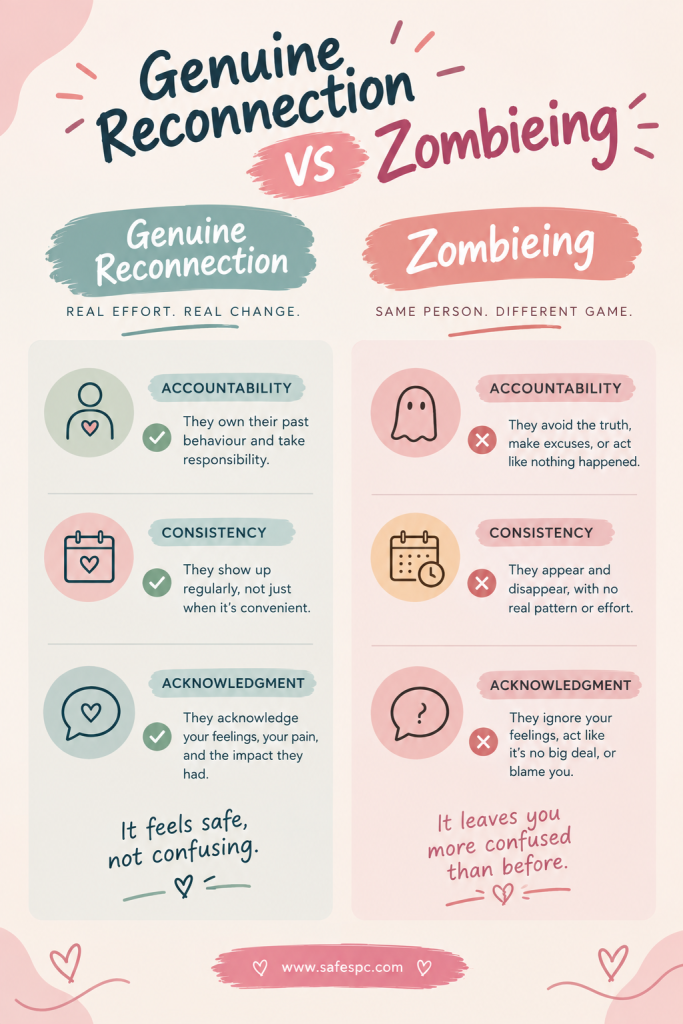
Contact resumes with no acknowledgment of the previous silence whatsoever. The tone stays casual, light, almost performatively normal. There’s no explanation offered for the disappearance, even when you ask directly. Follow up after the initial message tends to be inconsistent again, echoing the original pattern rather than breaking from it.
Zombieing vs ghosting vs orbiting, what’s actually different
These terms get confused constantly, but each describes a distinct phase of the same broader pattern. Ghosting is the initial disappearance itself, sudden and total. Orbiting is staying passively visible through likes and story views without ever fully vanishing. The zombieing meaning describes the specific act of resurfacing after having fully disappeared first.
Understanding which pattern you’re actually experiencing changes how much weight to give it.
Someone who never fully vanished is behaving differently than someone who went completely silent and then reappeared months later. The psychology, and the right response, differs meaningfully between the two.
Zombieing vs submarining, the difference worth knowing
These two get mixed up often, and it’s easy to see why. Both involve total disappearance followed by resurfacing. The distinction is mostly about frequency and pattern rather than the core mechanics of each behavior.
Zombieing typically describes a single reappearance after ghosting. It’s usually a one-off resurfacing that either leads somewhere or fizzles back into silence.
Submarining tends to repeat. Someone vanishes and resurfaces multiple times in an ongoing cycle, often following the same shallow, low accountability script each time. If it’s happened more than once with the same person, you’re likely dealing with submarining, not a single zombieing incident.
A brief note on haunting
You may also come across the term haunting used almost interchangeably with orbiting. It describes an ex who ghosted you but continues watching your content passively without any direct contact.
Some sources treat haunting and orbiting as the same behavior under two different names. Others use haunting specifically for a ghost who leaves small, low-effort traces, a like, a view, without ever fully resurfacing. The overlap between these terms is genuinely blurry. This glossary’s broader entry on modern dating terms and meanings keeps that terminology updated as usage shifts.
How to respond once you understand the zombieing meaning
1. Notice the missing accountability before responding at all. A genuine reconnection attempt usually includes some acknowledgment of the silence. Its absence is itself important information, not something to overlook in your relief at hearing from them.
2. Give yourself permission to not respond immediately, or at all. There’s no rule requiring an instant reply just because contact resumed. Taking a day, a week, or indefinitely to decide how you feel is completely reasonable.
3. If you do respond, ask directly about the gap. Something like, “It’s been months of silence, what happened.” This puts the accountability question on the table immediately, rather than letting the casual tone set the terms.
4. Watch their actual response to that question closely. A thoughtful, honest answer differs meaningfully from deflection, jokes, or a quick subject change. Their reaction to being asked directly tells you more than the original message did.
5. Decide based on the pattern, not the nostalgia. The rush of hearing from someone you once cared about can cloud judgment quickly. Give yourself at least a day of distance before deciding whether to re-engage.
Common mistakes people make when an ex zombies them
Responding purely out of curiosity, then getting pulled back in. A casual “just curious” reply can quickly reopen a dynamic you’d already started healing from. This is especially true if no real conversation about the original silence ever happens.
Assuming the reappearance means they’ve changed. Genuine change usually shows up as different behavior over time, not a single warm message. Reappearing casually, on its own, proves very little about whether the original pattern has shifted.
Letting relief substitute for real evaluation. The relief of broken silence can feel like closure, even when nothing has actually been resolved. It’s worth separating the emotional relief from an honest evaluation of what’s actually being offered this time.
When the zombieing meaning might actually be genuine reconnection?
Not every zombieing situation stays shallow. Occasionally, someone returns having done real reflection. Their message includes an actual explanation, a clear acknowledgment of the silence, and patience if you need time before responding. This version is meaningfully different from a casual, accountability-free reappearance.
The distinguishing factor isn’t whether they come back. It’s whether their return includes any real ownership of what happened the first time. A message that says, even briefly, “I know I disappeared and that wasn’t fair to you,” carries real weight. A cheerful greeting with no context carries almost none.
Frequently asked questions
What is zombieing in a relationship?
It refers to an ex who ghosted you, then resurfaces casually later, without ever acknowledging the silence.
What does zombieing mean?
The zombieing meaning centers on one thing, a return after a complete disappearance. Someone disappears completely without explanation, then later resurfaces casually as though the silence never happened.
Zombieing vs ghosting, what’s the actual difference?
Ghosting is the disappearance itself. Zombieing is what happens next, the reappearance after that silence, often with no acknowledgment of the gap at all.
Is zombieing the same as breadcrumbing?
No. Breadcrumbing involves ongoing, low effort contact that never fully stops. The zombieing meaning specifically requires a full disappearance first, followed by a later return.
Should I ever respond to someone who zombied me?
There’s no universal answer here. If you respond, ask directly about the gap. Watch how honestly they address it, rather than accepting the casual tone at face value.
Why do exes zombie instead of just staying gone?
Motives vary from genuine nostalgia to ego validation to disorganized regret. The common thread is usually low accountability, reconnecting without addressing the original silence directly.
The bottom line
Understanding the zombieing meaning puts you in a strange position. You’re forced to process an old loss and a confusing new signal at the same time. You’re allowed to feel both curious and cautious about it.
Trust the pattern you actually observe over the story you want to believe. Someone who genuinely wants to make things right will tolerate your questions and your hesitation. They won’t pull away or grow defensive at the first sign of caution on your part.
Someone repeating the original avoidance in a new outfit usually reveals that quickly. It tends to show up within the first real conversation, if you’re paying attention rather than hoping. Give the pattern room to show itself before deciding anything either way. Let that evidence, not the wave of nostalgia, guide what happens next.
How to know if you’re being ghosted covers a closely related pattern worth understanding too. This glossary’s broader entry on modern dating terms and meanings rounds out the full picture. It connects the zombieing meaning to the other patterns it tends to travel alongside.