
The 3-3-3 rule of dating showed up on your feed for a reason. It’s spread fast across TikTok and dating advice columns. Unlike most viral relationship trends, this one actually holds up under scrutiny. It gives you three specific checkpoints to pause. At each one, you ask an honest question. Is this real, or am I just caught up in the feeling of it.
What is the 3-3-3 rule of dating, exactly?
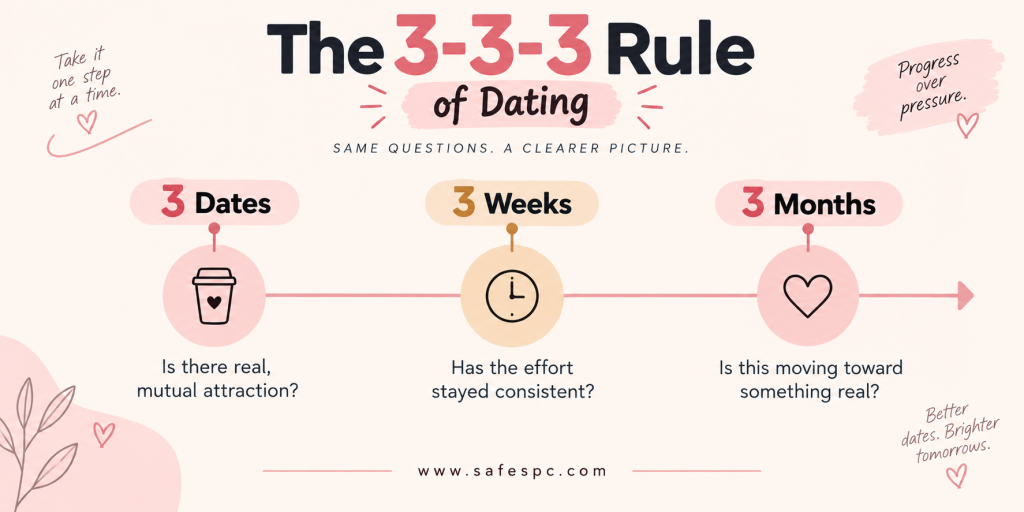
The 3-3-3 rule of dating breaks the early stages of a connection into three checkpoints. After three dates, after three weeks, and after three months. At each point, you stop and evaluate specific things. Not just ride the momentum of however things feel that week.
Dating and relationship expert Sarah Louise Ryan describes it simply.
- Three dates to decide if you’re attracted to someone.
- Three weeks to decide if real chemistry is developing.
- Three months to decide if the connection has legs to build something lasting.
Nobody claims a single formal inventor for this framework. It spread the way most useful relationship advice does now. Person to person, refined through real experience, then shared widely once it clicked for enough people.
The psychology behind why the 3-3-3 rule of dating actually works
Early romantic attraction shares real neurological features with addiction. Research from biological anthropologist Helen Fisher shows something important here. Early-stage romantic activation activates reward pathways similar to those involved in substance cravings. This is exactly why people so often mistake intensity for meaning.
This matters because intensity feels like proof. A racing heart, constant texting, an inability to stop thinking about someone. All of it feels like evidence of something real. But classic psychology research on misattributed arousal tells a different story. Excitement and adrenaline can get mistaken for genuine romantic connection. This happens especially early on, before enough real information exists to know the difference.
The 3-3-3 rule of dating works by inserting structured pauses into exactly this window. Instead of letting the emotional high run unchecked for months, you’re prompted to check in. You do this before attachment outpaces actual compatibility.
Checkpoint one, after three dates
By the third date, you’ve had enough exposure to notice real patterns. Not just a single good impression from one great evening. This checkpoint isn’t about deciding if you’re in love. It’s about noticing basic compatibility signals that are easy to overlook when you’re excited.
- Ask yourself honestly whether there’s real, mutual attraction. Not just politeness or convenience carrying the interaction along.
- Notice whether conversation flows naturally or feels like effortful small talk repeated three times over.
- Pay attention to basic reliability too. Do they show up on time? Do they follow through on plans and communicate clearly beforehand?
Checkpoint two, after three weeks
Three weeks in, the initial performance phase starts to fade. This is where the 3-3-3 rule of dating earns its usefulness. It’s exactly when people typically stop paying close attention, having already decided they like someone.
- Notice whether effort has stayed consistent, or started to taper off now that the initial chase has settled.
- Pay attention to how they handle a minor disagreement or scheduling conflict. This reveals real character more than a good first date ever could.
- Check whether curiosity about you feels genuine and specific, or generic and repetitive.
This is also roughly when situationship dynamics start forming, if they’re going to form at all.
Situationship vs relationship covers the exact signs worth watching for. This applies especially if things feel warm but undefined at this stage.
Checkpoint three, after three months
Three months is where the 3-3-3 rule of dating asks its most serious question. Is this moving toward something real. Or has it quietly stalled while still feeling exciting enough to ignore that stall.
By now, you should have real information, not just impressions.
- Has the relationship been named directly, or is it still technically undefined despite months of regular contact?
- Has meeting friends or family happened naturally, or is it being consistently avoided?
- Are future plans discussed as a real possibility, or does the conversation shut down every time it comes up?
Talking stage vs situationship vs relationship breaks down where you should realistically be by this three month mark. It also covers what it means if you’re not there yet.
How the 3-3-3 rule of dating helps you avoid situationships?
This might be the single most useful application of the framework. Situationships often survive specifically because nobody pauses to ask the hard question directly. Excitement, convenience, and hope keep things going long past the point where a clear answer should have emerged.
The 3-3-3 rule of dating forces that pause structurally, rather than relying on willpower alone in the moment. If you reach the three month checkpoint with no answer about direction, that’s not a technicality. That’s the actual answer, even if it’s not the one you were hoping for.
Common mistakes people make with the 3-3-3 rule of dating
Treating it as a strict deadline instead of a checkpoint: The goal isn’t ending things automatically if a box isn’t checked exactly on schedule. It’s pausing to ask an honest question. Then deciding deliberately rather than drifting forward automatically.
Using it to justify rushing: Some people flip the framework entirely. They treat three months as a deadline for commitment rather than a checkpoint for honest evaluation. The rule is about clarity, not speed. Pressuring someone toward a label by an arbitrary date defeats its actual purpose.
Applying it without adjusting for context: Long distance relationships, very busy seasons, or unusual circumstances might naturally extend these timelines. The 3-3-3 rule of dating works best as a flexible lens. It isn’t a rigid formula applied identically to every situation.
Is the 3-3-3 rule of dating right for everyone?
Not entirely, and it’s worth saying so honestly. Critics rightly point out that dating has produced no shortage of viral numeric formulas. Skepticism toward yet another one is reasonable. The value here isn’t magic in the numbers themselves. Three isn’t inherently special as a number.
The real value is the habit the framework builds. Pausing intentionally instead of drifting on autopilot. If you already do this naturally, formalizing it into a named rule may add little for you personally. If you tend to get swept up quickly and rarely pause to evaluate, the structure genuinely helps.
This tends to matter most for people who describe a repeating pattern in their own dating history. Feeling certain early, investing heavily, then realizing months later that the certainty was never actually backed by real evidence. The 3-3-3 rule of dating exists specifically to interrupt that exact cycle before it repeats again.
How the 3-3-3 rule of dating pairs with the 777 rule?
Once you’re past the evaluation stage and into an established relationship, a different framework becomes more useful.
The 777 rule for long distance relationships picks up roughly where the 3-3-3 rule leaves off. It shifts from deciding if a relationship is real toward actively maintaining one that already is.
Together, they cover two different phases well. The 3-3-3 rule of dating handles the uncertain early stretch. The 777 rule handles ongoing maintenance once uncertainty has resolved into something real.
Frequently Asked Questions
What is the 3-3-3 rule in dating?
The 3-3-3 rule of dating uses three checkpoints, after three dates, three weeks, and three months. Each one evaluates whether a new connection is developing into something real.
Does the 3-3-3 rule mean you should end things if something feels off at a checkpoint?
Not necessarily. Each checkpoint is meant for honest evaluation, and where needed, direct conversation. It’s not an automatic exit if one small thing feels uncertain.
Is the 3-3-3 rule scientifically proven?
It isn’t a formally studied clinical framework on its own. It’s a popularized structure grounded in real, well established psychology about early romantic intensity and misattributed arousal.
Can the 3-3-3 rule help avoid situationships?
Yes, this is one of its most practical uses. Prompting an honest check-in at the three month mark specifically interrupts the drift that allows undefined situationships to continue indefinitely.
How is the 3-3-3 rule of dating different from just trusting your gut?
Gut feelings can be swayed heavily by early chemistry and hope. The 3-3-3 rule of dating adds structure on top of instinct. It prompts a deliberate check at specific points, rather than relying on feeling alone to signal when something’s genuinely wrong.
The bottom line
The 3-3-3 rule of dating isn’t a magic formula, and the exact numbers aren’t sacred. What it actually offers is permission to pause during the exact window when clear thinking is hardest to access. Three checkpoints, three honest questions, and a habit of choosing intentionally instead of drifting forward on chemistry alone.
2 thoughts on “3-3-3 Rule Of Dating: The Viral Trick That Actually Works”