You have been texting every day for three weeks. They remember how you take your coffee, they send you songs at midnight, and then a friend asks, “So, are you two together?” and you hear yourself answer, “Kind of. It’s complicated.“
That “kind of” is what this guide is about. Here is the talking stage vs situationship question in one breath.
- A talking stage is a short, open ended try out where you both know nothing is decided yet.
- A situationship is what happens when that try out stops moving, you keep acting like a couple, and nobody names it.
- A relationship is the one where you have said out loud that it is exclusive and you can both say where it is going.
Most guides stop at definitions. We will go further, with a table you can read in thirty seconds, a seven question test that shows where you stand, honest timelines, and scripts for the three things you can do next. If you are already deep in one of these and hurting, our guides on how to end a situationship and how to turn a situationship into a relationship pick up where this one ends.
Talking stage vs situationship vs relationship: the quick answer
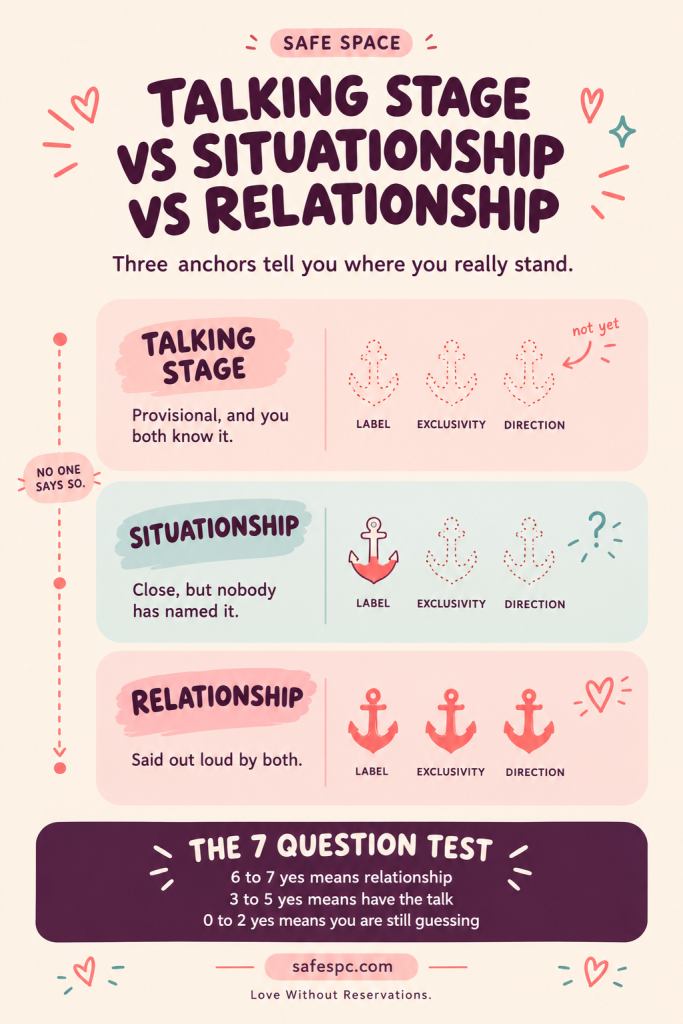
The easiest way to settle the talking stage vs situationship vs relationship question is to stop asking how long it has lasted or whether you are physical, and ask whether three things have been settled. We call them the three anchors.
- Label. Have you both said what this is?
- Exclusivity. Have you both agreed who else is, or is not, in the picture?
- Direction. Can you both say where this is heading, even roughly?
A talking stage has none of the anchors set yet, but both people expect to set them soon. A situationship has some of the feelings of a couple while the anchors stay loose, and nobody is working to fix them. A relationship has all three. Here is how that looks side by side.
| Anchor | Talking stage | Situationship | Relationship |
|---|---|---|---|
| Label | Not yet, and you both know it | Avoided, joked about or “we don’t do labels” | Said out loud by both |
| Exclusivity | Unclear, but open to discussion | Unclear, and raising it feels risky | Agreed |
| Direction | Being worked out | Drifting, or one person is guessing | Both can describe it |
| Contact | Frequent, often by text | Regular, often with physical intimacy | Regular, with room for each other’s lives |
| Meeting each other’s people | Rare | Rare, or kept separate | Normal |
| Typical length (our rule of thumb) | Days to about six weeks | No set end, which is the problem | Open ended |
| How it feels | Excited and curious | Warm one day, confusing the next | Settled, with room to disagree |
Notice what is missing from the table. Physical intimacy is not an anchor, because you can be physical in a talking stage and in a relationship, and you can be in a situationship without it. Time is not an anchor either, though it matters for a different reason, which we cover in the section on timelines.
The difference between a talking stage and a situationship, in one line
A talking stage is provisional, and you both know it. A situationship is the same closeness after the provisional part has quietly ended and nobody has said so. That single idea is the heart of the talking stage vs situationship question, and everything below builds on it.
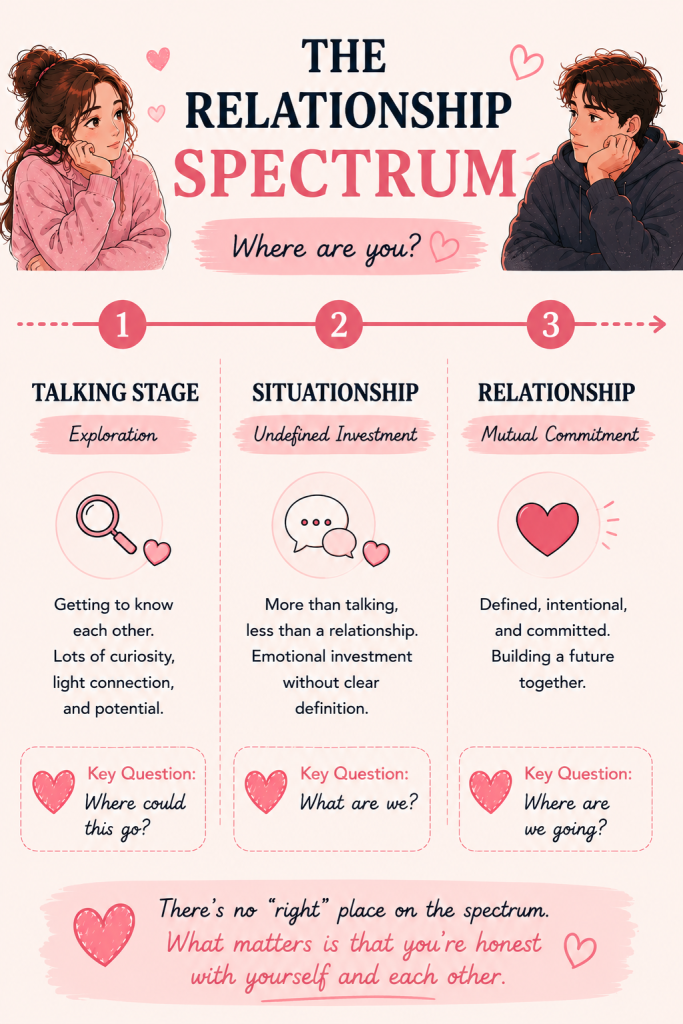
The talking stage: what it is, and when it quietly expires
Simply Psychology describes the talking stage as a stretch of regular contact with someone you like before anything is defined. There is frequent messaging, maybe a few meetups, no agreed status and no obligations. Its defining feature is that you have no shared set of rules, so each of you may be reading it differently.
That is fine at the start. A healthy talking stage is brief, curious and moving. You meet in person early, before an idealized version of the person has time to form. One of you asks something like “are you seeing other people?” and it does not feel like an emergency. You judge the overall pattern, not a single message.
How long should the talking stage last?
There is no fixed length. The useful marker, according to the same source, is whether the phase is moving: days to a couple of weeks, then a meeting. A phase that runs for months at the same rhythm has usually settled into something else. Our own rule of thumb is simple. If you have had about six weeks of regular contact and there is still no plan to meet or to talk about what this is, the talking stage is over, whether either of you admits it or not.
Some warning signs belong in the same list:
- Constant contact, but no one ever proposes to meet.
- Reply times that feel managed, as if each of you is performing availability.
- Asking “what is this?” feels riskier with every week that passes.
If you are decoding every reply, you will probably like our piece on why you overthink every text message. And if someone keeps appearing in your notifications but never in your life, check whether it is orbiting before you call it a slow start.
To make the talking stage useful, an article republished from The Conversation suggests five habits: communicate your needs honestly, explore shared values, discuss what kind of relationship you each want, accept that the connection may fade, and set boundaries early. Add a sixth from us. Ask one real question by the second week, something better than “how was your day.” Our 100 couple conversation cards are full of them.
The situationship: when figuring it out stops
A situationship is a romantic connection with regular time together, often physical intimacy, and no clear label, commitment or agreed future. Writer Kayla Kibbe popularized the word in a 2017 Cosmopolitan article, and researchers at Baylor University later described it as high in passion and intimacy but low in commitment, according to PsyPost’s summary of the research.
That description borrows from Sternberg’s triangular theory of love, which names three ingredients: intimacy, passion and commitment. A situationship has the first two without the third. It lines up neatly with our three anchors, since commitment is simply the label, the exclusivity and the direction all agreed at once.
When does a talking stage become a situationship?
It happens when it stops being provisional and neither person says so. Simply Psychology frames it the same way: the talking stage is understood by both people as temporary, while a situationship is an arrangement that has stopped progressing. In practice you can feel the switch. The question “what are we?” used to be exciting to ask. Now it feels dangerous.
Signs you may be in one, drawn from the research PsyPost summarizes:
- You are in a gray area and nobody can say what you are.
- You act like you are dating, but you never agreed to stop seeing other people.
- You are rarely visible together, with no social media, no friends and no family.
- One of you wants more, and the other prefers things casual.
That last point is the real problem. Casual is not wrong. Plenty of people want it and say so, and when both of you have chosen it openly, it is closer to a defined arrangement than a situationship. The ache comes from mismatch and ambiguity. Our guide to situationship rules for protecting your feelings is written for exactly that mix.
Why it hurts so much is worth a short pause. In the research PsyPost describes, endings tend to be informal, such as ghosting or a slow fade, and grief can feel invalid because the relationship was never official. A qualitative study from Curtin University, as summarized there, found the heartbreak to be very painful and damaging to self-esteem.
The same summary suggests unpredictable affection makes leaving harder, and that people stay out of hope, because of what they have already invested, or from fear of being single. We unpack that in why situationships hurt more than breakups, and if you are on the other side of one, how to get over a situationship without closure is the next stop.
What a relationship has that the other two do not?
A relationship is not a feeling level. It is an agreement. All three anchors are set, and both of you can say them without flinching: this is what we are, this is who we are with, and this is roughly where we are going.
It shows up in small ways. You can say “my partner” and they will not wince. You make plans more than a few weeks out. When one of you raises a problem, it gets discussed rather than dropped. Most of all, you do not have to guess where you stand.
You may hear people say they have a “mutual understanding.” It is a phrase for a connection both people feel but have not labeled. We treat it as a situationship until exclusivity and direction are said aloud, because an understanding that only exists in each person’s head is exactly where two different stories grow.
If you want to see where all of this sits on the wider road, our guides to the 7 stages of dating and the 3-3-3 rule of dating lay out the usual order of things.
Where do you stand? A seven question test
This test settles the talking stage vs situationship question for most people, and it covers the relationship end too. Answer yes or no to each question, and be honest about the way things really are, not the way you hope they will be.
- Have we both said, in words, what this is?
- Have we agreed to be exclusive?
- If someone asked, could I call this person my partner and expect them to agree?
- Have we met at least some of each other’s friends or family?
- Do we make plans more than a month ahead?
- When one of us raises a problem, does it get discussed instead of dropped?
- Can I describe where we stand without guessing?
Count your yes answers.
| Yes answers | Where you probably stand | Your next step |
|---|---|---|
| 6 or 7 | A relationship | Keep talking, and keep checking in |
| 3 to 5 | A situationship with real potential, or a relationship nobody has named | Have the label conversation |
| 0 to 2, and under about six weeks | A talking stage | Meet in person and ask about exclusivity |
| 0 to 2, and longer than about six weeks | A situationship | Decide whether to name it or leave |
The test is a guide, not a verdict. If your answers feel wrong for your situation, trust that feeling and look at which questions you hesitated over. The hesitation is the information.
Here is a second check that takes one minute and costs nothing. Each of you finishes the sentence “We are ____” on your own, then compares. If you cannot finish it, or your answers differ, you are not in the same stage, and that gap is the thing to talk about.
Situationship vs friends with benefits, and the opposite of a situationship
People often lump friends with benefits into the talking stage vs situationship debate, and the lines do blur. The difference we use is agreement. Friends with benefits is usually an arrangement both people have named as casual. A situationship is ambiguous because it has never been named, so one person is often hoping for more.
If you want the full comparison, read our guide to friends with benefits vs situationship vs relationship. For signs that point to a situationship rather than a relationship, see situationship vs relationship.
What is the opposite of a situationship?
The opposite of a situationship is a defined, committed relationship: one that is official, exclusive and agreed by both people. Other words people use are an official relationship, a committed partnership or an exclusive relationship. If you mean a casual arrangement with clear terms, that is not the opposite, but a different thing, since the clarity is what changes it.
How long is too long? Timelines for each stage
Time does not settle the talking stage vs situationship question by itself, but it is a clock on the anchors. The longer you go without setting them, the harder it becomes to ask. Here are the windows we would use. They are rules of thumb built on the sources above, not scientific cut offs.
| Stage | Healthy window | Warning sign | What to do |
|---|---|---|---|
| Talking stage | Days to about six weeks | No meeting and no talk about what this is | Ask to meet, then ask about exclusivity |
| Situationship, both want it casual | As long as you both agree | One of you starts hoping for more | Say so, and check whether the other agrees |
| Situationship, one wants more | About a month after you realize it | Waiting for them to bring it up | Have the conversation, with a date you will decide by |
| Situationship, three months or more | Not a healthy default | Regular contact with no talk about status | Name it or leave |
How long should a situationship last?
There is no right answer. It lasts as long as both people want the same thing. Once one of you wants more, a clock is running, even if nobody has said so. The PsyPost summary also notes that the Curtin research found situationships rarely turn into committed relationships unless both people change how they communicate and commit, so waiting and hoping is not a plan.
What to do once you know: three paths, with scripts
Knowing where you stand in the talking stage vs situationship divide is only useful if you do something with it. There are three honest choices.
Path one: move it forward
Say what you want in one clear sentence, and ask a real question. Do it in person or on a call, at a calm moment, not mid-argument and not by text at midnight. You could say: “I really like where this is going, and I’d like us to be exclusive. How do you feel about that?” Then stop talking and let them answer. Our guide on how to turn a situationship into a relationship has more wording for different starting points.
Path two: stay, with your eyes open
Some people genuinely want to keep things casual for now, and that is allowed. Be honest about it instead of pretending. You could say: “I’m happy to keep this casual for the moment, but I want to be honest that I’m not seeing anyone else. Are you?” Agree on how you will check in, and set a date to revisit it. Our situationship rules help you protect your feelings while you do.
Path three: leave
If the answer is “I don’t want what you want,” or if you simply realize this is not enough, you are allowed to go. You could say: “I’ve realized I want something with more clarity than this, so I’m going to step back.” Keep it short and kind. If you are not sure yet whether to end it, read how to know when to end a situationship, and when you are ready, our scripts and texts for ending one give you the words.
Mistakes that keep people stuck
Almost every mistake we see in the talking stage vs situationship gray zone comes back to one habit, which is waiting.
Waiting for them to bring it up. Often nobody does, and mismatched investment already creates a power imbalance, as the research summary above points out. If you want an answer, you will probably have to ask.
Mistaking intensity for direction. Long late night calls and a lot of physical closeness feel like momentum, but they do not set any anchors. Ask where it is going, not how it feels.
Treating “I don’t like labels” as the end of the conversation. It is a start. Ask what they do want, whether they are seeing other people, and what they imagine in three months. Their answers tell you more than the word label ever could.
Confusing breadcrumbing with a slow start. Small, irregular signs of interest that never lead anywhere are a pattern of their own. Our guide on signs someone is breadcrumbing you shows the difference.
Decoding instead of asking. Hours spent reading tone into a text are hours not spent asking the question. Ask the question.
Staying for the potential, not the person. Potential is what you can see in someone. The person is what they do today. Judge them on the second.
Which guide to read next
We have written several guides around the talking stage vs situationship question, and each has a different job. Use this table to go straight to the one you need.
| If you want to | Read |
|---|---|
| Compare a situationship with a defined relationship in detail | Situationship vs relationship |
| See how friends with benefits differs | Friends with benefits vs situationship vs relationship |
| Move into a real relationship | How to turn a situationship into a relationship |
| Protect your feelings while you decide | Situationship rules |
| Work out whether to end it | How to know when to end a situationship |
| End it kindly | How to end a situationship: scripts and texts |
| Heal afterward | How to get over a situationship without closure |
| Understand why it hurts so much | Why situationships hurt more than breakups |
| Decode newer dating terms | Modern dating terms and meanings |
Frequently asked questions
Is a talking stage the same as a situationship?
No. A talking stage is a short, provisional phase that both people understand. A situationship is what it becomes when it stops moving and nobody names the change. The talking stage vs situationship line is crossed when “let’s see what happens” turns into “this is just how it is.”
Can I see other people during the talking stage?
Usually yes, because nothing has been agreed. That is why it helps to ask early whether the other person is seeing anyone, and to say what you are doing. Honesty in the talking stage saves a lot of heartache later.
Is it normal to be physical in the talking stage?
It is common, and there is no rule about it. What matters is whether you both want the same thing and have said so. Physical intimacy can deepen the pull, which makes the three anchors even more important to talk about.
Can a situationship become a relationship?
It can, but it usually takes a change. The research summarized by PsyPost suggests it happens rarely unless both people change how they communicate and commit. That means one honest conversation, followed by action from both of you.
What if they say they don’t want labels?
Ask what they do want. Some people truly dislike the word but are fully committed, and they will show it by being exclusive and clear about the future. Others use the line to avoid the question. Their actions, not the label, tell you which it is.
How do I ask “what are we” without scaring them?
Make it a statement about you first, and then a question. “I’m really enjoying this, and I’d like to know where you see it going” is a very different message from “what are we?” Choose a calm moment, keep it short and listen to the answer.
Is a situationship always bad?
No. It is a problem when it is ambiguous and one person is hurting, not when both of you know what it is and chose it. If you are both honest and both content, it is a different arrangement with a different name.
Say the three things out loud
The line in the talking stage vs situationship vs relationship puzzle is not mysterious. It is whether you have said three things out loud: what this is, who is in it and where it is going. Until then, you are guessing, and guessing is where most of the hurt lives.
So, take the talking stage vs situationship test, then ask the question. The answer will not always be the one you hope for, but it will be an answer, and that is far kinder to you than another month of “kind of.”