Fearful avoidant vs dismissive avoidant attachment is one of the most confusing comparisons in attachment theory. Both styles pull away from closeness. Both can leave a partner feeling shut out. Underneath that shared avoidance, something genuinely different is happening. Knowing which one you’re actually dealing with changes everything about how to respond.
What is fearful avoidant attachment?
Understanding fearful avoidant vs dismissive avoidant attachment starts with defining each half clearly. Fearful avoidant attachment, also called disorganized attachment, is the most complex of the four adult attachment styles. It combines high anxiety with high avoidance at the same time. Someone with this style genuinely wants closeness and is genuinely afraid of it, often within the same conversation.
This creates a distinct push-pull pattern. They reach toward connection, then retreat the moment it starts feeling real.
Psychologists Mary Main and Judith Solomon first identified this style in 1990. They described it as the least consistent of the attachment patterns. The person’s own behavior can feel confusing even to themselves.
What is dismissive avoidant attachment?
Dismissive avoidant attachment is the other half of fearful avoidant vs dismissive avoidant attachment. It looks similar from the outside but runs on a different internal engine entirely. Someone with this style genuinely values independence. They minimize their own need for closeness, often without much internal conflict about it at all.
Unlike fearful avoidants, dismissive avoidants aren’t typically anxious underneath their distance.
They’ve largely deactivated the desire for closeness rather than suppressing an active craving for it. This makes their avoidance feel calmer and more consistent, if also harder to break through emotionally.
The core difference, in one sentence
Fearful avoidant vs dismissive avoidant attachment comes down to this.
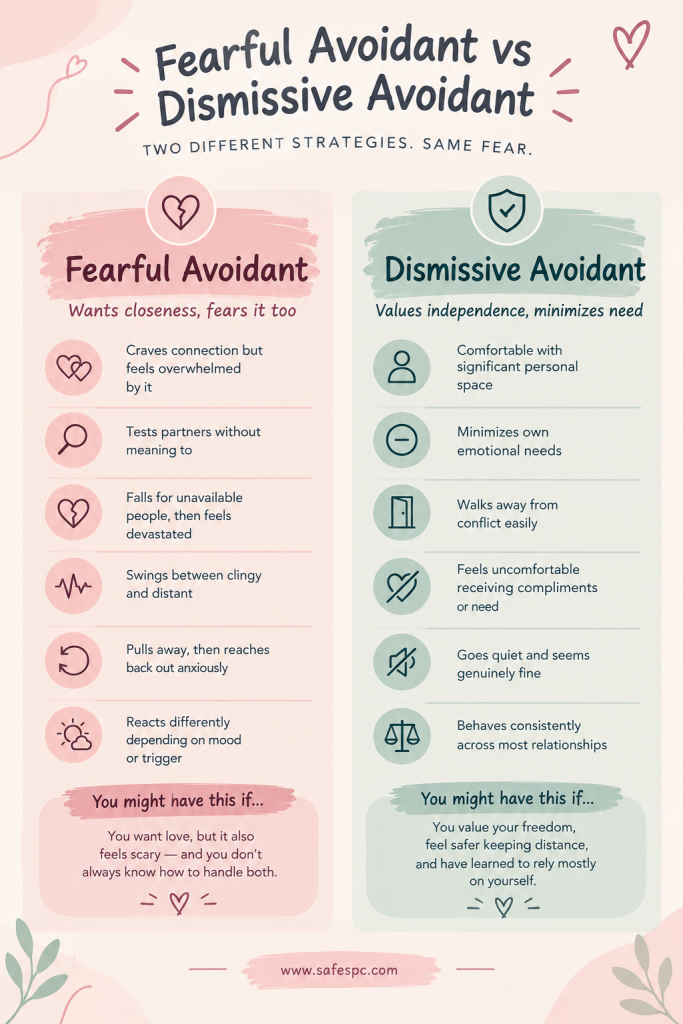
Fearful avoidants want closeness and fear it simultaneously. Dismissive avoidants have largely stopped wanting closeness as intensely in the first place. One is a live wire of conflicting desire. The other has quieted the desire down to something more manageable, at real cost to genuine intimacy.
The psychology behind each style
Fearful avoidant vs dismissive avoidant attachment traces back to different early caregiving experiences. Both styles form early, but the specific pattern differs.
- Fearful avoidant attachment typically develops when a caregiver was both a source of comfort and a source of fear. The nervous system learns to associate closeness with danger and safety at the same time.
- Dismissive avoidant attachment more often develops from consistent emotional unavailability, without that added element of fear. The child learns that needs simply won’t be met. They adapt by suppressing those needs rather than living in ongoing conflict about them.
Research backs up just how different the lived experience is. A 2019 study published in Personality and Individual Differences found something striking.
- Adults with fearful avoidant traits report the highest relationship stress and lowest emotional regulation of all attachment styles.
- Dismissive avoidants often report lower distress. They’ve distanced themselves from the need that would otherwise cause it.
How do I know if my avoidant is fearful or dismissive?
Telling fearful avoidant vs dismissive avoidant attachment apart is one of the most practical questions people actually search. There’s a genuinely useful test. Watch how they behave right after conflict or closeness. Not just whether they pull away, but what the pulling away actually looks like emotionally.
- A dismissive avoidant partner tends to go quiet and seem genuinely fine. Sometimes almost relieved by the space. They rarely swing back toward you with sudden intensity afterward.
- A fearful avoidant partner tends to pull away, then seem distressed by their own distance. They often reach back out anxiously once the space starts to feel unbearable to them too.
Another clue is consistency over time.
- Dismissive avoidance tends to look the same across most relationships and situations.
- Fearful avoidance tends to be more erratic. Warm and clingy one week, cold and distant the next, without an obvious external trigger explaining the shift.
Signs you might be fearful avoidant
Recognizing your own place in fearful avoidant vs dismissive avoidant attachment starts with honest self reflection.
- You crave deep connection but feel overwhelmed once you actually have it.
- You test partners, sometimes without meaning to, to see whether they’ll stay despite your distance.
- You fall for emotionally unavailable people, then feel devastated when they behave exactly as expected.
- You experience extreme highs and lows within the same relationship, sometimes within the same week.
Signs you might be dismissive avoidant
The other side of fearful avoidant vs dismissive avoidant attachment looks different day to day.
- You feel most comfortable when you have significant independence and personal space.
- You minimize your own emotional needs, often without fully realizing you’re doing it.
- Conflict feels easier to walk away from than work through.
- Compliments or expressions of need from a partner can feel oddly uncomfortable, even when you genuinely care about them.
Which is worse, a dismissive avoidant or a fearful avoidant?
Neither side of fearful avoidant vs dismissive avoidant attachment is worse morally. They’re genuinely harder in different ways.
- Fearful avoidant attachment tends to create more visible chaos and emotional volatility. This can feel more painful day to day.
- Dismissive avoidant attachment tends to create a quieter, slower erosion. Less dramatic, but often harder to address directly since there’s less visible distress prompting the conversation.
What is the hardest attachment style to love?
Within fearful avoidant vs dismissive avoidant attachment specifically, most researchers point to fearful avoidant as the most difficult to navigate. This is specifically because of its unpredictability.
- A dismissive avoidant partner, while distant, tends to be consistent in that distance. That at least gives a partner something stable to plan around.
- A fearful avoidant partner’s push and pull can leave a partner feeling like the ground keeps shifting under them.
Do fearful avoidants ever fall in love?
Yes, often intensely. The anxious half of fearful avoidant attachment means genuine, deep longing for connection is very real. It’s not absent the way it can seem from the outside. The complexity isn’t a lack of feeling. The same nervous system generating the longing also generates the fear response. That happens the moment the longing gets close to being met.
Who do fearful avoidants end up with?
Fearful avoidants often find themselves drawn to partners who mirror their own push-pull intensity. Sometimes another fearful avoidant. Sometimes an anxious partner whose pursuit soothes the fear of abandonment while simultaneously triggering the fear of engulfment. Without awareness, this can create a genuinely exhausting cycle for both people involved.
With real self awareness, fearful avoidants often do best with a patient, securely attached partner. Someone who can tolerate the push-pull without taking it personally or escalating it further.
This cycle shows up often in fearful avoidant vs dismissive avoidant attachment dynamics specifically. Anxious attachment vs avoidant attachment covers the mechanics in more detail, including how it plays out day to day.
Who is the best partner for a dismissive avoidant?
Dismissive avoidants tend to do best with a partner who respects independence without taking distance personally. Someone who can express needs clearly without escalating into pursuit the moment space appears. A partner who panics or pursues intensely tends to confirm the dismissive avoidant’s underlying belief. That closeness equals loss of freedom, reinforcing the exact pattern that needs softening.
A patient, secure partner who states needs plainly and calmly, without drama attached, offers something valuable. It gives a dismissive avoidant the safest possible environment to slowly practice tolerating closeness.
How to actually work with either pattern?
Navigating fearful avoidant vs dismissive avoidant attachment well starts with the right approach for each specific pattern.
1. Name the pattern honestly, out loud, to yourself first: Before addressing it with a partner, get clear on which pattern you’re actually seeing. Confusing the two leads to mismatched responses that don’t address the real underlying fear.
2. For a fearful avoidant partner, offer steady reassurance without chasing: Try a script like, “I’m not going anywhere, take whatever space you need, I’ll be here when you’re ready.” This meets the anxious half without feeding the avoidant half’s fear of being trapped.
3. For a dismissive avoidant partner, state needs plainly without escalating: Try, “I’d like more check-ins during the week, no pressure, just something to think about.” Calm, low intensity requests tend to land better than emotional appeals, which can trigger withdrawal.
4. Watch your own attachment response too. If you’re anxiously attached yourself, either pattern can activate real panic: How to stop being scared of intimacy and why am I attracted to emotionally unavailable people cover the other half. Both are worth reading if you recognize yourself pursuing either pattern repeatedly.
5. Consider professional support for fearful avoidant patterns specifically: This style often traces back to real early trauma. It frequently benefits from therapeutic support beyond what self awareness alone can shift.
Common mistakes people make with this distinction
Getting fearful avoidant vs dismissive avoidant attachment confused leads to a few predictable mistakes worth naming directly.
Assuming all avoidant behavior comes from the same place: Treating a dismissive avoidant partner like a wounded fearful avoidant, or vice versa, tends to misfire. The underlying fear each style responds to is genuinely different.
Taking either pattern as a personal verdict: Both styles are shaped by early experience, not by anything specific to the current relationship. Internalizing the distance as proof of being unlovable usually isn’t accurate, even though it can feel that way.
Expecting rapid change: Both patterns took years to form. They typically take real time and consistency to soften, not a single honest conversation, however well handled.
Frequently Asked Questions – FAQs
What’s the main difference between fearful avoidant and dismissive avoidant attachment?
The core of fearful avoidant vs dismissive avoidant attachment is this. Fearful avoidants want closeness and fear it at the same time. Dismissive avoidants have largely minimized wanting closeness in the first place, making their distance feel calmer but harder to shift.
Can someone be both fearful avoidant and dismissive avoidant?
Attachment exists on a spectrum, and people can show traits of both. One pattern typically dominates though. Context and specific relationships can also shift which pattern shows up more strongly.
Is fearful avoidant attachment the same as disorganized attachment?
Yes, these terms describe the same style. Disorganized is the term used more often in childhood attachment research. Fearful avoidant is the more common term used for adults.
Can dismissive avoidant attachment become secure?
Yes, with consistent, patient effort. Often with real relational experience alongside a secure partner, dismissive avoidant patterns can genuinely shift over time.
How common is fearful avoidant attachment compared to dismissive avoidant?
Fearful avoidant attachment is generally considered the rarer of the two, and the most complex. Dismissive avoidant attachment shows up more frequently across the general population.
The bottom line
Fearful avoidant vs dismissive avoidant attachment isn’t about deciding which pattern is worse. Understanding it means recognizing two genuinely different responses to the same underlying fear of closeness. One is loud and conflicted. The other is quiet and resigned. Both are learnable, both are workable. Neither one defines what a person is capable of. Not with enough patience, awareness, and the right kind of support around them.