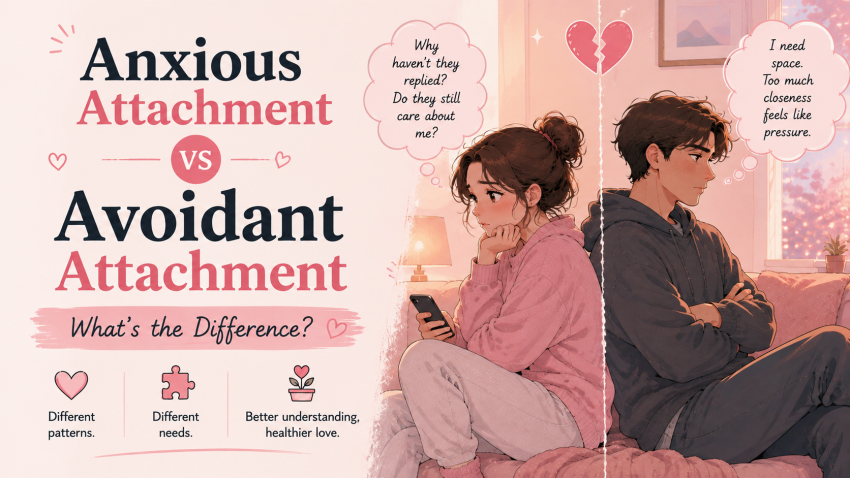
Anxious attachment vs avoidant attachment is the pattern behind a familiar conversation. The “why do I keep dating the same person in different bodies” one you’ve had with a friend. One of you wants more closeness. The other wants more space. And somehow, you keep finding each other, over and over, like it’s fate instead of a pattern.
It’s not fate. It’s psychology, and once you see it clearly, you can’t unsee it. Let’s break this down the way I wish someone had broken it down for me. Plainly, without the clinical language that makes half this stuff harder to understand than it needs to be.
What anxious attachment actually looks like
If you’re anxiously attached, closeness feels like oxygen. You want reassurance often, and when it’s missing, your mind fills the silence with worst case scenarios. A late text reply doesn’t just feel annoying, it feels like evidence something’s wrong.
You tend to give a lot early on, sometimes too much, too fast. Connection feels urgent rather than something that can build slowly. You notice tiny shifts in someone’s tone or energy immediately. You replay conversations, searching for what you might have done wrong.
Underneath all of it is a real, understandable fear. Abandonment. Not being enough. Being left before you even fully arrive.
What avoidant attachment actually looks like
If you’re avoidantly attached, closeness can feel like pressure, even with someone you genuinely care about. Independence feels safer than depending on someone else. You might pull away right when things start getting good, without fully understanding why.
You tend to process emotions alone rather than out loud with a partner. Vulnerability can feel exposing, even dangerous, in a way that’s hard to explain to someone who doesn’t operate this way. You might come across as cold or distant, even when you’re actually just overwhelmed internally.
Underneath all of it is a real, understandable fear too. Losing yourself. Being smothered. Depending on someone who might not actually be dependable.
How to stop being scared of intimacy goes deeper into this specific fear, if this section sounds like you.
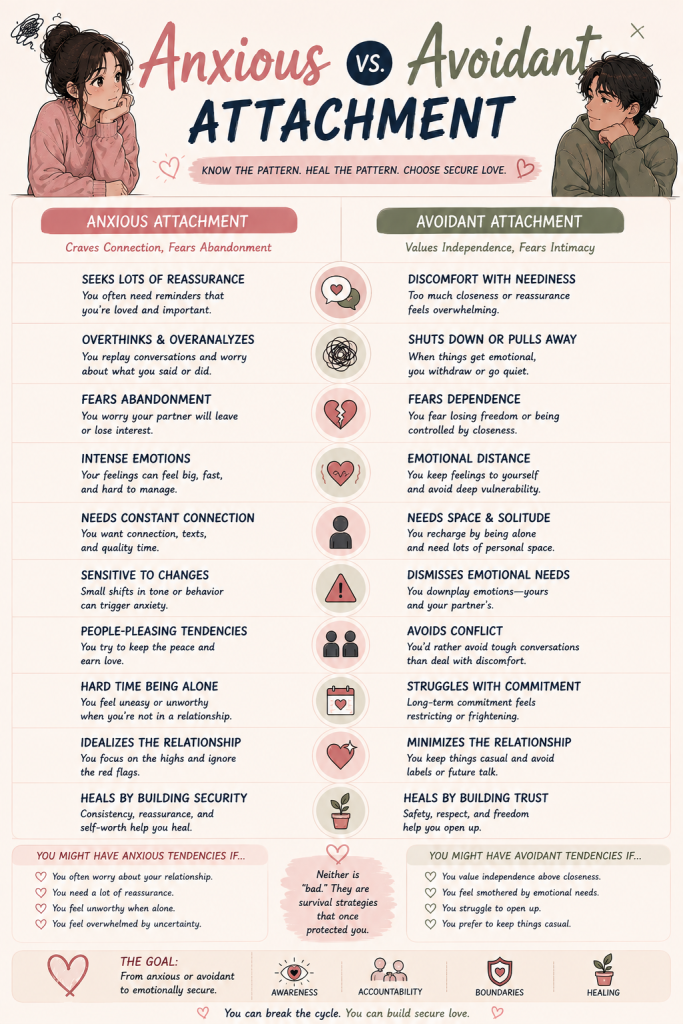
Anxious attachment vs avoidant attachment, side by side
Anxious wants reassurance. Avoidant wants space. Anxious moves toward conflict to resolve it fast. Avoidant moves away from conflict to cool down. Anxious over-shares early. Avoidant shares slowly, if at all.
Anxious reads silence as danger. Avoidant reads silence as relief. Anxious feels safest when close. Avoidant feels safest when independent. Neither reaction is wrong. They’re just two different nervous systems, shaped by two different early environments, doing what once kept them safe.
Why anxious and avoidant people always seem to find each other?
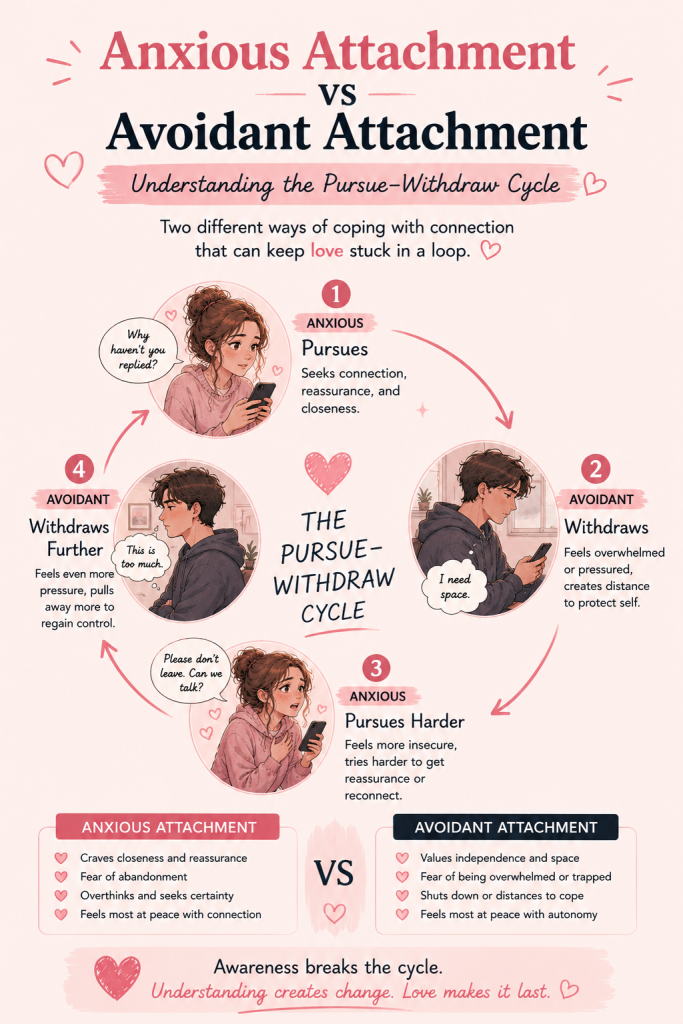
This is the part that makes people’s jaw drop a little. It’s not bad luck. Anxious attachment and avoidant attachment fit together like two puzzle pieces. Both built from the same underlying wound, just expressed in opposite directions.
Here’s the cycle.
- The anxious partner senses distance and moves closer, seeking reassurance.
- The avoidant partner feels the pressure of that closeness and pulls back to protect their independence.
- The anxious partner feels the pulling away and pursues harder, trying to close the gap.
- The avoidant partner feels even more pressure and withdraws further.
Both people are actually terrified of the same core thing, disconnection, just responding to that fear in completely opposite ways. The anxious partner protests loudly. The avoidant partner goes quiet. Neither one is doing it on purpose. Both are running an old, automatic script.
Why am I attracted to emotionally unavailable people unpacks the anxious side of this pull. Especially why it can feel like chemistry instead of pattern.
How to tell which one you actually are?
Most people lean toward one side. But plenty show up as anxious in one relationship and avoidant in another, depending on the dynamic. What matters more than the label is noticing your actual instinct under stress.
When a relationship feels uncertain, do you move toward the person, seeking more contact and reassurance? Or do you move away, needing space to process on your own?
That single instinct, under real pressure, usually tells you more than any quiz result will.
Breaking the cycle if you’re the anxious one
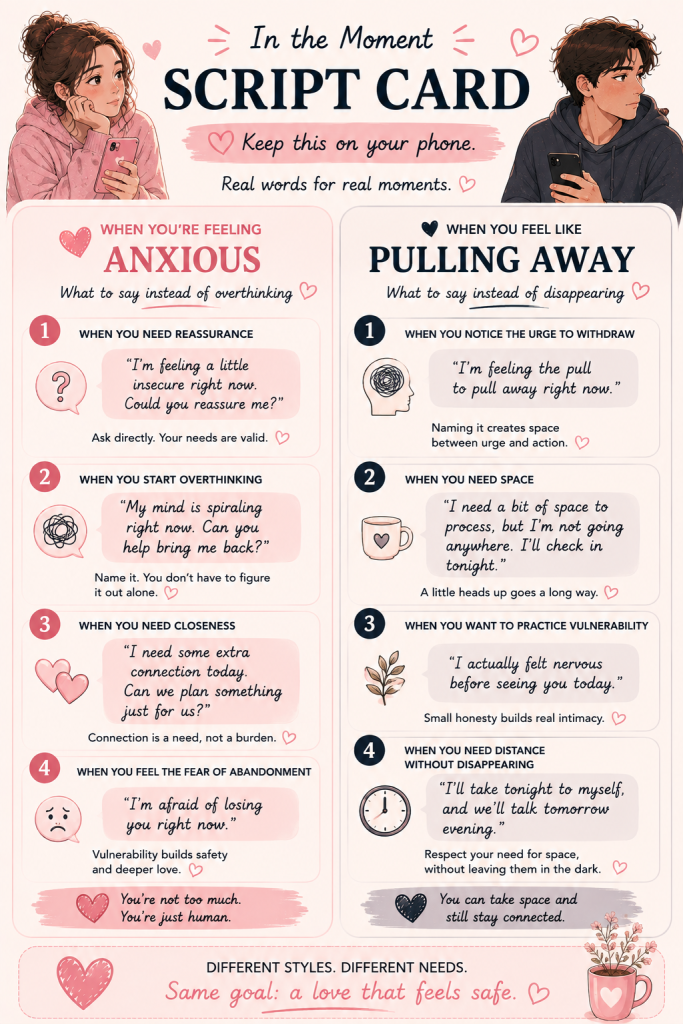
- Start by building a pause between the urge to reach out and actually doing it. Set a real timer, ten minutes, before sending that third follow up text. Use that time to ask yourself honestly. Am I reaching out because something is actually wrong, or because I feel anxious and want relief.
- Practice a specific self soothing phrase for the moment panic hits. Something like, “their silence is not proof I’m being left, it’s just silence right now.” Say it out loud if you need to. This interrupts the spiral before it fully takes hold.
- Try communicating the need directly instead of testing for it indirectly. Instead of going quiet to see if they notice, say something direct. “I’m feeling a little anxious today and could use a quick reassurance, no pressure.” This gives your partner a clear ask instead of a puzzle to solve.
- Build a life that isn’t entirely centered on your relationship’s availability. Schedule things with friends on days you know your partner is busy. This isn’t a distraction technique, it genuinely reduces how much weight any single relationship has to carry alone.
Breaking the cycle if you’re the avoidant one
- Start by naming the urge to withdraw the moment you notice it, even just internally. Something like, “I’m feeling the pull to pull away right now.” Naming it creates a tiny gap between the urge and the action, which is exactly where change happens.
- Instead of going silent when overwhelmed, try a short, low pressure heads up. Something like, “I need a bit of space to process, but I’m not going anywhere, I’ll check in tonight.” This single sentence does more for a relationship than most people realize.
- Practice sharing one small vulnerable thing on purpose each week, even if it feels unnatural at first. It doesn’t need to be huge. “I actually felt nervous before seeing you today” counts completely.
- Set a personal rule around distance. If you feel the urge to create space, allow it, but attach a specific return time. “I’ll take tonight to myself, and we’ll talk tomorrow evening” works well. It respects your need without leaving your partner in an unexplained void.
Moving toward secure attachment, together or solo
Neither style is a life sentence. Attachment patterns form early, but they’re genuinely capable of shifting with enough awareness and consistent practice. Secure attachment isn’t about needing nothing or wanting nothing. It’s being able to ask for closeness and tolerate space without spiraling into fear either way.
If you’re with the opposite style, understanding this dynamic changes everything about how you interpret each other’s behavior. The chasing isn’t clinginess, it’s fear translated into action. The withdrawing isn’t rejection, it’s fear translated into silence. Once you can see the fear underneath the behavior, compassion becomes a lot easier to access than blame.
How to love someone who doesn’t know how to receive love is worth reading next. Especially if you’re the partner trying to support someone through this pattern.
The bottom line
Anxious attachment vs avoidant attachment isn’t a battle between a needy person and a cold one.
It’s two protective strategies, built early, doing exactly what they were designed to do. They just no longer serve either person well in adult relationships. Understanding your own pattern is the first real step toward changing it.

I’m Patricia – a writer, a wife, and the kind of person who feels just about everything at full volume. I live in Manhattan, but I don’t write about the fairytale version of romance. I write about the real stuff: the miscommunications, the long-term commitment, and the tiny, everyday decisions it takes to keep a relationship thriving. I’m just a fellow wildheart trying to put honest words to how love actually feels from the inside.
2 thoughts on “Anxious Attachment vs Avoidant Attachment: What’s the Difference?”