
You did the hard thing. You said the honest sentence, you meant it, you didn’t take it back when they pushed. And now it’s been eleven days, and you still reach for your phone to tell them something funny that happened, and catch yourself halfway through typing it. Missing them wasn’t supposed to still be happening. You left. Leaving was supposed to feel like relief, or at least like progress. Instead it mostly just feels like missing someone, with an extra layer of confusion on top, because you’re the one who ended it.
If you’re searching for how to get over a situationship without closure, or wondering why you can’t forget someone you willingly walked away from, this isn’t a contradiction you need to solve. It’s just what this particular kind of ending actually feels like, and almost nothing written about situationships prepares anyone for that part.
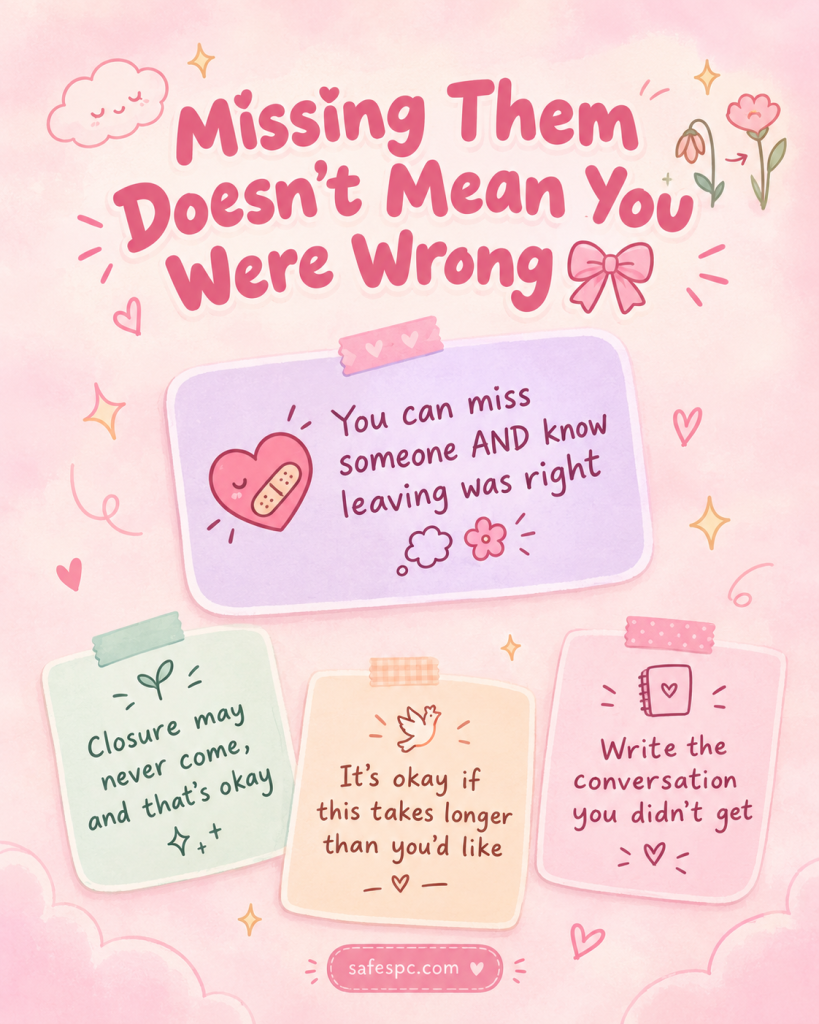
Missing them doesn’t mean you were wrong
This is worth saying plainly before anything else, because it’s the thing most people secretly use against themselves.
Missing someone is not evidence that leaving was a mistake. It’s evidence that something real existed, which is a completely different fact. You can be certain the decision was right and still ache over it.
Those two things live in the same body at the same time constantly, in grief of every kind, not just this one.
The confusion usually comes from expecting missing them to feel like doubt. It rarely does, once you look closely. It feels more like absence, the specific shape of a person no longer in the part of your day they used to occupy. That absence doesn’t argue against your decision. It just means the decision had a real cost, which most decisions worth making do.
The first 30 days are the hardest. Day 6 of the 7-Day Situationship Exit Plan gives you a no-contact guide, a 30-day action calendar and an emergency plan for the moments you want to reach out. Get the 30-day Situationship exit plan here.
The closure you were waiting for already happened, it just didn’t look like what you pictured
Here’s the reframe that actually helps, more than any amount of time usually does on its own. You were probably waiting for a specific kind of closure, a conversation where everything got said, where the other person understood fully, where the ending felt resolved rather than ongoing. Situationships, almost by design, rarely offer that. The whole relationship ran on undefined terms, so why would the ending suddenly produce a clean, defined one.
Therapist Pauline Boss, who spent decades studying losses that never resolve cleanly, found that closure as most people picture it is largely a myth, and that healing from an unresolved loss doesn’t require reaching an endpoint, it requires learning to find meaning despite the lack of one.
What you’re waiting for may simply not be coming, not because you did something wrong, but because this kind of ending was never going to produce it. The closure isn’t missing. The expectation of it is the part that needs to be released.
This matters for the practical question too, the one underneath “how can I get over this without closure.” You’re not actually missing a step. You’re trying to complete a process that was built for a different kind of ending than the one you had.
Why it won’t let go, even though you know it’s over?
Part of why this lingers longer than a clean breakup sometimes does: the relationship never got to fully exist in the first place, which means your mind doesn’t have a complete story to file away. A defined relationship ending gives you a whole arc to grieve, a beginning, middle, and end. A situationship often ends with a middle that stopped, nothing more, and an unfinished story is harder for the mind to let settle than a finished one, regardless of how it ended.
If this person also ghosted you back out of the undefined space entirely, rather than you ending things cleanly, that incompleteness is even sharper, since you’re grieving something that doesn’t even have an agreed-upon ending between the two of you.
If missing them has turned into checking their social media, rereading old messages, or constructing reasons to reach out, why do I overthink every text message covers the mechanics of that particular loop, and why it tends to intensify right when you’re trying hardest to move on from someone.
What actually helps, since waiting for closure won’t be the thing?
- Write the conversation you didn’t get: Not to send. Just to get the unfinished version out of your head and onto a page, where it can exist without needing their participation to feel complete.
- Let the story be complicated instead of simple: You don’t need to decide whether they were a good person or a bad one, whether it was all real or all a waste. It can be true that it mattered and that it was right to end. Simplifying it into one clean narrative, good or bad, is usually an attempt to manufacture the closure that isn’t coming, and it tends to backfire into either idealizing them further or resenting them more than the situation actually calls for.
- Notice the moments you’re missing the real person versus missing the potential: Sometimes what aches is a specific memory, a particular conversation, a real closeness that existed. Sometimes it’s the version of them you were hoping they’d become. Both are real feelings. Only one of them is actually about who they were.
- Give the missing somewhere to go that isn’t them: A friend who already knows the full story, a journal, a walk where you let yourself think about it fully instead of pushing it down all day and having it surface at midnight. Grief that gets expressed tends to move. Grief that only gets suppressed tends to wait.
- Let it take the time it takes: Not an undefined forever, but longer than you’d like, probably. If the relationship had real closeness in it, however it was labeled, the ache for it follows roughly the same timeline any real loss does, regardless of what the relationship was officially called.
If you’re not sure the decision is still the right one
Missing someone sometimes tips into genuine doubt, and it’s worth knowing the difference, because they call for different responses. Plain missing feels like absence and tends to soften gradually, even while it’s still present. Real doubt feels more like a specific, repeated thought: this might have actually worked if I’d given it more time, I don’t think I gave it a fair chance. If what you’re feeling is closer to the second one, it’s worth revisiting honestly rather than assuming it’s just grief talking. How to know when to end a situationship can help you check that against the same questions that got you here in the first place, without assuming either answer is automatically right.
For most people, though, it’s the first one. Missing someone you were right to leave isn’t your judgment wavering. It’s just what caring about someone, even briefly, even without a clear label on it, actually costs on the way out. You already paid the harder price when you ended it instead of staying somewhere it wasn’t working. This part, the missing, is just the bill arriving a little late. It doesn’t mean you owe anything back.