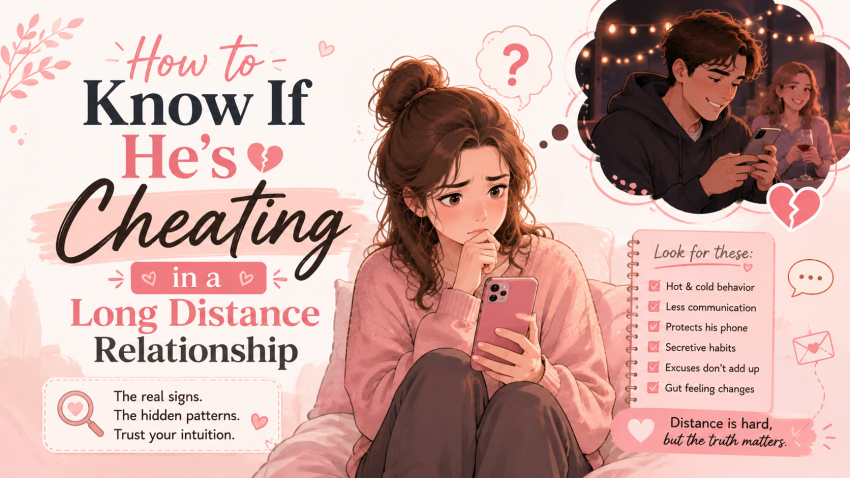
If you’re reading this, you’re probably done enough Google searches on “How to Know If He’s Cheating in a Long Distance Relationship” lying awake with a knot in your stomach, replaying a conversation, wondering if you’re overthinking or if your gut is trying to tell you something real.
That’s an awful place to sit in, and I want to be honest with you before anything else. Distance makes this specific fear harder, because you can’t just look at someone’s face and know. But it doesn’t make the fear impossible to work through carefully.
Here’s how to actually think about this, without spiraling and without ignoring something real either.
Start by separating anxiety from evidence
This is the most important distinction, and the hardest one to make when you’re already anxious.
Long distance relationships naturally produce more uncertainty than in-person ones, simply because you have less visibility into each other’s daily lives. That gap in visibility often gets filled with anxious imagination, even when nothing is actually wrong.
Before assuming the worst, ask yourself honestly, am I responding to something specific he’s actually done, or am I responding to the general discomfort of not being able to see what he’s doing right now.
Both are valid feelings to sit with, but they call for different responses. The first deserves a direct conversation. The second deserves self compassion and maybe a conversation about needing more reassurance, not an FBI investigation on “How to Know If He’s Cheating in a Long Distance Relationship?”.
Look at patterns, not single moments
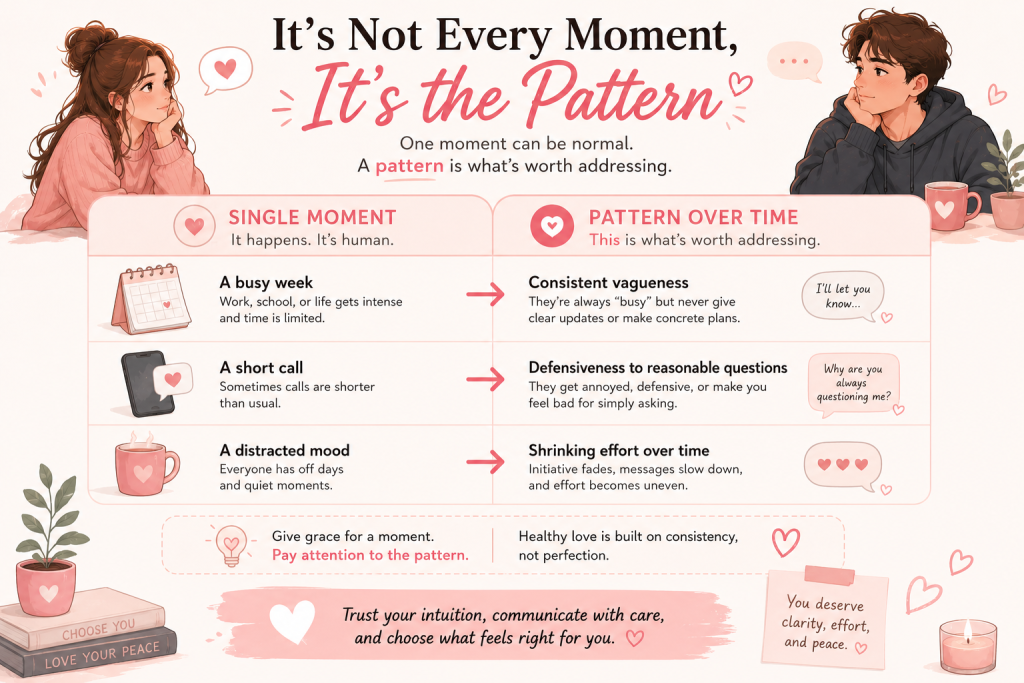
A single unanswered text, a shorter than usual call, a slightly off mood, none of these mean much in isolation.
Everyone has off days, busy weeks, moments of being distracted. What actually matters is whether you’re seeing a consistent pattern over time, not a single data point you’re replaying on a loop.
Patterns worth paying attention to include:
- A real, sustained shift in communication frequency without explanation
- Increasing vagueness about basic daily details
- Defensiveness that appears specifically when you ask simple reasonable questions
- And a general withdrawal of emotional openness that doesn’t match his usual behavior.
Notice how he responds when you express concern
This tells you more than almost anything else. When you bring up a worry, even an insecure or slightly irrational one, does he respond with patience and reassurance, or does he get defensive, dismissive, or turn the conversation around to make you feel like the problem.
A partner who has nothing to hide can usually sit with your insecurity without punishing you for having it.
Consistent defensiveness or guilt-tripping in response to reasonable questions is worth paying more attention to than the original worry itself.
Trust changes in effort, not just changes in words
Words are easy to say. What’s harder to fake over time is consistent effort.
- If communication has genuinely dropped,
- If plans to close the distance have quietly stopped being mentioned,
- If the relationship has started to feel like it’s running on autopilot rather than active investment,
…that pattern of behavior tells you more than any single reassuring text does.
Talk to him directly, without leading with accusation
This is the step most people skip because it’s the scariest one.
But an honest conversation, framed around your feelings rather than a certain accusation, usually gets you further than silent surveillance or quiet suspicion ever will.
Something like, I’ve noticed things feel different lately and I’ve been feeling insecure about it, can we talk, opens a real conversation.
A conversation that starts with an accusation tends to produce defensiveness regardless of guilt, which makes it much harder to actually read the response.
What this is not about
This isn’t about monitoring his phone, tracking his location, or trying to catch him in a lie through surveillance.
Beyond the fact that this usually damages trust further regardless of what it finds, it also keeps you focused on detective work instead of the actual question that matters, whether this relationship currently feels safe, honest, and mutual to you.
If it doesn’t, that’s worth addressing directly, with him, rather than trying to solve it alone through investigation.
When it might be more than anxiety
If you’ve had an honest conversation, given it real time, and you’re still seeing a consistent pattern of vagueness, defensiveness, and shrinking effort, it’s fair to trust that pattern.
Ongoing dishonesty doesn’t usually stay contained to one area, it tends to show up in small inconsistencies across different conversations, over time.
If you’re noticing that specifically, that’s meaningfully different from a single anxious spiral, and it’s okay to take it seriously.
And if it turns out to be anxiety, not evidence
This is worth sitting with too. Long distance relationships can genuinely produce anxiety that isn’t about your partner’s actual behavior at all, it’s about the discomfort of loving someone you can’t see or reach whenever you want to.
If that’s what’s happening, it doesn’t mean your feelings aren’t valid, it means the fix is different, more reassurance, more communication about your need for it, maybe outside support if the anxiety feels bigger than the relationship itself.
The bottom line
Real concern usually comes from a consistent pattern, met with defensiveness instead of reassurance, and confirmed rather than eased by honest conversation.
Anxious spirals usually come from the discomfort of distance itself, and tend to ease with direct communication and reassurance.
Both are real experiences. Knowing which one you’re in is the difference between protecting yourself and quietly torturing yourself over nothing.

I’m Patricia – a writer, a wife, and the kind of person who feels just about everything at full volume. I live in Manhattan, but I don’t write about the fairytale version of romance. I write about the real stuff: the miscommunications, the long-term commitment, and the tiny, everyday decisions it takes to keep a relationship thriving. I’m just a fellow wildheart trying to put honest words to how love actually feels from the inside.