Signs a long distance relationship will last are easy to search for. They’re hard to trust once you find them. Every long distance couple asks this question eventually. Usually around 2am after a long call, or in the quiet stretch between visits. Is this actually going somewhere, or are we just holding onto something that’s already run its course.
It’s a fair question. The good news is the research is more encouraging than the popular reputation suggests. A foundational study by Guldner and Swensen found something reassuring. No significant difference in satisfaction or commitment between long distance couples and geographically close ones.
Distance alone doesn’t doom a relationship. The real signs a long distance relationship will last are more specific than distance itself. They show up in patterns you can genuinely observe right now.
The real reason most long distance relationships actually end
Before getting into the signs themselves, it helps to understand what actually breaks these relationships apart. According to research summarized by Lainie’s long distance relationship data, roughly 70 percent of long distance breakups trace back to unplanned changes, not the distance itself. A surprise move, a job relocation, a graduation that scatters everyone’s plans.
This single statistic reframes the whole question.
The couples who last aren’t necessarily the ones who feel the most longing. They’re the ones who planned the most. That distinction runs through most of the genuine signs a long distance relationship will last, covered below.
“We miss each other” isn’t actually a reliable sign
This is one of the more misleading signs a long distance relationship will last, at least on its own. Missing each other doesn’t tell you much by itself. Almost everyone in a long distance relationship misses their partner. That’s simply what distance does. It’s not evidence of anything beyond caring about someone who isn’t physically near you.
What actually matters is what you both do with that feeling. Does missing each other turn into consistent effort? Or does it stay a passive feeling that never quite becomes action?
Longing without follow through isn’t a strong foundation. Longing paired with reliable, repeated effort usually is.
A shared plan to close the distance matters more than people admit
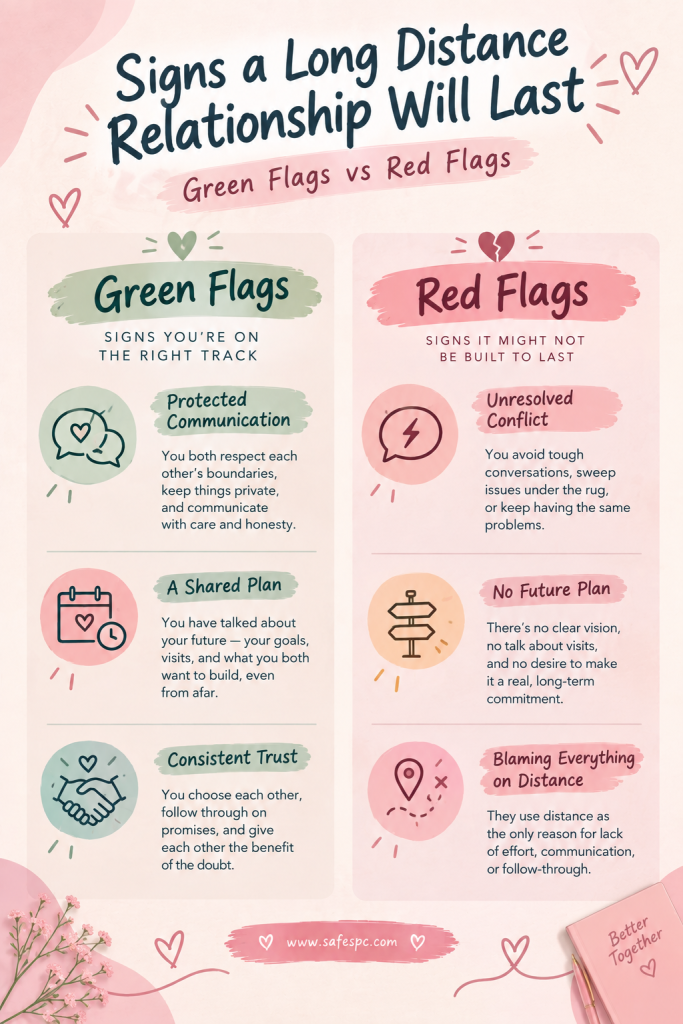
Given what the research shows, this is one of the clearest signs a long distance relationship will last. LDRs with a real, even if flexible, plan to eventually live together tend to fare significantly better. Ones drifting along with no defined direction tend to struggle more.
The plan doesn’t need exact dates or a rigid timeline. But there should be a shared sense of working toward closing the gap. Maybe that means one person relocating after finishing school. Maybe it means both saving toward a future move.
Relationships without any version of this plan often start to feel like they’re circling rather than progressing. That circling eventually wears couples down, even if nothing specific has gone wrong.
The 777 rule for long distance relationships offers a practical structure for building this kind of consistency day to day, while the bigger plan takes shape in the background.
How you handle conflict remotely tells you a lot
Conflict handling is one of the more overlooked signs a long distance relationship will last.
In person, small disagreements often get smoothed over through simple proximity. A hug, a shared meal, enough shared space for tension to dissolve naturally. Long distance removes that safety net entirely. Conflict has to be resolved through conversation alone, with no physical reassurance to soften it.
Couples whose LDRs last tend to get genuinely good at this.
- They don’t let disagreements fester over unanswered texts.
- They pick up the phone instead of stewing in silence.
- They repair after conflict intentionally, checking in afterward instead of letting things quietly move on.
If conflict in your relationship tends to spiral or go unresolved, that’s worth paying attention to. Distance won’t make that pattern easier, only harder.
Trust patterns predict a lot more than jealousy does
Trust patterns are among the quieter signs a long distance relationship will last, easy to miss until tested. It’s tempting to think jealousy is the main threat to a long distance relationship. But jealousy itself isn’t the strongest predictor. What matters more is how trust gets handled underneath it.
- Relationships that last tend to have partners who default to trust rather than suspicion.
- They don’t feel the need to monitor every unanswered message.
- They’ve built enough transparency that the absence of proof doesn’t automatically read as a problem.
If trust feels fragile or constantly under negotiation, that pattern typically doesn’t resolve once the distance ends. It tends to follow the relationship into the next phase instead.
If unexplained silences are becoming a recurring source of anxiety rather than an occasional exception, how to know if he’s cheating in a long distance relationship covers how to tell the difference between reasonable concern and anxious spiraling.
Watch for the excuses that get made because “it’s just the distance”
This pattern is easy to miss when you’re checking for signs a long distance relationship will last. It hides inside reasonable-sounding excuses. Certain warning signs get quietly excused in LDRs simply because distance provides a convenient explanation. Inconsistent communication gets blamed on a busy schedule. Emotional distance gets blamed on the physical distance itself. Growing apart gets reframed as a normal side effect of not being in the same place.
Sometimes that’s genuinely true. But sometimes distance is cover for a relationship that was already losing momentum.
Ask yourself honestly. If we lived in the same city right now, would this issue actually resolve, or is the distance just making it easier to avoid looking at directly.
What kills long distance relationships goes deeper into these exact patterns.
What research says doesn’t actually predict failure?
A few common fears don’t hold up as well as people expect once you look at the actual data. Missing your partner intensely isn’t itself a warning sign, as established earlier. Neither is occasional insecurity, as long as it gets named and addressed rather than left to fester silently.
Communication frequency alone also isn’t the deciding factor people assume it is. Research summarized by Connected Couples found that responsiveness and communication quality mattered more for satisfaction than video call frequency on its own.
A couple exchanging a handful of genuinely present, responsive messages a day tends to fare better than one running up daily call minutes without real presence behind them.
Signs that genuinely point toward longevity
Putting it together, the clearest signs a long distance relationship will last show up consistently. Not perfectly, but as a reliable baseline you can actually observe in daily life.
A consistent, protected communication rhythm that doesn’t require constant reminders. A real, shared plan for eventually closing the distance, even a loosely defined one. Conflict that gets addressed and repaired, rather than avoided or left to linger. A baseline of trust that doesn’t require constant proof to feel secure.
Honesty about problems, instead of quietly blaming everything on the distance itself. Responsiveness in daily contact that feels present, not just frequent for its own sake.
Frequently asked questions
What percentage of long distance relationships actually work?
Estimates vary depending on how success is defined, but commonly cited figures put it around 58 to 60 percent, a number that’s far more encouraging than the popular reputation suggests.
Does missing your partner intensely mean the relationship will last?
Not on its own. Missing someone is nearly universal in long distance relationships. Among the real signs a long distance relationship will last, what that longing turns into matters more than its intensity.
How long do most long distance relationships last before ending?
There’s no single answer, since outcomes vary by couple and circumstance. Research consistently shows one of the strongest signs a long distance relationship will last. A shared plan to close the distance predicts lasting past the early stages better than almost anything else.
Is jealousy a sign a long distance relationship won’t last?
Occasional jealousy is common and not automatically disqualifying. What matters more is whether it gets handled through open conversation, or left to quietly erode the relationship underneath.
Can a long distance relationship with no set end date still last?
It’s harder, but not impossible. Even a loosely shared sense of direction counts as one of the real signs a long distance relationship will last. That beats a genuinely open ended arrangement with no plan discussed at all.
The honest bottom line
Distance doesn’t determine whether a relationship lasts. It amplifies whatever was already there. Strong communication, real trust, and genuine effort tend to get stronger under the pressure of distance.
Weak versions of those same things tend to unravel faster than they would have in person, simply because there’s less to paper over the cracks.
If you’re seeing most of the signs a long distance relationship will last, that’s a genuinely good indication. You’re building something real. If you’re seeing the opposite, sit with that honestly. Not as a verdict on your worth or your partner’s. Just useful information about what needs attention before the distance is expected to fix itself. How to keep a long distance relationship alive covers exactly what that attention can look like day to day.
If what you’re noticing feels more like doubt than confidence, signs a long distance relationship isn’t going to work walks through how to tell a real warning sign from ordinary distance-related drift.
2 thoughts on “Signs A Long Distance Relationship Will Last: The Real Predictors That Matter”