You’ve read the lists. Communication is a green flag. Love bombing is a red flag. Supporting your goals, green. Jealousy, red. And yet you’ve probably had the experience of dating someone who checked every green flag box on paper, said all the right things, texted back reliably, supported your career, and still left you feeling quietly unsettled in a way you couldn’t explain. Or the reverse: someone who needed more space than the lists say is healthy, and it turned out to be exactly what a good relationship looked like for you.
That gap between the list and your actual experience isn’t you overthinking it. It’s the lists missing something important: a flag isn’t a fixed fact about a behavior. It’s a fact about the fit between that behavior and the specific person standing across from it. This post covers what green and red flags actually are, why the same behavior can be either one depending on who’s involved, how your own attachment style quietly changes what you read as safe or alarming, and a full, real accounting of both, organized in a way a numbered list never quite manages.
The problem with fixed flag lists
Search “green flags in a relationship” and you’ll find the same handful of items across nearly every result: honesty, good communication, respects boundaries, supports your goals, treats service staff well. Search “red flags” and you’ll get the mirror image: love bombing, jealousy, inconsistency, poor communication, disrespects boundaries.
None of this is wrong, exactly. It’s just incomplete in a way that matters.
These lists treat every reader as an identical person with identical needs, which means they can only ever tell you what’s true on average, not what’s true for you, in this relationship, with this particular history.
A list can’t tell you that the very behavior it labels healthy might be the exact thing feeding an old wound, or that the behavior it labels alarming might be precisely what a healthy relationship requires from someone in your position.
What a green flag actually is?
A green flag is a behavior or pattern that signals safety, consistency, and respect, the kind of thing that makes it reasonable to lower your guard a little and invest more. At its best, it’s evidence that someone is capable of the specific things a good relationship actually runs on: following through, telling the truth even when it’s inconvenient, handling disagreement without contempt, and treating your needs as real rather than an inconvenience.
What a red flag actually is?
A red flag is a behavior or pattern that signals risk, most often to your trust, your autonomy, or your safety. It’s worth being precise here, because the term gets used loosely. A genuine red flag isn’t just something that annoys you or clashes with your preferences. It’s something that predicts real harm if it continues unaddressed: dishonesty, control, contempt, or a pattern of your boundaries simply not being respected once they’re stated clearly.
The core idea: flags are relative, not universal
Here’s the piece almost nothing else in this space says directly, and it changes how useful the rest of this post can be to you. Whether a behavior reads as safe or alarming isn’t only about the behavior. It’s about how it lands for the specific person receiving it, shaped heavily by that person’s own history and attachment patterns.
This isn’t just a nice reframe. It’s backed directly by research. Psychologists studying what’s called perceived partner responsiveness, essentially whether a partner’s behavior actually feels supportive and attuned, have found that these perceptions are highly subjective and shaped by the attachment orientation of the person perceiving them, especially during stressful moments. In plain terms: two people can receive the exact same behavior from a partner and walk away with completely different read on whether it felt safe. That’s not a flaw in either person’s judgment. It’s how the nervous system actually processes closeness, filtered through everything it learned before this relationship even started.
This is why the flag lists feel incomplete. They’re describing the behavior. They’re not describing you, and the behavior only means something once you put the two together.
Behaviors that flip depending on the person
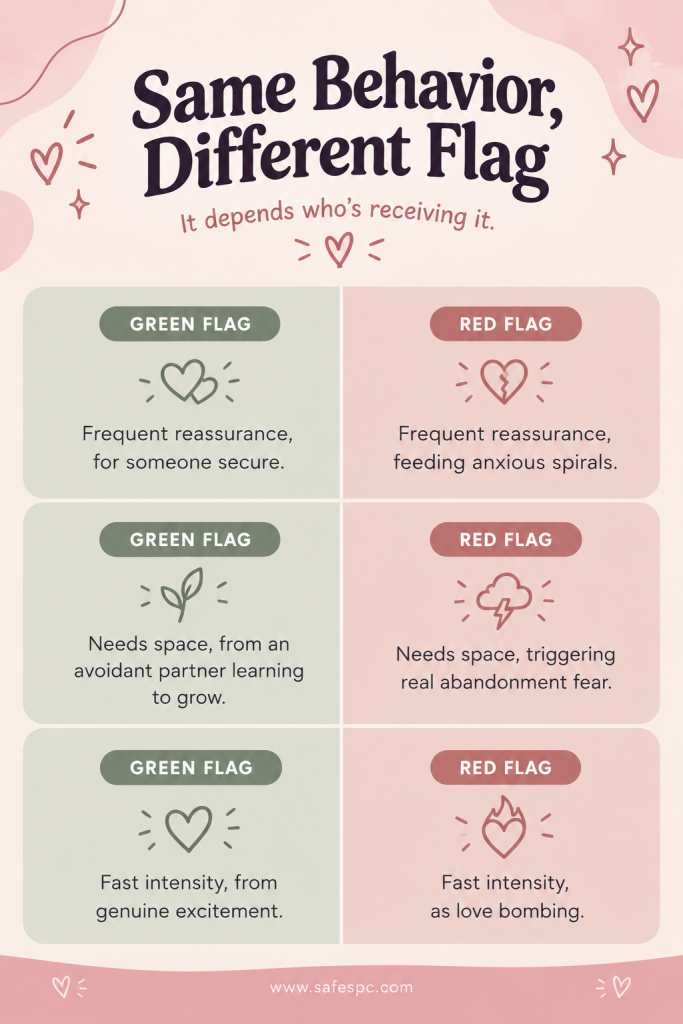
This is the section no listicle covers, and it’s the most useful thing in this whole post. Here are real examples of behaviors that read as a green flag for one person and a red flag for another, depending on what they actually need.
Giving frequent reassurance. For someone who’s generally secure, a partner who checks in and offers reassurance now and then is a pleasant bonus. For someone working through anxious attachment, a partner who gives unlimited, unprompted reassurance can quietly become a problem, not because reassurance is bad, but because it removes any reason to build their own capacity to sit with uncertainty. What looks like a green flag on the surface, a caring, communicative partner, can end up reinforcing the exact pattern that needs to soften.
Wanting a lot of independent space. For a lot of people, a partner needing solo time, separate friendships, and real independence is exactly what a healthy relationship should look like. For someone with abandonment issues, that same need for space can trigger genuine alarm, not because the space is unreasonable, but because their nervous system reads distance as danger regardless of the actual intention behind it. The behavior isn’t the problem. The mismatch between the behavior and that person’s history is.
Moving quickly toward intimacy and commitment. Fast intensity can be a green flag when it comes from genuine, well-regulated excitement and both people are on the same page about pace. It’s a red flag when it functions as love bombing, overwhelming affection used to fast-track trust before it’s actually been earned, often followed by a sudden cooling once the other person is invested. Same speed, completely different function, and the difference usually only becomes visible over time, not in the moment itself.
Needing to talk things through immediately during conflict. For someone whose sense of safety depends on quick repair, an partner who wants to resolve things right away reads as caring and committed. For someone who needs to self-regulate before a conversation is productive, often true for someone leaning avoidant, the same immediacy can feel like pressure rather than care. Neither preference is wrong. The mismatch between them is what actually creates friction, not either style on its own.
Being easygoing and low-conflict. This one surprises people. A partner who rarely argues and goes along with most things can look like a dream, calm, agreeable, drama-free. It can also mean someone who’s avoiding honest disagreement entirely, which eventually produces distance and resentment rather than harmony. Whether it’s a green flag or a slow-building red flag often only becomes clear months in, once something actually needs to be disagreed about.
Talking openly and quickly about the future. For someone who values intentional, direct dating, a partner who names what they want early is refreshing and rare. For someone who’s been burned by a partner who talked a big future and delivered nothing, the same directness can trigger real suspicion, and reasonably so, until it’s actually backed by consistent behavior over time.
The pattern across all six: almost no behavior is a flag in isolation. It becomes one in the specific context of who’s receiving it, what they’ve lived through, and whether it’s a single instance or a real pattern.
How your attachment style changes what you read as a flag?
If you tend toward anxious attachment, you’re more likely to read distance, independence, or a slower pace as a red flag, even when it’s coming from someone perfectly healthy, simply because your system is tuned to treat inconsistency as dangerous. You’re also more likely to read intense, constant attention as a green flag, even when it’s actually love bombing, because that intensity feels like the safety you’re chronically looking for.
If you tend toward avoidant attachment, the read often flips. Closeness, frequent check-ins, and a desire to talk things through can register as pressure or a red flag, even from someone offering completely reasonable intimacy. Meanwhile, a partner who gives you a lot of space and doesn’t push for emotional depth can feel like a green flag, even if what’s actually happening is two people quietly avoiding real connection together.
This doesn’t mean your instincts are untrustworthy. It means they need a second check before you fully trust them: is this behavior actually risky, or does it just feel unfamiliar to whatever your nervous system currently calls safe? Why do I push people away when I like them and why do I overthink every text message both go deeper into how this plays out day to day, depending on which direction your own pattern runs.
Real green flags, grouped by what they actually protect
Rather than one flat list, here’s what genuine green flags protect, because grouping them this way makes it easier to notice what’s actually missing if something feels off.
Green flags that protect trust:
- They say the same thing to you that they say about you to other people.
- They admit mistakes without immediately becoming defensive.
- Their words and their actions consistently match over time, not just in the beginning.
- They’re transparent about where they stand, even when the honest answer isn’t the easy one.
Green flags that protect your autonomy:
- They encourage your friendships and interests outside the relationship, rather than subtly discouraging them.
- They can tolerate you disagreeing with them without punishing you for it.
- They respect a stated boundary the first time, without requiring you to repeat it five times.
- They’re genuinely glad when you succeed at something that has nothing to do with them.
Green flags around conflict:
- They can stay in a disagreement without resorting to contempt, mockery, or the silent treatment.
- They can say “I was wrong” and mean it, not as a tactic to end the conversation faster.
- They come back to repair after a fight, rather than pretending it didn’t happen.
- Disagreement doesn’t threaten the relationship’s stability in their mind or in yours.
Green flags around growth:
- They’re willing to look at their own patterns rather than only ever pointing at yours.
- They can hear feedback about their behavior without treating it as an attack.
- The relationship, on balance, makes both of you more yourselves over time, not less.
Real red flags, grouped the same way
Red flags that damage trust:
- Their story about the same event changes depending on who’s asking or what’s convenient.
- They deny things you clearly remember happening, a pattern closely related to ghostlighting and other forms of gaslighting.
- They’re consistently vague about basic facts: where they were, who they were with, what they actually meant.
Red flags that damage autonomy:
- They discourage your friendships, subtly or directly, especially ones they don’t fully control.
- They punish a boundary rather than respecting it, through guilt, withdrawal, or anger.
- They need to know your whereabouts in a way that goes well past normal interest into monitoring.
Red flags around conflict:
- Contempt: eye-rolling, mockery, or a tone that communicates disgust rather than disagreement.
- Escalation instead of repair: every disagreement gets bigger rather than resolving.
- Using past vulnerabilities you’ve shared against you during an argument.
Red flags around growth:
- Every problem in the relationship gets narrated as your fault, with no room for their own part in it.
- Feedback about their behavior is met with defensiveness so intense that the conversation becomes about managing their reaction instead.
- According to resources like loveisrespect.org, red flags are signs that a relationship could become unhealthy or abusive over time, and this pattern specifically, an inability to hear any account of harm without turning it back on you, is one of the more reliable early indicators worth taking seriously.
Beige flags and yellow flags, clearly defined
These two terms get thrown around constantly right now with almost no consistent definition, so here’s a clear line between all four categories.
Beige flags are quirky, mildly odd, or slightly annoying traits that don’t actually predict anything about relationship health. An intense opinion about how the dishwasher should be loaded, a slightly unusual hobby, a habit of narrating what they’re cooking out loud. These are personality, not warning signs, and treating every beige flag like a red flag is its own trap, one that can keep you perpetually dissatisfied with perfectly good partners.
Yellow flags sit in between. They’re not immediately dangerous, but they’re worth watching rather than ignoring: a noticeably different communication style around money, a pattern of being consistently late without acknowledgment, an ex who’s still unusually present in their life. A yellow flag becomes a real concern if it repeats without any willingness to discuss or adjust it. It stays a yellow flag, not a red one, if it’s a one-off or something they’re genuinely open to talking through.
Red flag, or just a dealbreaker that’s actually about you?
Not everything that ends a relationship for you needs to be labeled a red flag in the universal sense. Wanting kids when your partner doesn’t, having very different social needs, or simply not sharing the same values around money or faith can be completely valid reasons to end things without either person having done anything wrong.
The distinction matters because calling every incompatibility a red flag quietly implies the other person is flawed, when sometimes the honest answer is simply mismatch. A useful test: a red flag predicts how someone will treat you. A dealbreaker predicts whether your two lives actually fit together. Both are valid reasons to walk away. Only one says something concerning about the person’s character.
What to do once you’ve spotted one of each?
When you notice a green flag, let yourself actually register it rather than waiting for the other shoe to drop. If you tend anxious, this can feel uncomfortable in its own way, since good, steady things can feel unfamiliar. What right love actually feels like goes deeper into learning to let the good moments land.
When you notice a possible red flag, look for pattern over single instance before reacting. One bad night rarely defines a relationship. A repeated behavior, especially one that continues after you’ve named it clearly, tells you far more than intensity ever does.
When you’re not sure which one you’re looking at, ask the two questions this whole post is built around: is this actually risky, based on what it predicts about trust, autonomy, or safety, or does it just feel unfamiliar against what your own nervous system currently calls normal? And, separately, is this a repeated pattern, or a single moment you’re generalizing from?
Common mistakes people make with flags
- Treating a flag list as a scorecard. Counting green flags like points on a test misses that one serious red flag can outweigh a dozen green ones, and vice versa, a single rigid rule can disqualify someone who’s otherwise excellent for you.
- Diagnosing every unfamiliar behavior as a red flag. If it’s simply different from what you’re used to rather than actually risky, it may be a beige flag, or evidence of your own pattern rather than theirs.
- Ignoring a real red flag because everything else looks green. A long list of green flags doesn’t cancel out one genuine pattern of dishonesty or control. Good qualities elsewhere don’t neutralize risk, they just make it harder to see clearly.
- Assuming your read is automatically objective. Given how much attachment shapes perception, it’s worth checking your own read against a trusted friend’s outside perspective, especially when something feels intensely alarming or intensely wonderful very early on.
When to seek support?
If you consistently struggle to trust your own read on flags, either missing real warning signs repeatedly or treating every ordinary behavior as alarming, that pattern is worth exploring with a therapist, since it’s often rooted in attachment history rather than a lack of good judgment. If you’re currently in a relationship with several of the red flags listed here, particularly around control, contempt, or dishonesty, it’s worth speaking to a professional or a resource like loveisrespect.org sooner rather than later, since these patterns tend to escalate rather than resolve on their own.
Frequently Asked Questions
What is a green flag in a relationship?
A green flag is a behavior or pattern that signals safety, consistency, and respect, things like honesty, respecting boundaries, and handling conflict without contempt.
What is a red flag in a relationship?
A red flag is a behavior or pattern that predicts real harm if it continues, typically around trust, autonomy, or safety, such as dishonesty, control, or contempt during conflict.
Can a green flag actually be a red flag?
Yes. Behaviors like constant reassurance, fast intensity, or a very low-conflict style can be healthy for one person and harmful for another, depending on that person’s own patterns and history.
What’s the difference between a red flag and a beige flag?
A red flag predicts real risk to trust, autonomy, or safety. A beige flag is a quirky or mildly odd trait that says nothing meaningful about relationship health at all.
What’s the difference between a red flag and a dealbreaker?
A red flag says something concerning about someone’s character or how they’ll treat you. A dealbreaker can simply mean your values or life goals don’t align, without either person being at fault.
How do I know if I’m misreading a flag because of my own attachment style?
Check whether the behavior is genuinely risky by pattern, not just unfamiliar by feeling. If it’s a single instance and the discomfort feels bigger than the behavior warrants, it may be your own history speaking rather than the relationship itself.
The bottom line
Green flags vs red flags in a relationship isn’t really a question of memorizing two opposite lists. It’s a question of learning to read a behavior in context: what it actually predicts, whether it’s a pattern or a moment, and how much of your reaction to it belongs to this relationship versus everything that came before it. The lists can tell you what’s true on average. Only you, looking honestly at your own history alongside theirs, can tell you what’s actually true here.
3 thoughts on “Green Flags vs Red Flags in a Relationship: The Real Guide”