
The date went perfectly. You laughed more than you have in months, walked to your car smiling, and replayed it all the way home. The next morning, they text: “Last night was great. Can’t wait to see you again.” And instead of joy, something in your chest tightens. By afternoon, you’ve noticed how they chew, decided you probably have nothing in common, and let their message sit for nine hours.
If you keep asking yourself why you push people away when you like them, you’re not broken, and you’re not cold. You’re probably not even uninterested. This post explains what’s actually happening underneath, how to tell fear from a genuine lack of interest, and how to stop sabotaging relationships you actually want.
Does this sound like you?
Pushing people away rarely looks like slamming a door. It looks like a series of small, reasonable-sounding moves:
- You get warm, attentive, and fully present early on, then vanish once it starts to feel real.
- You suddenly notice flaws in someone you were excited about a week ago.
- You get “busy” right after a moment of real closeness.
- You pick a fight over something small, right before a milestone.
- You keep one foot out the door, staying vague about labels or future plans.
- You feel relief when plans get canceled, then loneliness an hour later.
- You’ve ended things with someone kind and thought, “What is wrong with me?”
If that’s familiar, notice the last two together. Relief followed by loneliness is the signature of this pattern, and it matters more than it seems, because it tells you something the “fear of commitment” label completely misses.
Why do I push people away when I like them?
For many people, closeness itself sets off an alarm. When someone gets close, especially someone you actually care about, the stakes rise. And a nervous system that learned early that depending on people leads to disappointment, engulfment, or loss will respond to that rising closeness the way it would to any threat: by creating distance.
Attachment researchers call the mechanics of this deactivation. Research on adult attachment describes how avoidantly attached people inhibit or block the activation of the attachment system to keep attachment needs and tendencies switched off, which suppresses the emotional experience itself.
In plain terms: the part of you that wants closeness gets turned down, quickly and automatically, before you’ve consciously decided anything. That’s why the flaw-finding, the sudden busyness, and the emotional flatness can feel like your real opinion when they’re actually a protective reflex.
To be clear, this is a learned strategy, not a character flaw. It usually forms in a home where emotional needs were dismissed, where closeness came with control or criticism, or where the safest move was to need no one. You got very good at self-reliance because you had to. It just stopped being useful the moment someone safe showed up.
If you want the fuller picture of how this style differs from anxious attachment, anxious vs avoidant attachment breaks it down side by side.
Is this fear of commitment, or something deeper?
Almost every article on this topic calls it fear of commitment. That label is convenient and mostly wrong.
Fear of commitment implies you don’t want the relationship, or that you’re avoiding a future. But a lot of people who push others away want closeness badly. They feel lonely, they reread the messages, they think about the person constantly. What they fear isn’t commitment. It’s what closeness costs: being known, being dependent, being disappointed, or losing themselves in someone else.
That difference changes the fix.
- Someone afraid of commitment needs to decide what they want.
- Someone afraid of closeness needs to slowly teach their nervous system that closeness is survivable.
Different problem, different work. There are also a few distinct patterns worth separating, since they’re often confused:
- Avoidant pulling away: Distance feels like relief. You feel safest alone, and closeness feels like pressure. The pull-away tends to come right as the relationship deepens.
- Fearful-avoidant push and pull: You want closeness and dread it, at the same time, and swing between the two. If you go back and forth rather than steadily distancing, fearful avoidant vs dismissive avoidant attachment will help you see which one fits.
- Anxiety wearing avoidant clothing: Some people pull away preemptively because they’re certain they’ll be left, so they leave first. From the outside it looks like avoidance. Underneath it’s fear of loss, a close cousin of the patterns in signs your partner has abandonment issues.
- Trauma or a recent hurt: If you were betrayed or blindsided in your last relationship, some of this may be recent self-protection rather than a lifelong style. That version often eases faster with a patient, consistent person.
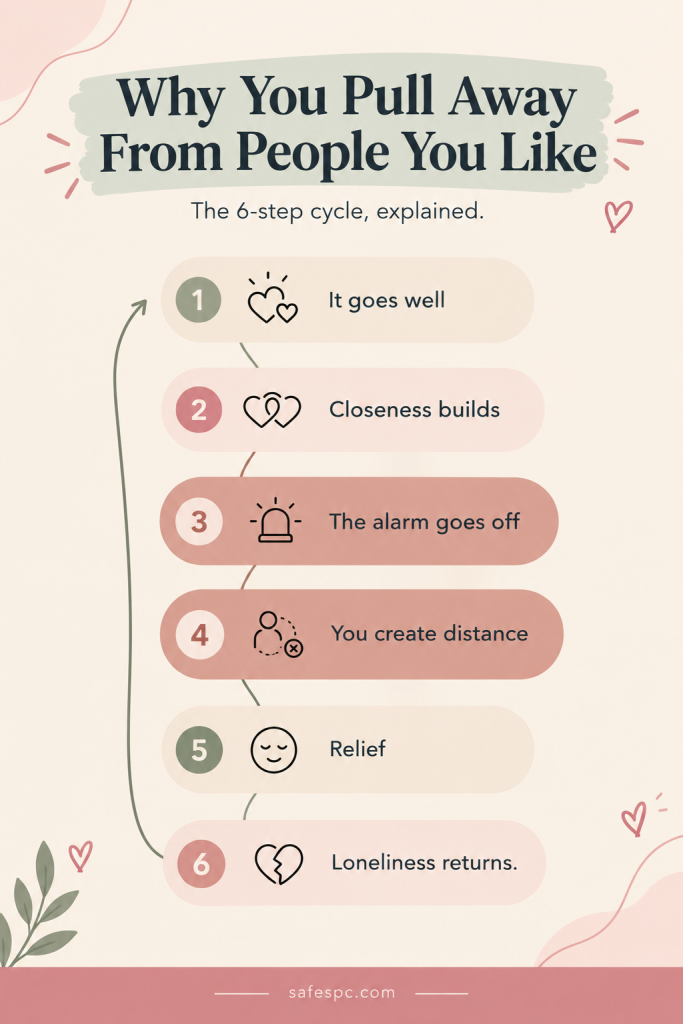
The cycle, step by step
This pattern tends to run on a predictable loop. Recognizing where you are in it is half the work.
- Things go well. You feel genuinely connected.
- Closeness builds. They say something warm, or the relationship reaches a new level.
- The alarm goes off. You feel a wave of pressure, irritation, or numbness that you can’t fully explain.
- You create distance. You find a flaw, go quiet, get busy, or start a fight.
- Relief. The pressure drops.
- Loneliness returns. You start missing them, sometimes just as they’ve begun to pull back in response.
Notice step 6. If you felt pure relief with no loneliness afterward, that’s worth taking seriously as a different answer (more on that below). But if you feel both, you’re almost certainly running this loop, and the loneliness is the honest signal.
What this pattern costs you?
Left unexamined, this pattern quietly shapes your whole romantic history. You end things with people who were kind and consistent, and you drift toward people who keep you at arm’s length because that feels comfortable. That’s not random. Why am I attracted to emotionally unavailable people explains why unavailable partners can feel safe to someone whose alarm goes off around availability.
It also costs the people on the other side. Someone who was warmly pursued and then suddenly met with distance often spirals, second-guessing everything, which is exactly the loop described in why do I overthink every text message. Your pulling away can unintentionally set off someone else’s anxiety, and then their anxiety looks like proof, to you, that closeness is exhausting.
Or maybe you just don’t like them that much
Here’s the part nobody writes about, and it matters: not everyone you pull away from is someone you secretly love.
Sometimes distance is the right answer. If you feel steady relief with no loneliness afterward, if you find yourself relieved to be out of it rather than conflicted, or if the person had real red flags you were reasonably uneasy about, your instincts may be working correctly. Assuming every urge to leave is avoidance is its own trap, and it can keep people in relationships that genuinely aren’t right for them.
A useful test: imagine the relationship ending permanently. If what you feel is grief mixed with regret, that points to fear. If what you feel is mostly calm, that points to genuine incompatibility. Neither answer makes you a bad person. It just tells you which problem you’re actually solving.
How to stop sabotaging relationships you actually want?
In the moment: when the alarm goes off
1. Notice the urge before acting on it. Name it silently: “This is the alarm, not necessarily the truth.” You don’t have to believe it yet. Just create a gap.
2. Delay the irreversible move. Don’t end things, pick the fight, or send the cold message in the first hour. The urge to flee is at its loudest right after closeness. Give it a night.
3. Ask what changed. The alarm almost always follows something specific: a warm comment, a shift toward exclusivity, a moment of vulnerability. Finding the trigger takes away much of its power.
4. Separate the flaw from the feeling. If you’re suddenly cataloging their faults, ask: “Did I notice this before things got close?” If not, it’s probably the alarm doing the noticing.
Over time: rewiring the pattern
- Practice staying one beat longer. When you feel the urge to withdraw, stay present for ten more minutes, or one more honest sentence. Small doses of tolerated closeness gradually convince the nervous system that closeness doesn’t end in disaster. If the fear runs deeper than dating, how to stop being scared of intimacy goes further into that.
- Say it out loud instead of acting it out. Replace going silent with a sentence: “I’m feeling a bit overwhelmed, and I need a little time, but I’m not going anywhere.” That single change transforms a disappearing act into a communication.
- Track your own pattern. Keep a short note of when you pulled away and what happened right before. Patterns you can see are patterns you can interrupt.
- Let someone be consistent with you. Healing this usually happens through repeated experience of a reliable person staying steady when you pull back. That requires letting one in, which is exactly the hard part.
What to say to the person you’re dating?
You don’t owe anyone your whole history, but a little honesty goes a long way. Try something like:
“I’m someone who sometimes pulls back when things start feeling close, and it’s not about you. It’s an old habit I’m working on. If I go quiet, it would help if you asked me about it instead of assuming the worst.”
Say it on a calm day, not in the middle of a retreat. A person who responds with patience is showing you the kind of consistency this pattern needs. If you’re on the other side of this, dating someone who runs hot then cold, the most useful thing you can do is stay steady without chasing, and protect your own boundaries while you do.
Common mistakes
- Assuming the pull-away means they aren’t the one: Sometimes true, but often it means they got close. Reacting to the alarm as if it were a verdict ends good relationships early.
- Testing people: Going silent to see if they’ll chase teaches you nothing reliable and exhausts the other person.
- Waiting until you feel ready: You’ll rarely feel fully ready. Growth here happens through small, uncomfortable steps, not a sudden readiness.
- Blaming it all on avoidance: If someone repeatedly disrespects you, the distance may be earned. Discernment matters as much as self-awareness.
When to consider professional support?
If this pattern repeats across every relationship, if it’s rooted in early neglect or trauma, or if it causes real loneliness and regret, therapy can change it more reliably than self-help alone. Attachment-based therapy and Emotionally Focused Therapy both work directly on the strategies described above. The right therapist won’t try to make you need people more. They’ll help you become someone who can tolerate closeness without losing yourself in it.
Frequently Asked Questions
Why do I push people away when I like them?
Because closeness can set off a protective alarm in a nervous system that learned early that depending on others is risky. The distancing is usually an automatic strategy, not a considered decision about how you feel.
Is pushing people away the same as fear of commitment?
Not quite. Fear of commitment is about avoiding a future. Pushing people away when you like them is usually about the emotional cost of closeness, which is why many people who do it still feel lonely and want connection.
Why do I lose interest once someone likes me back?
Often the interest was real, but reciprocity made the relationship feel more real, which is what triggers the alarm. It can also mean the excitement was mostly about the chase, so it’s worth asking honestly which one it was.
Can I stop pushing people away?
Yes. This pattern is a learned strategy, not a fixed trait, and it shifts with awareness, small exposures to closeness, and consistent relationships over time.
How do I know if I’m pulling away out of fear or because they’re wrong for me?
Imagine the relationship ending for good. Grief and regret point toward fear. Steady relief with no loneliness points toward genuine incompatibility.
The bottom line
Why you push people away when you like them usually has little to do with the people themselves. It’s a protective reflex, built long ago, that treats closeness as danger just as the real thing arrives. You don’t need to become someone who feels no fear. You need to become someone who can feel the alarm, name it, and choose to stay one beat longer.