How to fix anxious attachment style in a relationship is a question that usually comes after a familiar cycle repeats. The spiraling texts. The need for constant reassurance. The exhausting sense that love always comes with fear attached. There’s real hope here, and real research behind that hope.
The psychology: What causes anxious attachment style?
Anxious attachment typically forms in early childhood, when a caregiver’s responsiveness was inconsistent rather than absent entirely. Sometimes warm and attentive, sometimes distracted or unavailable, with no reliable pattern connecting the two. The child learns that love is real but unpredictable.
They adapt by staying hyper alert to any sign it might disappear. This inconsistency, not outright neglect, is what distinguishes anxious attachment from other insecure styles.
A child with an anxious pattern didn’t necessarily lack love. They lacked the ability to predict when it would show up. This teaches the nervous system to stay vigilant rather than relaxed, even decades later in adult relationships.
Later experiences can reinforce this pattern too. A relationship with genuine inconsistency, someone warm one week and distant the next, can deepen an existing anxious tendency. It can even activate it in someone who leaned more secure before.
Does anxious attachment ever go away?
This is one of the most hopeful areas of attachment research. The honest answer is yes, meaningfully, though not always completely or instantly. Psychologist Mary Main identified a phenomenon called earned secure attachment. Adults who had genuinely difficult early attachment experiences can develop real security later in life through consistent, corrective relationships.
The research is specific about how this happens. One study found that most people revert toward their baseline attachment style within a few years. But roughly 25 percent of significant relational experiences produce lasting shifts toward greater security.
That’s not a guarantee, but it’s a real, documented pathway, not just a hopeful idea.
Anxious attachment doesn’t typically vanish overnight. Expecting instant transformation usually leads to discouragement. What actually happens looks more like a gradual quieting:
- Fewer spirals
- Faster recovery from triggers
- More capacity to self soothe before reaching for reassurance.
Progress here tends to be measured in degree, not in becoming an entirely different person.
Can you heal anxious attachment while in a relationship?
Yes, and for many people, a relationship is actually one of the most effective places to do this work. Research on relational healing points to consistent partner responsiveness as one of the strongest predictors of attachment change over time.
A partner who’s comfortable with warmth, who responds reliably during moments of vulnerability, helps rewire the nervous system’s expectations directly. This doesn’t mean the relationship does the healing for you passively.
It means the relationship becomes the practice ground. Real opportunities to notice an old trigger, try a new response, and get direct feedback. Feedback from someone who isn’t disappearing the way old patterns predicted.
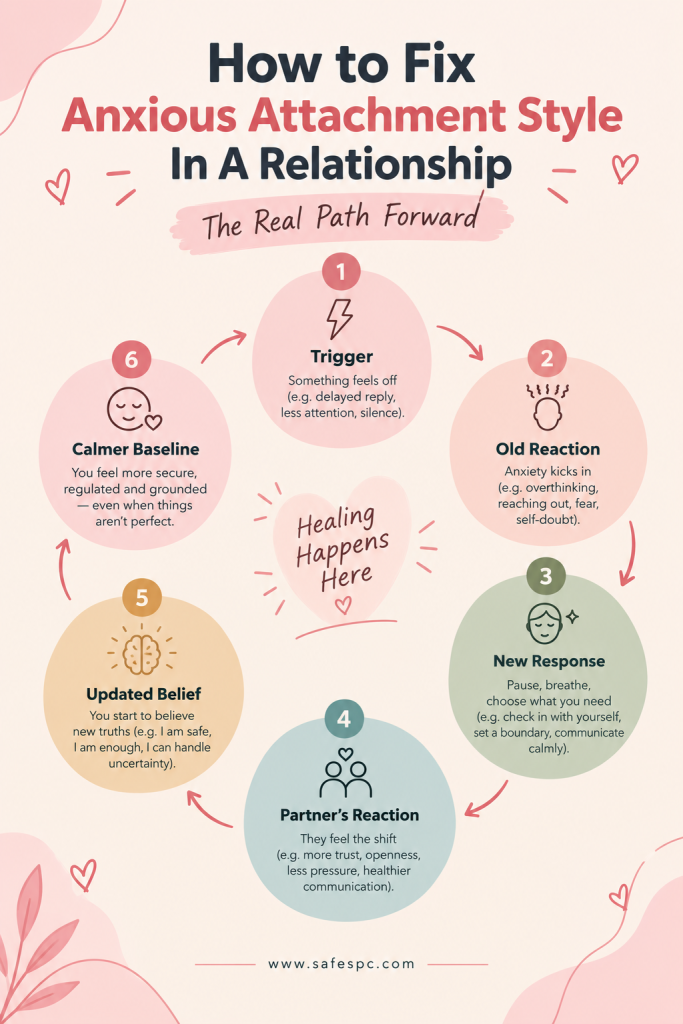
How to fix anxious attachment style in a relationship? [Step by step]
1. Learn to name the activation before reacting to it. When anxiety spikes, pause and name it internally. Something like, “this is my attachment system activating, not necessarily an accurate read on what’s happening.” This tiny gap is where real change starts.
2. Build a self soothing practice you can access in the moment. Before reaching for your phone to check on a partner, try a physical grounding technique first. Slow breathing, a short walk, splashing cold water on your face. Give the nervous system sixty seconds to settle first.
3. Communicate the need directly instead of testing for it. Rather than going quiet to see if your partner notices, say plainly what you feel. Try, “I’m feeling anxious right now and could use a little reassurance.”
4. Practice tolerating small gaps in contact on purpose. Let a text sit unanswered by you for an hour instead of replying instantly. Notice the discomfort without acting on it. This builds real tolerance gradually, the same way exposure therapy works for other anxieties.
5. Separate your partner’s mood from your own safety. A partner having an off day, being tired, or needing space isn’t automatically a threat. Practice the internal sentence, “their bad mood is about them, not a verdict on us.”
6. Track your own progress, not just your triggers. Keep a simple log of moments you managed differently than you would have months earlier. This evidence matters more than it seems. Anxious attachment often distorts memory toward hard moments and minimizes real growth.
7. Choose a partner who can actually meet this work halfway. Healing happens fastest with a partner capable of consistency and patience. Anxious attachment vs avoidant attachment covers what happens when this work meets an avoidant partner instead. It also covers why that pairing makes healing harder.
What a supportive partner can actually do to help?
A partner doesn’t need to fix anxious attachment, since that’s not genuinely possible from the outside. What helps most is consistency, following through on small commitments reliably. Predictability is exactly what anxious attachment craves and rarely received early on.
Direct reassurance also matters more than partners sometimes realize. A simple, unprompted “I’m not going anywhere” costs almost nothing to say and does real, measurable work over time. Avoiding defensive reactions to anxious moments helps too. Meeting a spiral with patience rather than frustration tends to shorten it considerably.
Common mistakes people make while trying to heal
Expecting a partner to provide constant reassurance indefinitely. Reassurance helps, but relying on it exclusively keeps the underlying pattern intact. Building no internal capacity to self soothe stalls real change.
Treating a single hard week as proof nothing is working. Healing isn’t linear. A stressful stretch can temporarily intensify old patterns without erasing genuine progress. Why am I attracted to emotionally unavailable people covers a related trap worth watching for during setbacks.
Avoiding the discomfort of small exposure exercises. Growth here requires some willingness to sit with the exact discomfort the pattern was built to avoid. Skipping that discomfort tends to keep the old pattern fully intact.
When to consider professional support?
If anxious attachment consistently disrupts daily functioning, self directed work alone may not be enough. The same is true if it traces back to genuine early trauma. Therapy approaches like Emotionally Focused Therapy and attachment based therapy specifically target these patterns. They often produce faster, more durable change than self help alone typically can.
How this pairs with other attachment work?
Sometimes the pattern behind how to fix anxious attachment style in a relationship feels less like anxiety, more like fear of closeness itself. How to stop being scared of intimacy covers that specific angle in depth.
If you suspect your partner might be the avoidant half of this dynamic, one article breaks it down clearly. Fearful avoidant vs dismissive avoidant attachment covers exactly which type you might actually be dealing with.
Frequently Asked Questions – FAQs
What causes anxious attachment style in adults?
Anxious attachment typically develops from inconsistent early caregiving. It can be reinforced later by inconsistent adult relationships that echo the same unpredictable pattern.
Does anxious attachment ever fully go away?
For many people, it meaningfully improves rather than disappearing completely. Research on earned secure attachment shows real, lasting change is genuinely possible with consistent effort and support.
Can you heal anxious attachment while in a relationship?
Yes. A relationship with a consistent, responsive partner is one of the most effective environments for this kind of healing. Both people need to be willing to do the work involved.
How long does it take to fix anxious attachment style in a relationship?
There’s no fixed timeline. It depends on the severity of the pattern and the consistency of support around it. Most people notice gradual improvement over months, not days.
Is it possible to fix anxious attachment style in a relationship alone, without a partner’s help?
Some progress is possible through therapy and self directed work. But a relationship offers something solo work can’t fully replicate, real, repeated evidence that closeness can be safe.
The bottom line
How to fix anxious attachment style in a relationship comes down to consistent, small acts of self awareness stacked over time. Not one dramatic breakthrough.
2 thoughts on “How To Fix Anxious Attachment Style In A Relationship: The Real Path Forward”