Midnight, a time zone apart, and the story in your head is already three scenes ahead of anything that’s actually happened. They said they were tired and going to bed. That’s it. That’s the whole fact. And somehow you’ve built an entire narrative on top of one tired sentence, checked when they were last active, noticed it was later than when they said, and now you’re lying there running a trial with no evidence, just a gap where information used to be.
Here’s something that might surprise you, and it’s worth sitting with before anything else in this post: research doesn’t actually back up the fear that distance erodes trust. If anything, it finds close to the opposite. That doesn’t mean your anxiety is imaginary. It means the real story is more interesting, and more useful, than “distance breaks trust.”
The research nobody mentions in this conversation
Distance didn’t weaken what these couples had. It intensified it, because they couldn’t coast on physical proximity to carry the relationship, so they put more into every conversation instead.
There’s a mechanism behind this, and it matters for what comes next. Researchers found that long distance couples tend to idealize their partners more than couples who are physically close, forming heightened, more positive perceptions of the relationship as a way of managing the uncertainty that distance creates.
In plain terms: not knowing exactly what your partner’s day looked like doesn’t just produce anxiety. For a lot of people, it also produces its opposite, an inflated, generous read on everything, filling the gaps with the most flattering interpretation rather than the most suspicious one.
So, if the research says trust is often fine, even elevated, why does it feel like the hardest part of your relationship?
Why it doesn’t feel fine, even when it technically is?
Averages hide a lot. The idealization effect is real, but it isn’t universal, and it isn’t permanent. It tends to depend heavily on what you’re bringing into the distance with you.
If you lean toward anxious attachment, ambiguity doesn’t default to generous interpretation. It defaults to threat, because that’s what an anxious nervous system is built to do with uncertainty, fill it with the worst case rather than the best one.
Distance doesn’t create this tendency. It just removes the thing that used to quiet it fastest, a hand on the shoulder, a face you could read in real time, the small physical cues that usually settle a nervous system before a thought spirals into a full story.
Why do I overthink every text message covers exactly this mechanism, and it’s worth reading alongside this post if the midnight spiral above felt uncomfortably familiar.
So two people can be in the same objective situation, same distance, same contact frequency, and have completely different internal experiences of it. One idealizes. One spirals. Most people do a little of both, depending on the week.
The trust that’s real, and the trust that’s just untested
Here’s the part that actually matters more than whether you currently feel anxious or secure. Idealized trust and earned trust are not the same thing, even though they can feel identical from the inside while everything’s going fine.
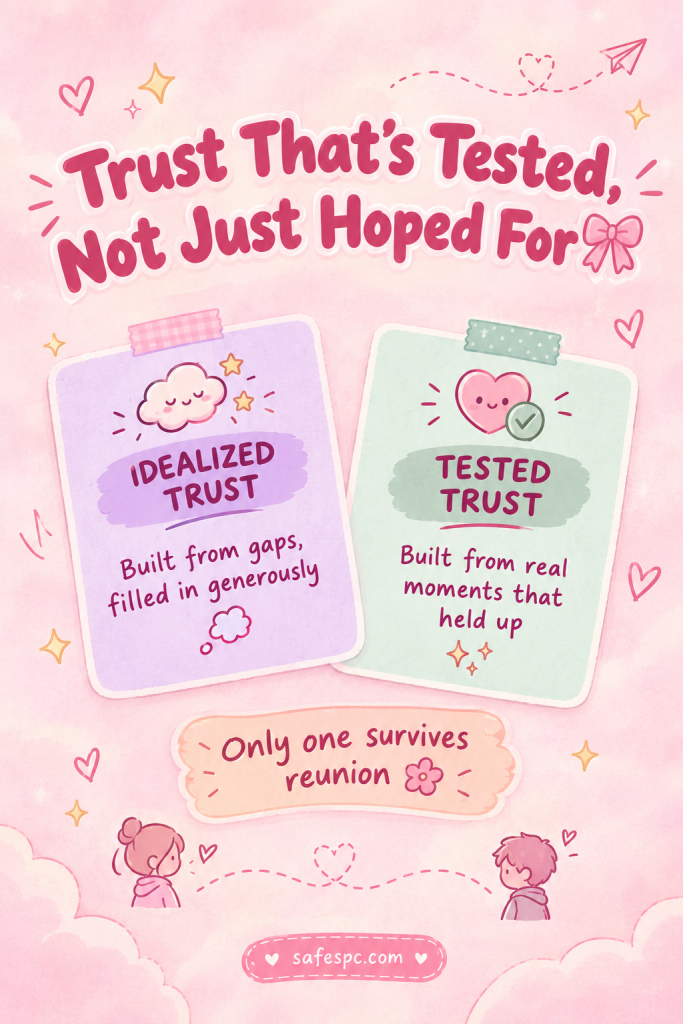
- Earned trust is built from specific, repeated moments where your partner had the chance to handle something badly and didn’t. A hard conversation they didn’t dodge. A plan they followed through on when it would’ve been easy not to. A moment of real transparency when a comfortable lie was sitting right there. That kind of trust holds up under pressure, because it’s already been pressure-tested.
- Idealized trust is built mostly from absence of evidence either way, generously interpreted. It feels just as warm, sometimes warmer, but it hasn’t actually been tested against anything hard yet. This is worth being honest with yourself about, not because idealized trust is bad, it isn’t, it’s a completely normal and even useful part of how distance works psychologically. It’s worth knowing the difference because only one of these holds up reliably later, and the moment that tends to reveal which one you actually built isn’t during the distance. It’s after.
The part almost nobody warns you about: reunion, not distance, is often the hard part
Read that again, because it reframes the whole anxious question you came here with. The danger was never really “will the distance break our trust.” For a lot of couples, the real danger is the opposite: trust that felt completely solid at a distance, built heavily on idealization, meeting daily reality for the first time and finding it can’t carry the weight.
The small irritations neither of you had to manage before. The version of them you’d built in your head meeting the actual, specific, sometimes-annoying person.
This isn’t a reason to stop trusting your partner during the distance. It’s a reason to build trust that’s tested now, not trust that’s only ever been imagined.
Building tested trust instead of performed trust
Let transparency be proactive, not extracted. There’s a real difference between a partner who shares their day because they want to and one who only shares because you asked a pointed question first. The first builds tested trust. The second builds a habit of reassurance that quietly teaches you to need more of it over time.
Create a few small, real tests of follow-through, not manufactured ones. Not tests in the manipulative sense, tricking them to see what happens, but simply paying attention to the ordinary moments that already exist: did they do the thing they said they’d do, did they bring up a hard topic themselves instead of waiting to be caught, did they handle a disagreement by engaging with it or by going quiet. These are naturally occurring data points. Notice them rather than needing a bigger, more dramatic test to feel convinced.
Talk about money, time, and other people honestly, before it’s a problem. Idealization tends to paper over exactly these three categories, since they’re the ones most likely to surface real incompatibility once proximity returns. A direct conversation now is tested trust. Assuming it’ll be fine because everything else has been is idealized trust.
Notice the difference between a real red flag and your own uncertainty intolerance. Not every uneasy feeling means something’s wrong, and not every calm feeling means it’s fine. Green flags vs red flags in a relationship walks through how to tell a genuine warning sign apart from a feeling that’s really about your own nervous system’s relationship with ambiguity, which is worth knowing cold before you’re trying to apply it at 1am with limited information and a tired brain.
Build in a version of reunion before the real one happens. A video call where you handle something mildly stressful together, planning logistics, navigating a disagreement in real time, is a small, low-stakes rehearsal for the thing research says is actually the harder test. It won’t predict everything, but it gives you real information instead of only imagined information.
If the distrust has a real source
Everything above assumes the anxiety is mostly about distance and uncertainty rather than about something your partner has actually done. If there’s a real reason behind the distrust, a lie you caught, a pattern of vagueness that doesn’t add up, inconsistency that’s gotten worse rather than better, that’s a different conversation than the one this post is having.
Signs your partner has abandonment issues and what is ghostlighting both cover genuine warning patterns worth checking against, separately from the idealization-versus-tested-trust framework above.
You’re allowed to want more consistency than a framework like the 777 rule provides. Structure helps the ordinary uncertainty of distance. It was never going to fix an actual breach of trust, and it isn’t supposed to.
Trust, at this distance, was never really about believing nothing bad is happening on the other end of the silence. It’s about building something specific and tested enough that it doesn’t need the silence to be empty in order to survive. Most of what you’re afraid of isn’t happening. What’s actually worth your attention is whether what you’re building together could hold up if it did.
2 thoughts on “How to Trust Your Partner in a Long Distance Relationship”