Most games for long distance couples are built to fill an hour. The better ones are built to fix something. Distance takes specific things away from a relationship, and when a game hands one of them back, a Tuesday night call stops feeling like homework and starts feeling like a shared living room.
Here is the short answer. The best games for long distance couples are the ones matched to the gap you are actually feeling:
- The missing sense of sharing a space (presence)
- Clashing schedules (rhythm)
- A thin pile of stories that belong only to you (memory)
- or a future that feels vague (future).
Name the gap, play one game built for it, and notice how you feel afterward. This guide to games for long distance couples is organized around those four gaps and includes 25 games and formats.
A few are well known and worth the hype. Many are formats we designed ourselves, like the Day Forecast, the Memory Museum and the Life Draft, because the usual lists of Truth or Dare and Pictionary skip the hard parts of loving someone from far away. You will also find fairness rules, a consent-first section for flirty play, and a four week plan so you never start from a blank calendar.
If you are still sorting out the basics, start with our guide to long distance relationship activities, then come back here. If you want a steady rhythm for your calls, pair this guide with the 777 rule. Now let’s look at why most lists miss the mark.
Why most games for long distance couples fall flat?
Skim the top results for games for long distance couples and you will see the same pattern: a long numbered list of Truth or Dare, Pictionary, trivia and Would You Rather, each with two sentences of instructions. Nothing in those lists is wrong. The problem is what they assume. They treat distance as a boredom problem, as if the only thing missing from your calls is an activity.
Distance is not mostly a boredom problem. It is a set of specific losses, and the research points that way.
A diary study by Jiang and Hancock, published in 2013, found that people in long distance relationships reported more adaptive self-disclosure than couples who lived near each other, and that they also formed more idealized pictures of their partners. Both were linked to higher intimacy, and the effects depended on features of the communication medium, such as how live and mobile it was.
Read that again with games in mind. Long distance couples are often good at talking and prone to polishing. You show the best version of your day, and you build a partner in your head who is a little tidier than the real person. The games that help most keep disclosure going and bring ordinary life back into view. Louder jokes and longer evenings do not do that.
Three habits make otherwise decent games backfire.
- The first is repetition. Aron and colleagues found that couples who did more novel and exciting activities together reported less boredom and higher relationship quality than couples who stuck with ordinary routines. A nightly trivia habit goes stale within a month.
- The second is pure competition. When you lose to your partner in person, you can laugh and hug it out. Over a screen, the sting just sits there, so we lean toward cooperative play and keep scores light.
- The third is ignoring fatigue. Video calls are tiring for reasons that Stanford researcher Jeremy Bailenson laid out in 2021, including constant close-up eye contact and an ever-present view of yourself. A game that locks you both into a bright video grid for two hours can drain you before it connects you.
We need a better way to choose games for long distance couples, and that is what the next section gives you.
The Four Gaps framework: how to choose games for long distance couples
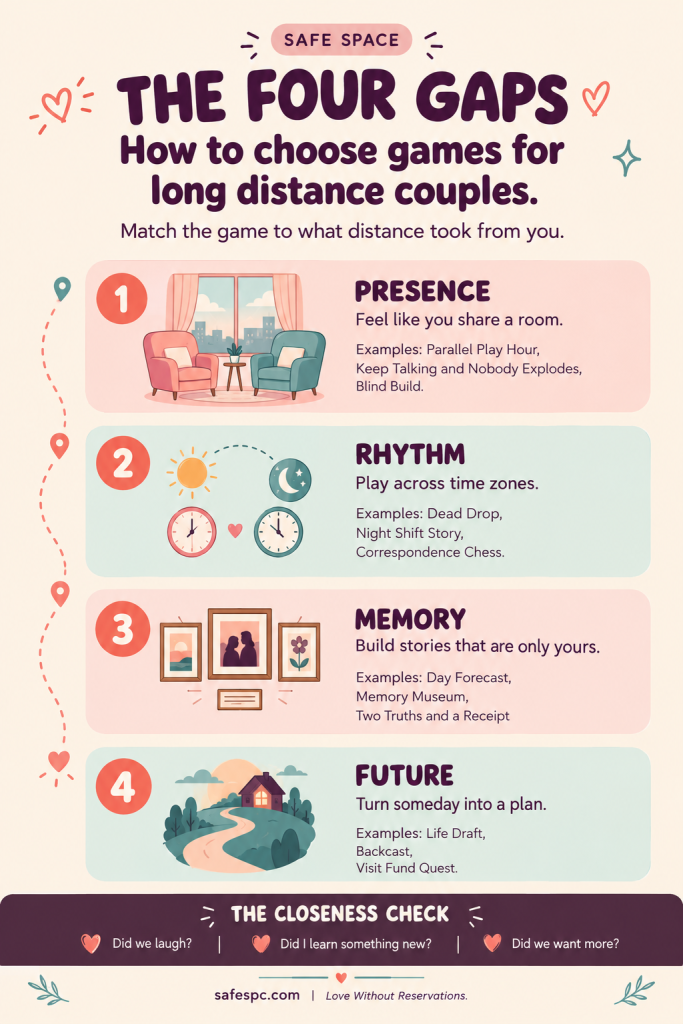
Every long distance relationship loses the same four things to some degree. We call them the Four Gaps, and each one calls for a different style of games for long distance couples.
Presence is the missing sense of being in the same space. You can talk for an hour and still feel like you are on separate islands.
Rhythm is what time zones, work shifts and sleep do to your timing, so one of you is always arriving as the other is leaving.
Memory is the thin pile of stories that belong only to the two of you, because most of your days happen apart.
Future is the open ended feeling that comes when nobody can say how or when the distance ends.
| Gap | What it feels like | What closes it | Game type |
|---|---|---|---|
| Presence | You talk, but you do not share a space | Side by side activity and shared attention | Co-op and parallel play |
| Rhythm | Time zones keep you chasing each other | Play that survives delays and sleep schedules | Asynchronous games |
| Memory | Few stories belong only to you | Making and revisiting shared stories | Memory and disclosure games |
| Future | The distance feels open ended | A concrete plan built together | Planning games |
Using the framework takes three steps.
- First, name the gap that hurt most this week. A quick test: if you felt lonely in the middle of a call, it is presence. If you kept missing each other, it is rhythm. If a conversation felt thin, it is memory. If you went quiet when “someday” came up, it is future.
- Second, pick one game from that section below.
- Third, run the Closeness Check afterward by asking three questions. Did we laugh? Did I learn something new about you? Did either of us want to keep going?
Two yeses means the game stays in rotation. Fewer than two means you rotate it out, no hard feelings. Your own Closeness Check is how you find your best games for long distance couples, and it is more reliable than any ranking, including ours.
Presence games: close the same room gap
These games for long distance couples work because they give you something to face together instead of each other. That takes pressure off conversation and recreates the feeling of sitting on the same couch.
1. Parallel Play Hour
Get on a call, then do separate things at the same time: each of you plays a puzzle, folds laundry or works on a hobby. Talk when you feel like it, and narrate one moment of your hour, such as “I just finished the corner pieces.” It sounds too simple to be a game, yet it is the closest thing to sharing a room. Audio only works well and spares you the video fatigue we covered above.
2. It Takes Two and other co-op story games
Co-op story games are built so that neither of you can progress alone, which means you have to keep talking, helping and laughing at each other’s mistakes. It Takes Two is made for exactly two players, and the publisher offers a Friend’s Pass so only one of you needs to buy it, though you should check how that works on the platform you both use. Pick one game and stay with it for several sessions, because the shared story is part of the point.
3. Keep Talking and Nobody Explodes
One of you faces a bomb on screen but cannot read the instructions. The other holds the Bomb Defusal Manual, which the official game site says can be printed or viewed for free. Neither of you can win without clear, calm and specific communication, which makes it the best argument-training game we know. It runs on iOS and Android, so you do not need a console, and a non-gamer can hold the manual with zero skill required.
4. Blind Build
Open Minecraft, where the Bedrock edition makes cross-platform play easiest. One of you sees a reference picture, such as a cottage or a bridge, and the other builds it from spoken directions alone. Then swap. Within five minutes you will know whether your instruction style is “a bit to the left” or “exactly seven blocks,” and you will laugh about it for weeks.
5. Shared Farm
Stardew Valley’s multiplayer mode lets you run a farm together, and it works because the world keeps going whether or not you are talking. Treat the farm like a shared apartment: decide who waters, who cooks and who decorates, and leave notes in a chest for each other. It is slow, cozy and surprisingly intimate.
6. Two Player Duels on Board Game Arena
Board Game Arena runs real board games in your browser, live or turn by turn. Browse its two player titles, such as Patchwork and 7 Wonders Duel, which are gentle on beginners. If you live in very different time zones, switch to turn based mode and finish a game over a week.
7. GeoGuessr Co-pilot
GeoGuessr drops you somewhere random on a map and asks you to guess where you are. Make it a team sport: one of you plays while the other navigates with a second map and a search engine. Every guess becomes a story about a place you have lived in or visited, so a game turns into a quiet exchange of life histories. Check its current free limits before you plan a session.
Rhythm games: when time zones are the opponent
If you live eight hours apart, or one of you works nights, live play will not always fit. Asynchronous games for long distance couples turn that mismatch into a feature. A move made at midnight and answered at breakfast is a tiny message that says “I thought of you today.”
These games also soften the anxious waiting that comes when replies slow down, which we unpack in why you overthink every text message. Many of them slot neatly into the seven day layer of the 777 rule without extra scheduling. Rhythm is also where many games for long distance couples quietly fail, because they assume you are both online at the same time.
8. Dead Drop
Each day, photograph something ordinary from your day and hide a clue in it: a number on a receipt, the color of a mug, a name on a shop sign. Your partner has until tomorrow to find the clue and send one back. You are not playing for points. You are quietly learning what the inside of each other’s day looks like, which is the part of life that distance hides.
9. Night Shift Story
Open a shared note. At bedtime, write exactly 100 words of a story and end on a cliffhanger. Your partner continues when they wake up, and you trade like this for fourteen days. Then read the whole thing aloud on a call. Time zones stop being an obstacle because the story only works when someone is asleep.
10. Correspondence Chess
Lichess offers correspondence games where each move can take days. One move a day becomes a slow conversation across a board. If chess is not your thing, pick any turn based game from Board Game Arena and keep the same rhythm.
11. Same Puzzle, Different Clocks
Wordle and Connections give everyone the same puzzle every day, no matter where they live. Add one rule: before you share your result, guess your partner’s score. Over a few weeks you will learn their habits, such as the opening word they always pick, and the guessing is where the closeness lives.
12. Voice Note Quiz Show
Record five trivia questions that only you can write: how many steps it is to your bus stop, what you eat when you are stressed, the name of your childhood pet. Send them as a voice note. Your partner records their answers along with a reaction to each one, and wrong answers owe a story. It sounds silly, and it builds real knowledge of each other fast.
13. Song Bracket
Each of you picks eight songs that mean something to you and builds a bracket from a shared playlist. Over a week, vote on the matchups and add one line explaining each choice. By the final, you have a map of each other’s taste and a soundtrack for your next reunion.
Memory games: build the shared story distance cannot give you
Couples who live together collect memories by accident: the burnt toast, the shared umbrella. You have to collect yours on purpose. John Gottman describes a love map as a mental picture of your partner’s inner life, covering their worries, hopes and preferences, and he stresses that it needs regular updating because people keep changing. These games for long distance couples update the map while making stories you actually own.
14. Day Forecast
Each morning, text three predictions about your partner’s day: “You will skip lunch,” “The meeting will run late,” “You will think of me at 3.” At night, score each other. After a week, read back the misses. The misses are the point, because they show exactly where your love map is out of date. It takes two minutes a day.
15. Memory Museum
Each of you curates three exhibits from your shared history: the first message you sent, a trip, an inside joke. Your partner writes the museum placard for each of yours, describing what happened and why it mattered. Then compare placards. The places where your memories differ are the most interesting, and often the sweetest.
16. The 36 Questions in Slow Motion
Psychologist Arthur Aron’s famous 36 questions were designed to build closeness between strangers in about 45 minutes. As a couple, do them slowly: two questions per call across three weeks, and write down one answer that surprised you. Our 100 couple conversation cards work the same way if you want fresh prompts after that.
17. Two Truths and a Receipt
This is a twist on the classic. Each of you shares three stories, two true and one invented, but the true ones must come with proof, such as a photo, a ticket or a screenshot. Your partner guesses the invented one before seeing any proof. The proof is where the stories come alive.
18. The Podcast Interview
Take turns hosting a show about your partner’s life. Ask one real question per episode, such as “What did you want to be at ten?” or “What is the bravest thing you did this year?” Record it as a voice note and keep the archive. After a few seasons you will have an oral history of your relationship.
Future games: play your way toward closing the distance
Distance is easier to carry when it has an end. These games for long distance couples turn “someday” into something you can plan, and they show you early whether you want the same things. Pair them with our guides on the signs a long distance relationship will last and the hard truths about long distance relationships, so the playful side and the honest side travel together.
19. Life Draft
Run it like a fantasy draft. List ten life decisions, such as where you live first, how often you see each other’s families, how you handle money, whether you want pets and how a weekend should feel. Take turns drafting one topic at a time, say what you would want, and let your partner respond. Anything that makes either of you tense goes in a “talk soon” pile instead of being forced. It is a gentle way to find out whether your futures match.
20. Backcast
Start on the day you finally live in the same place and work backward. What must be true three months before? Six months before? A year before? You are building a milestone timeline from the end, which is how many planners handle big projects. You will quickly see which pieces are already in motion and which nobody has started.
21. Visit Fund Quest
Turn your next visit into a quest. Build a shared tracker with a target amount and bingo squares for small wins, such as skipping a takeout, selling something unused or picking up an extra shift. Every filled square unlocks a tiny reward from the other person, like a voice note or a handwritten letter. Money talk becomes a team project instead of a worry.
22. Floor Plan Fantasy
Open any free room planner and furnish one room together on a fixed imaginary budget. Take turns placing items and explain each choice. You will learn who needs a desk, who needs a reading chair, who cares about sofa color and who is comfortable with clutter. It is a surprisingly honest preview of living together.
Flirty games for long distance couples, with consent built in
Flirting is part of staying close, and it can be sweet instead of explicit. Treat these as optional games for long distance couples, never as a test of how much someone cares.
Set three rules before you start. Ask rather than assume. Either of you can stop any game at any time without explaining. And nothing is screenshotted, saved or forwarded. A good test is to share only what you would be fine with seeing on a billboard someday. If trust is still a work in progress, our guide to how to trust your partner in a long distance relationship is a good companion.
23. Compliment Draft
Pick categories such as your mind, your laugh, your hands and your courage. Take turns drafting one category at a time and give a compliment you have never said before. Repeats are not allowed, which pushes you past the safe answers.
24. Slow Burn Texting
For one evening, every text must be exactly three words. The restriction builds tension and makes you choose each word carefully. Keep it playful and suggestive at most, never explicit.
25. Describe It Blind
Describe a place you want to take your partner using only senses: smells, sounds, textures and temperatures. Do not name it. Your partner sketches it or guesses the place, then you swap. Keep a list of the places, and visit one when you finally meet.
Rules that keep games for long distance couples fun instead of tense
A few shared rules keep games for long distance couples friendly far better than any scoreboard. Agree on them once and revisit them monthly.
The lag rule. If a connection drops mid-round, the round is void and nobody loses points. Bad internet should never be anyone’s fault.
The handicap rule. If one of you is far better at a game, the stronger player plays with a limit, such as fewer hints or the non-dominant hand. The goal is a close game, not a fair fight.
The pause card. Either of you can say “pause” without explanation, and you switch to something easier. Tired people lose games and feelings.
The rotating host. Take turns choosing the game and teaching it. Teaching is intimate, and it stops one person from becoming the permanent activity planner. That imbalance is one of the quiet ways resentment grows, which we cover in what kills long distance relationships.
The novelty budget. Introduce one new game or format a week, because novelty protects against boredom.
The fatigue policy. Make at least one session in three audio only, on a walk, or on separate screens. Moving your body while you talk is a gift to your brain.
The reset rule. Reset scores monthly. A permanent leaderboard makes one of you the champion and the other the challenger, and nobody needs that dynamic in a relationship.
A four week plan for your first month of play
You do not need a calendar full of game nights. A little and often beats a lot and rarely. The 777 rule works well as scaffolding: small check-ins through the day, a real conversation each week, and something bigger every seven weeks. Here is how to place the games for long distance couples we covered above.
| Week | Focus | Games to try |
|---|---|---|
| 1 | Presence and rhythm | Parallel Play Hour once, Same Puzzle Different Clocks daily |
| 2 | Memory | Day Forecast daily, Memory Museum at the weekend |
| 3 | Presence, deeper | One co-op session of Keep Talking and Nobody Explodes or It Takes Two, and start Night Shift Story |
| 4 | Future | Life Draft, then set up the Visit Fund Quest |
At the end of the month, look back at your Closeness Checks. Keep the two or three games that scored best, retire the rest, and choose a new gap to focus on in month two. By then you will have your own short list, which is worth more than any list of 25 you find online.
What if one of you does not like games?
This is more common than most lists of games for long distance couples admit, and it does not close the door. Many people who say they hate games actually dislike competition, controllers or feeling bad at something in front of someone they like.
So choose formats that feel like conversations rather than contests. Day Forecast, Memory Museum, The Podcast Interview and Describe It Blind need no skill at all. Keep Talking and Nobody Explodes lets the non-gamer hold the manual, which is the most important role in the game and requires nothing but a calm voice.
Offer a ten minute taste test instead of an evening commitment, and let the reluctant partner choose the next one. If they are still lukewarm, drop the screen entirely, because games for long distance couples work on paper too: draw each other’s rooms from memory, write postcards you read aloud, or try one of our romantic things to do in a long distance relationship. The point is closeness. Games are only one road to it.
Games for long distance couples: your questions answered
Here are the questions couples ask most often about games for long distance couples, with straight answers.
How often should we play games as a long distance couple?
Aim for one proper session a week and small daily touches, like Wordle, a Day Forecast or a voice note quiz question. A weekly session is easy to keep and leaves room for real conversation. If you feel obligated, play less. If you feel starved, add a second session.
What are the best free games for long distance couples?
Wordle, Connections, Lichess correspondence chess and the free options on Board Game Arena cost nothing to start. Every format we designed in this guide, such as Dead Drop or the Memory Museum, needs only a phone, which makes them the cheapest games for long distance couples you can find. Free tiers change, so check each site before you plan a session.
What if we are in very different time zones?
Lean on the Rhythm games and protect sleep first. Use asynchronous play on weekdays and keep live games for the one overlap window you can share, even if that is only 30 minutes. A short, fun session beats a long one that leaves one of you wrecked at work.
Are video games good or bad for a long distance relationship?
It depends on how you use them. Cooperative video games can be some of the best games for long distance couples, because they build teamwork and shared stories. Games that become a place to hide, or that fill every call so you never actually talk, can slowly empty the relationship. If you finish a game feeling closer, it is helping. If you finish it feeling the same or worse, rotate it out.
Which games work with only a phone?
Keep Talking and Nobody Explodes runs on iOS and Android, and Wordle, Connections, Day Forecast, Dead Drop, Song Bracket and the Voice Note Quiz Show all work on any phone. For long calls, go audio only and walk around.
Do games replace deep conversation?
No. Games open doors, and conversation walks through them. After a game, ask one follow up question, such as “What did that remind you of?” That single question is often where the real talk starts.
How do we know games are actually helping?
Use the Closeness Check after each session. Over a month, you should see more laughing, more new facts about each other and more wanting to keep going. If games are the only thing holding things together, or you start noticing the patterns in signs a long distance relationship isn’t going to work, have the honest conversation instead of adding more games.
The point of playing
Distance asks you to build closeness on purpose, and games are one of the friendliest tools you have. They give your hands and attention something to do, so the harder parts, like honesty, trust and planning, have room to show up. You do not need all 25. You need two or three that feel like yours and a habit you can keep when life gets busy.
Start small this week. Name the gap that hurt most, pick one game from its section, and run the Closeness Check afterward. The best games for long distance couples are usually the ones a pair invents for themselves, so tell us in the comments what you end up playing.
2 thoughts on “Games for Long Distance Couples: 25 Ways to Feel Close”