
The 777 rule is usually explained as a date every 7 days, a night away every 7 weeks and a trip every 7 months. It is a neat idea for couples who live in the same city. For the 777 rule for long distance relationships, though, the numbers need a rethink, because you cannot walk to a coffee shop together or take a weekend away for the price of a tank of gas.
Here is the short answer. The 777 rule is a rhythm, not a law: something small and frequent, something focused every week, something special every few weeks, and something big every few months. The long distance version keeps that shape and adapts every layer to screens, time zones and travel budgets.
This guide gives you the original rule and the long distance version side by side, a four layer plan, fixes for time zones and tight budgets, the research behind why rhythm helps (and what it does not prove), and a fill in template you can finish in fifteen minutes. If you are looking for ideas for the weekly layer, our guides to long distance relationship activities and games for long distance couplesare good companions.
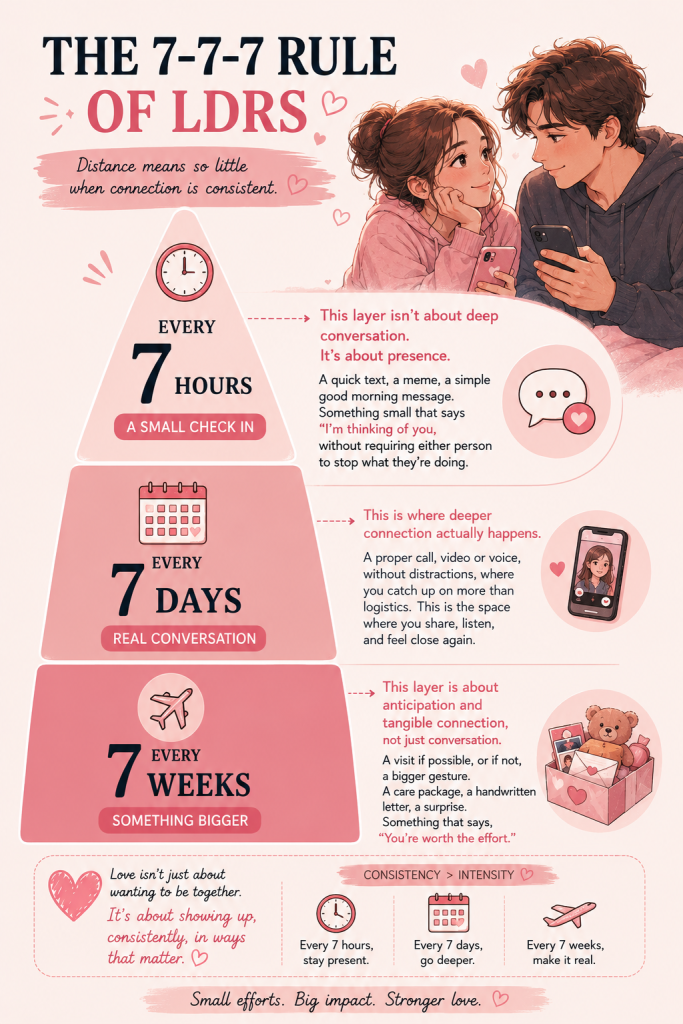
What is the 777 rule? The original version, explained
The 777 rule in relationships is a schedule built around the number seven. In its common form, it asks a couple to go on a date every 7 days, spend a night or a weekend away every 7 weeks, and take a longer trip together every 7 months. The dates can be cheap, like a coffee run or a phone free walk, and the trips do not need to be fancy. The point is to keep time together on the calendar instead of hoping it appears.
Where the rule came from is unclear. Brut reports that it spread mainly through social media, where short videos and infographics made it easy to share, and that it is not based on formal research. That honesty matters. Seven is memorable, which is why the rule travels so well, but nothing suggests that seven days, weeks and months are scientifically special. Eight would probably work too.
What the rule gets right is the structure: regular small investments, with bigger ones spaced out so that you always have something to look forward to. One therapist who has written about it calls the rule incomplete rather than wrong, because couples often struggle less with finding time than with feeling connected once they have it. We agree, and we build that idea into the long distance version below.
The original also assumes you can be in the same room. When you cannot, three of its pieces break at once. The weekly date needs a screen, the 7 week night away needs a plane ticket, and the 7 month trip can be a year away. That is why the 777 rule for long distance relationships needs adjusting rather than copying.
The 777 rule for long distance relationships: four layers
The version we recommend keeps the original three layers and adds a fourth at the bottom. Distance makes a week feel long, so a light touch in between matters. We call that bottom layer the pulse.
| Layer | Original 777 rule | 777 rule for long distance relationships | What it looks like |
|---|---|---|---|
| Pulse (about every 7 hours) | Not part of the original | A small, specific touch | A voice note, a photo of your view, one real question |
| Date (every 7 days) | A date | A focused call or shared activity with a purpose | A call with a simple agenda and one shared game or project |
| Moment (every 7 weeks) | A night or weekend away | A visit if you can, or a shared special event if you cannot | A weekend visit, or a surprise delivery plus a long themed night |
| Reunion (every 7 months) | A longer trip | Extended time together and a plan checkpoint | A week or more together, and a talk about the path to closing the distance |
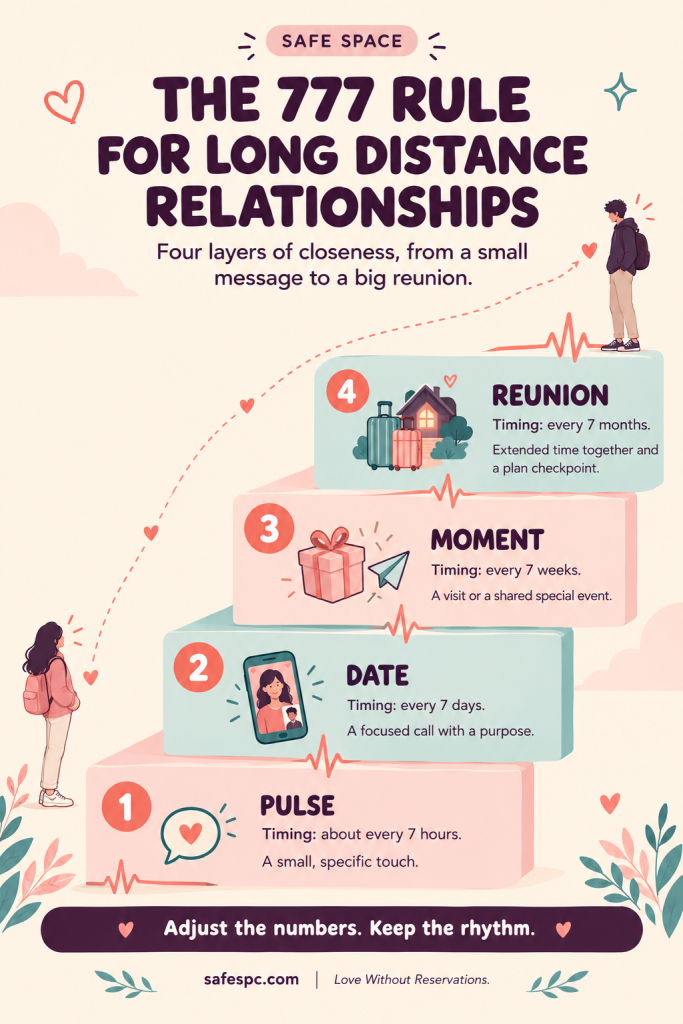
Once you see the 777 rule for long distance relationships as four layers instead of three dates, it gets much easier to adapt.
A quick note on the numbers: treat 7 as a starting point, not a deadline. The pulse is not a clock, so think of it as two or three touches across the hours you are both awake.
If flights are expensive, your 7 week layer might be a surprise delivery, and your 7 month layer might stretch to six or twelve months with a date you both can see.
The rule works when the rhythm matches your life, not when the numbers are perfect.
Layer 1: the 7 hour pulse
The pulse fills the quiet space between bigger moments. Its job is simple: to say “you are on my mind” before the silence starts telling a different story. If you tend to spiral when a reply is slow, our piece on why you overthink every text message will help you see why small, regular touches calm that.
A good pulse comes in three flavors.
- The first is the window: a photo or ten second video of what you are looking at right now, such as the queue at the bakery or the light on your desk.
- The second is the thought: one sentence about why you thought of them, with a specific detail, like “the man on the bus had your laugh.“
- The third is the question: something tiny and easy to answer later, like “what was the best bite of your day?“
Three rules keep the pulse from turning sour. Make it replyable but never a demand, so a missed reply is not a failure. Keep it specific, because “good morning” every day fades into wallpaper while “your coffee mug is in my dream again” does not.
And never let it become surveillance. If you notice yourself using pulses to check where your partner is, read our guide on how to trust your partner in a long distance relationship before you continue.
Layer 2: the 7 day date
Once a week, you protect one proper block of time, the way you would protect a flight. This is the original rule’s date, adapted for a screen or a phone. It does not need to be long. Forty five minutes with full attention beats three hours with half of it.
A simple four part agenda keeps the call from sliding into logistics.
- Start with land, about ten minutes of arriving: how the week felt, with no planning allowed.
- Move to learn, where each of you answers one question you do not know the answer to. Our 100 couple conversation cards are built for this part.
- Then play, about twenty minutes of a game, a shared playlist, cooking the same meal or anything light.
- Finish with look ahead, five minutes on the next date, the next visit and one thing each of you is looking forward to.
Rotate who plans the date. If one of you always arranges it, the other slowly becomes a guest in their own relationship. For fresh formats, browse our list of romantic things to do in a long distance relationship, and skip the camera now and then. A call while you both walk outside is a kind of date too, and it lets your bodies move.
Layer 3: the 7 week moment
The moment is the layer that gives you something to count down to. In the original rule it is a night away. For you, it is a visit if you can afford one, and a shared special event if you cannot.
A visit works best when it is short and booked early. A weekend you can see on the calendar seven weeks out does a lot of work before you even pack. Research on holidays offers a hint of why. A Dutch study of more than 1,500 people found that vacationers reported more happiness before leaving than people who did not travel, which the authors link to looking forward. That study was about holidays, not couples, but the lesson carries over: the countdown is part of the gift.
When a visit is out of reach, build a moment out of novelty.
- Order the same meal to both doors and eat together on a call.
- Choose a country or decade and style the whole evening around it.
- Watch a live event at the same time.
- Send a box that you both open on camera.
Studies on couples show that partners who do more novel and exciting things together report less boredom and better relationship quality, so the moment does not have to be big, only new.
Layer 4: the 7 month reunion
The reunion is longer than a weekend, and it should include ordinary days, not only highlights. Plan a week or more when you can, and let part of it be errands, cooking and a lazy morning. Long distance couples often form a slightly idealized picture of each other, and researchers who studied intimacy in long distance relationships found exactly that tendency. Ordinary days turn the picture back into a person.
Reunions also work as checkpoints. Before the visit ends, spend an hour on four questions.
- Where are we on the plan to close the distance?
- What has changed for either of us since the last visit?
- What is the next milestone before we meet again?
- What do I need from you in the next seven months?
If those answers feel clear, read our guide to the signs a long distance relationship will last. If they feel foggy or avoided, our piece on the hard truths about long distance relationships will help you open that conversation.
If travel is limited, protect the layer with a date rather than a distance. Knowing the day you will next be together matters more than the length of the trip.
A sample month of the 777 rule for long distance relationships
Seeing the layers in a real week makes them easier to copy. Here is how a week could look for two partners eight hours apart, where one is finishing the workday as the other is waking up.
| Day | Pulse | Date or bigger layer |
|---|---|---|
| Monday | You send a photo of your morning commute with one line about it, and your partner answers by voice note that evening | None |
| Tuesday | Your partner sends a question, such as “what did you eat today that surprised you?” | None |
| Wednesday | You each send one thought, a small detail that reminded you of the other | None |
| Thursday | You swap three minute voice notes | None |
| Friday | A countdown message, such as “14 days to the visit” | None |
| Saturday | A short hello in the shared window | The weekly date: 45 minutes with the four part agenda |
| Sunday | One photo each | A five minute review: what felt good this week? |
Over the first month, week 1 adds the pulse and the date, week 3 adds a moment such as a themed dinner on a call, and the reunion gets a date on the calendar before the month ends. By month two, add the 7 week visit or a shipped surprise. The countdown starts the day you book.
How to adapt the 777 rule for long distance relationships?
The 777 rule for long distance relationships only works if the numbers fit your life, and yours will not match the standard ones exactly. Use this table to adjust.
| Situation | What to change | Example |
|---|---|---|
| Time zones 0 to 3 hours apart | Keep the layers as written | Pulse in the morning and evening, date on a weeknight |
| Time zones 4 to 8 hours apart | Lean on voice notes and a fixed overlap window | Pulse by voice note, weekly date in the shared evening window |
| Time zones 9 hours or more | Move the date to the weekend and use asynchronous play | Two pulses a day timed to each other’s morning, plus turn based games |
| Tight travel budget | Make the moment a shipped surprise and an extended themed night | Same meal, same movie and a handwritten letter |
| Military or deployment | Plan around communication windows and keep backup channels | Letters and recorded messages for the pulse, flexible date |
| Early stage or newly dating | Use it as a menu, not a schedule | Keep the pulse and the date, skip the rest until you decide where this is going |
| Student or shift work schedules | Anchor the rule to your calendar, not the clock | A fixed weekly date even if the time changes |
If you or your partner serves, our guide on how to survive a long distance military relationship covers the communication gaps in detail. For couples who are brand new, the rule works best once you have both said you are exclusive or at least serious. Before that, treat the layers as ideas to try and not as promises you owe each other.
The psychology: why a rhythm helps, and what no study proves?
No study has tested the 777 rule for long distance relationships itself, so we cannot say it works because of research. What we can say is that its parts line up with findings from different studies. This table pulls them together.
| Research | What it found? | How the 777 rule uses it? |
|---|---|---|
| Gottman Institute on bids | In a study of newlyweds followed for six years, couples who stayed married turned toward their partner’s bids for connection 86 percent of the time, while those who divorced averaged 33 percent | The pulse is a series of small bids that your partner can turn toward |
| Jiang and Hancock, 2013 | Long distance partners reported more self-disclosure and more idealized views of each other, and the effects depended on features of the medium | The date uses richer media and real questions, and the reunion includes ordinary days |
| Aron and colleagues, 2000 | Couples who did more novel and exciting activities reported less boredom and higher relationship quality | The moment is built on novelty |
| Nawijn and colleagues, 2010 | Vacationers were happier before a trip than non-travelers, a gap the authors link to anticipation | Booking the moment early lets the countdown work |
Treat this as supporting evidence, not proof. Two of these studies are about married couples or holidays, and none of them involve the 777 rule by name. A rhythm helps most when it makes your partner feel noticed, and it fails when it becomes a checklist.
Common mistakes with the 777 rule for long distance relationships
Keeping score. Counting missed layers turns a gift into a debt. Missing one is information, not an offense.
One person doing all the planning. If it is always you who starts the call or books the visit, resentment grows quietly. We explain this pattern in what kills long distance relationships. Rotate the planning.
Using the pulse as surveillance. A message that says “where are you” is a check, not a touch. Send windows and thoughts, not audits.
Starting all four layers at once. Begin with the pulse and the date for a month, then add the moment and the reunion.
Saving everything for the reunion. If the visit has to carry the entire relationship, it will buckle under the pressure. Let the smaller layers do their share.
Copying numbers instead of adapting them. If your schedule has no 7 week visit in it, do not force one. Change the layer.
Never reviewing it. Life changes. Look at the rule together every month and adjust what no longer fits.
When the 777 rule for long distance relationships is not enough?
A rhythm can organize a relationship, but it cannot create what is missing from it. If you follow every layer and still feel lonelier each month, the schedule is not the problem. Common reasons include:
- Different expectations about the future
- Trust that is thin
- or one person being less invested than the other.
Pay attention to patterns such as constant cancellations, vague answers about the plan to close the distance, or a feeling that you are doing most of the work. Our guide to the signs a long distance relationship isn’t going to work can help you read them honestly. If talking about it feels impossible, a couples counselor can help, and many offer sessions online.
Your 777 setup in 15 minutes
Copy this table into a shared note and fill it in together. It turns the 777 rule for long distance relationships from an idea into a plan, so keep each answer short.
| Layer | Our version | Who plans it | Backup if it falls through |
|---|---|---|---|
| Pulse | We send a voice note, a photo or a question about ____ | Both of us | A text with one detail from the day |
| Date | Every ____ at ____ for ____ minutes | We take turns | Move it to the next day, never skip it |
| Moment | Every ____ weeks we will ____ | ____ | A shipped surprise and a themed call |
| Reunion | We next meet on ____ for ____ days | Both of us | A fixed new date within 30 days |
Then answer three questions: What is our overlap window? What is our budget per visit? When will we review this rule together? Put the review on the calendar before you close the note.
Frequently asked questions
Is the 777 rule only for married couples?
No. It is popular among married couples, but dating partners and long distance couples use it too. The 777 rule for long distance relationships above suits partners who are not in the same place.
Do we have to follow the numbers exactly?
No. Seven is easy to remember, not magic. Choose a rhythm you can keep, and adjust it when life changes.
What if we cannot visit every 7 weeks?
Replace the visit with a shared special event, such as a themed night with delivered surprises, and keep the date on the calendar. Then protect the reunion layer with a fixed date.
How is the 777 rule different from the 72 hour rule?
The 777 rule sets a rhythm for time together. The 72 hour intimacy rule is a guideline about not going more than three days without some form of intimacy, which suits couples in the same place. You can use both ideas, but they answer different questions.
Does the 777 rule for long distance relationships work for a new relationship or a situationship?
Use the pulse and the date, and skip the moment and reunion until you both know where you stand. Rules about the future make little sense without a shared definition of the relationship.
What if one of us keeps missing the layers?
Ask what is getting in the way before assuming a lack of interest. Work schedules, time zones and mental load all play a part. If the pattern continues after you adjust the plan, have the honest conversation.
Where did the 777 rule come from?
Nobody seems to know. It appears to have spread through social media and relationship coaches rather than from a single study or author.
Keep the rhythm, adjust the numbers
The 777 rule for long distance relationships is not a test you pass or fail. It is a way to turn good intentions into a pattern, so the days apart have a shape and the days together are something you can see coming. Start with two layers, make them yours, and add the rest when you are ready.
If you only do one thing today, send a pulse. Pick a detail from your day that your partner would not know, and send it.
4 thoughts on “What Is the 777 Rule for Long Distance Relationships?”