
You were talking every day. Then daily became every few days, then nothing, for six weeks, with no explanation. You’d made peace with it, mostly. Then last Tuesday, a text arrived: “hey stranger, thought of you today.” No apology. No acknowledgment that anything happened at all. Just a cheerful reappearance, as if the silence had been in your imagination.
That’s ghostlighting, and if you’ve lived through it, you already know why the term caught on so fast. This post covers everything wrapped up in it: what ghosting actually means, what gaslighting actually means, how the two combine into something worse than either alone, the psychology behind why people do it, how to spot it, real examples, and exactly what to do if it’s happening to you right now.
What does ghosting mean?
Ghosting means ending a relationship, romantic or otherwise, by cutting off all communication suddenly and without explanation, rather than through any kind of conversation or closure. Psychology Today defines it plainly as abruptly ending communication with someone without explanation. One day you’re texting normally. The next, nothing. No fight, no warning, no reply, ever again, to any message you send.
Ghosting deprives the person on the receiving end of the normal closing rituals of a relationship ending: the conversation, the chance to ask questions, the mutual acknowledgment that something real happened and is now over. Instead, they’re left to construct their own explanation out of silence, which is a big part of why ghosting is so disorienting. Researchers studying ghosting describe it as a cutoff that comes without warning or understandable reason, which is a core part of what makes it so distressing to experience.
If you want the fuller psychological picture, including the five stages people move through after being ghosted and what it reveals about the person who did it, what does ghosting mean in psychology covers that in depth.
What is gaslighting?
Gaslighting is a pattern of manipulation where someone makes you doubt your own perception, memory, or judgment, usually over an extended period of time. Psychology Today describes it as a manipulative technique involving deceptive statements repeated over time, aimed at making someone question their own perception of reality. Someone who gaslights doesn’t just lie. They lie in a way specifically designed to make you distrust your own read of the situation, so that you end up apologizing for noticing something that actually happened.
What is ghostlighting?
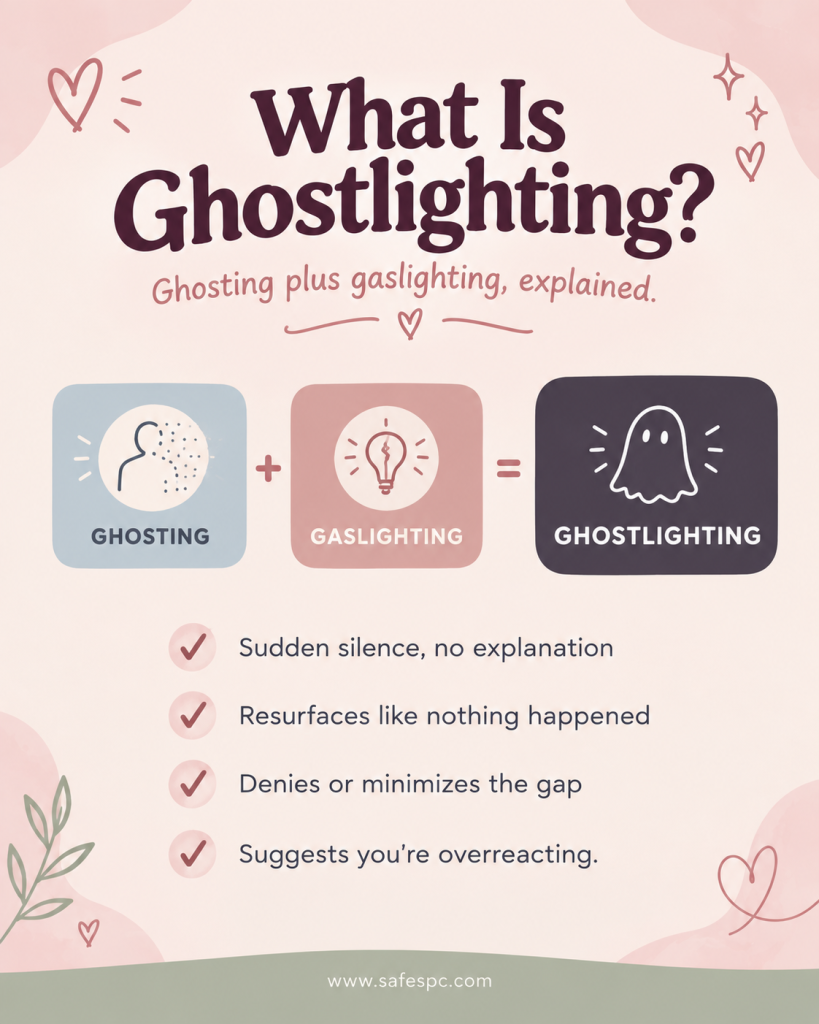
Ghostlighting is exactly what it sounds like when you combine the two: someone ghosts you, disappears completely with no explanation, and then resurfaces later acting as though nothing happened, denying or minimizing the disappearance if you bring it up at all. Vice describes the pattern as someone ghosting first and then returning to gaslight the other person about the ghosting itself, often acting confused or dismissive if you try to name what happened.
The reappearance is the part that makes ghostlighting distinct, and arguably worse than plain ghosting. Plain ghosting, however painful, is at least consistent. Ghostlighting reopens the wound and then denies the wound exists, which is a very specific kind of disorienting.
Ghostlighting psychology: why people do it?
This is the part most coverage of the term skips, and it’s the most useful thing to actually understand. There are a few different psychological pictures underneath ghostlighting behavior, and they call for different responses from you.
Dismissive-avoidant attachment. Psychologist Sarah Hensley explains that people who ghostlight often have a dismissive-avoidant attachment style, tending to shut down both their own emotions and other people’s, a pattern that traces back to early caregivers who focused on achievement and responsibility rather than emotional attunement. For someone with this style, disappearing isn’t necessarily calculated cruelty. It’s what happens when discomfort gets so high that the easiest move is to shut the whole thing off, and returning later without acknowledgment is simply how someone avoids the emotional weight of accountability. This is closely related to what’s covered in why do I push people away when I like them, just with a specific, ungenerous way of handling the return.
Genuine conflict avoidance. Some people ghostlight not out of malice but because they’re deeply uncomfortable with confrontation of any kind. Disappearing avoids one hard conversation. Denying it later avoids a second one. It’s cowardice more than cruelty, though the effect on you is the same either way.
Manipulation and low empathy. For some people, it’s more deliberate. Ghosting as a low-cost exit and gaslighting the return as a way to keep an option open without ever taking responsibility for how they’ve treated you. Psychology Today’s Bella DePaulo notes plainly that finding someone doing this to you is reason enough to ask whether you want to deal with someone capable of it at all, since gaslighters tend to specialize in blurring the truth, making an honest explanation unlikely even if you ask for one.
The honest, slightly uncomfortable truth: you often can’t tell which version you’re dealing with from the outside, and the healthiest response is largely the same regardless of which one is true. More on that below.
Signs of ghostlighting
Ghostlighting tends to follow a recognizable shape. Watch for:
- Communication was normal, even close, and then stopped abruptly with no explanation.
- Weeks or months pass with zero contact, not a slow fade, a hard stop.
- They resurface casually, often with a light, upbeat message, as if reconnecting after a normal gap.
- If you ask what happened, they minimize it: “I’ve just been busy,” “I didn’t realize it had been that long,” or “why are you making this a whole thing.”
- They avoid direct acknowledgment of the disappearance, redirecting instead to the present moment.
- If pushed further, they may flip the narrative, implying you’re overreacting or being dramatic for bringing it up.
- They expect the relationship, or situationship, to simply resume where it left off.
If you’re not yet sure whether you’re dealing with ghosting at all, how to know if you’re being ghosted walks through the clearest signs before it escalates to the ghostlighting stage covered here.
The gaslighting element is really the last three. Disappearing and returning is a pattern on its own. Denying, minimizing, or reframing your reasonable reaction is what tips it into ghostlighting specifically.
Ghostlighting examples
Example one, the dating app disappearance: You matched, talked daily for six weeks, met in person twice, and things felt genuinely promising. Then nothing, for two months. Then a message: “hope you’ve been well, would love to catch up sometime.” When you ask what happened, the reply is, “oh, life got hectic, you know how it is,” with no reference to the two months of total silence or how that might have felt on your end.
Example two, the established relationship version: You’d been together eight months. After an argument about spending more time together, your partner goes silent for three weeks, no explanation, unreachable. When they resurface, they act as though the relationship simply continued uninterrupted, and if you raise the silence, you get told you’re being “too sensitive about it” or that you’re “always looking for something to be upset about.”
Example three, the friendship version: Ghostlighting isn’t limited to romance. A close friend disappears after you set a boundary, resurfaces months later posting as though nothing shifted, and if you mention the gap, insists you’re “reading into things” or “making it weird.”
What all three share: the disappearance, the return with no acknowledgment, and the reframing of your reasonable question into your overreaction. That last move is gaslighting doing its actual job, making you doubt whether you’re even allowed to be bothered.
Gaslighting vs. ghosting: what’s the difference?
These are two distinct behaviors that ghostlighting happens to combine, and it helps to separate them clearly.
- Ghosting is an act of absence. Someone disappears and stops communicating. It’s painful because of what’s missing: explanation, closure, the chance to ask a question and get a real answer.
- Gaslighting is an act of presence. Someone is actively engaged with you, but using that engagement to distort your sense of reality, memory, or judgment. It’s painful because of what’s happening: manipulation designed to make you doubt yourself.
The simplest way to hold the distinction: ghosting hurts through silence. Gaslighting hurts through active distortion. Ghostlighting is what happens when the silence ends and the distortion begins, back to back, from the same person.
Ghosting vs. ghostlighting: what’s the difference?
Plain ghosting ends there. The person disappears, and in most cases, never comes back. However painful, it’s at least a consistent, if incomplete, ending. You’re left to grieve something with no closure, but you’re not being actively told your own experience of it was wrong.
Ghostlighting adds a second injury. The person returns, and instead of any accountability, you get denial, minimization, or a subtle accusation that you’re overreacting to something that, in their retelling, barely happened.
You’re not just left without closure. You’re told your need for closure is the actual problem. That’s the added psychological weight that makes ghostlighting distinct, and why many people who’ve experienced both describe ghostlighting as the more damaging of the two.
Ghostlighting is also worth separating from two other confusing variations. Soft ghosting vs. intermittent ghosting covers the slow fade and the on-again-off-again cycle, both of which are different from the clean stop-then-return shape ghostlighting follows.
How ghostlighting affects the person on the receiving end?
Being ghosted alone is already associated with real emotional distress, confusion, and a hit to self-esteem, since the mind tends to fill an unexplained silence with self-blame. Ghostlighting compounds this in a specific way: it adds a layer of self-doubt about whether you’re even entitled to your own reaction.
People who’ve been ghostlit often describe feeling disoriented in a way that’s harder to shake than ordinary heartbreak, because part of the injury is being told, directly or indirectly, that the injury didn’t happen the way they remember it.
If this pattern is showing up alongside a lot of second-guessing on your part more broadly, not just around this one person, why do I overthink every text message and signs your partner has abandonment issues both cover related ground worth reading.
What to do if you’ve been ghostlit?
1. Trust what you experienced. The silence happened. The length of it happened. Your feelings about it are a reasonable response to a real event, regardless of how it gets described to you later.
2. Decide if you even want an explanation. You’re allowed to want one. You’re also allowed to skip the conversation entirely if your gut says it won’t be honest. Both are valid choices.
3. If you do respond, keep it short and unemotional. Something like: “I noticed you went quiet for a while with no explanation, and I’m not looking to pick it apart, but I wanted to name it before we move forward.” This puts the fact on the table without opening a debate.
4. Watch the reaction closely. A person capable of accountability will acknowledge it, even briefly, without turning it back on you. A person who deflects, minimizes, or makes you the problem for bringing it up has just shown you exactly what continuing would look like.
5. Don’t let the resurfacing erase the disappearance. A cheerful “hey stranger” doesn’t cancel out weeks or months of silence. You’re allowed to let the new contact sit for as long as you need before deciding how, or whether, to respond.
6. Protect your own narrative. Write down what actually happened, in your own words, while it’s fresh. This matters more than it seems, because gaslighting works partly by outlasting your certainty. A clear record protects that certainty.
Should you give them another chance?
There’s no universal answer, but two questions tend to cut through the noise. First, did they acknowledge the disappearance clearly, without minimizing it or making it your fault, when given the chance? Second, is this the first time, or part of a pattern you’ve already seen once before?
A one-time disappearance with genuine, un-defensive accountability afterward is a very different situation from a repeated cycle with the same denial each time. The first is a mistake someone might actually learn from. The second is simply how this person operates, and no amount of your patience is likely to change that.
Common mistakes people make
- Accepting the resurfacing at face value: Moving forward as though the gap never happened skips the one thing that actually determines whether trust is rebuildable: how they respond when it’s named.
- Apologizing for bringing it up: If gaslighting has done its job, you may feel like the difficult one for even mentioning the silence. You’re not. Naming a real event that happened is not an overreaction.
- Assuming you did something to cause it: Ghosting says far more about someone’s capacity for direct communication than about your worth or behavior.
- Debating the facts with someone actively gaslighting you: If someone is committed to denying or distorting what happened, arguing the details rarely leads anywhere productive. Stating the fact once, calmly, and observing the response is usually more useful than a prolonged back and forth.
When to seek support?
If this pattern keeps repeating across relationships, either as something that keeps happening to you or something you notice yourself doing to others, it’s worth exploring with a therapist, since it often connects to deeper attachment patterns on one or both sides. If a specific instance has left you struggling with intrusive doubt about your own perception or memory, that’s also worth naming to a professional, since sustained gaslighting can have a real, lingering psychological impact well beyond the relationship itself.
Frequently Asked Questions
What does ghosting mean in dating?
Ghosting means someone suddenly cuts off all communication with no explanation, ending things through silence rather than a conversation.
What is ghostlighting?
Ghostlighting is when someone ghosts you, disappearing without explanation, and then later resurfaces and denies, minimizes, or gaslights you about the disappearance itself.
What’s the psychology behind ghostlighting?
It often traces back to dismissive-avoidant attachment, general conflict avoidance, or in some cases, a genuinepattern of manipulation and low empathy toward the other person’s feelings.
What are the clearest signs of ghostlighting?
A sudden, unexplained silence followed by a casual resurfacing, combined with minimizing or denying the gap when you bring it up, and sometimes a suggestion that you’re overreacting by mentioning it at all.
What’s the difference between gaslighting and ghosting?
Ghosting is an act of absence and hurts through silence. Gaslighting is an act of presence and hurts through active distortion of your reality. Ghostlighting combines both, back to back.
How is ghostlighting different from regular ghosting?
Regular ghosting typically ends there, with no further contact. Ghostlighting adds a return, along with denial or minimization of what happened, which adds a layer of self-doubt on top of the original hurt.
Should I give someone a second chance after they ghostlight me?
It depends on whether they take real accountability when it’s named, without deflecting or blaming you, and whether this is a one-time event or part of a repeated pattern.
Is ghostlighting the same as soft ghosting or intermittent ghosting?
No. Soft ghosting is a gradual decline in contact, and intermittent ghosting cycles between silence and normal warmth repeatedly. Ghostlighting follows a different shape: a hard stop, followed by a return where the disappearance gets denied or minimized rather than acknowledged.
The bottom line
Ghostlighting is what happens when someone doesn’t just disappear, but also tries to rewrite what the disappearance meant. The silence is painful enough on its own. The part that does lasting damage is being told, directly or through a shrug, that your memory of it is wrong. It isn’t. You’re allowed to name what happened, you’re allowed to want accountability, and you’re allowed to decide that a person who can’t offer it doesn’t get another chance to.
1 thought on “What Is Ghostlighting? Signs, Psychology, and Examples”