
Yes. You can love someone and still leave them, and doing so does not mean the love was fake, wasted, or a mistake.
Love is one ingredient in a relationship, not the whole recipe. You can care deeply about a person and still know that the life you are building together is not working, that you are not safe or well inside it, or that you want different futures. Millions of people have stood in that exact place, whether they were married, dating, in a situationship, or somewhere in between.
This question is back in the spotlight because tennis stars Elina Svitolina and Gaël Monfils recently announced the end of their marriage, with Svitolina speaking about love, family, and needing to find her way back to herself. We will use their public statement as a doorway, not a case file. We do not know the private details of their relationship and we will not guess at them. What we can do is look at what the statement points to and what it teaches anyone facing the same question.
In this guide you will learn why love and leaving can both be true, a framework for what love cannot cover, how to tell a rough patch from an ending, what to try before you go, how to leave someone who still loves you with kindness and clarity, how to handle a shared life or a child, and how to heal afterward. If you are the one being left, there is a section for you too.
What Svitolina actually said?
Here is what has been reported publicly, nothing more.
According to Yahoo Sports, Svitolina announced the divorce on October 19, 2026. She tied the decision to the lasting emotional toll of the war in Ukraine. In her words, she needs to “find my way back to myself” and cannot do that within the marriage.
She also said their daughter, Skai, remains the priority and that she wants to preserve “our family.” The tone of her message was grateful and respectful, thanking Monfils for his support through their happiest and hardest moments.
Per a timeline from AOL, the couple got together in 2019, announced their engagement in April 2021, married in July 2021, and welcomed their daughter in October 2022. Reports from 2021 also describe a break in their relationship announced that February, which Tennisnet covered, before the engagement and marriage.
What we can and cannot learn from this?
We can learn from the shape of her words: love and gratitude on one side, a personal need on the other, and a clear priority on the family. We cannot learn why it happened in detail, whose fault it was, or what was said in private.
Nobody outside a relationship can know that, and treating a public statement as a full explanation is how gossip is made. The rest of this guide stays with principles that hold for anyone.
Why you can love someone and still leave them?
It helps to separate three things people usually bundle together: loving someone, being compatible with them, and being well in the relationship.
Love is not the same as fit
You can love a person’s character, humor, and history and still not be able to build the same future. One wants children and the other does not. One needs to live in another country. One is ready for commitment and the other is not.
BetterHelp’s guide to ending a relationship with someone you love lists reasons like these: disagreement on big life decisions, repeated conflict despite effort, one person feeling drained from always leading or reassuring, growing apart as values change, and a connection that has faded.
Love has parts
Psychologist Robert Sternberg proposed in 1986 that love has three components: intimacy (closeness), passion (attraction and desire), and commitment (the decision to stay).
According to Simply Psychology’s explanation of the theory, different mixes produce different kinds of love, and the components change over time: passion tends to peak early and then settle, commitment usually grows and then holds, and intimacy has to be maintained by ongoing sharing. The theory also suggests relationships tend to be most stable when both people want and need the components to a similar degree.
This is useful because it shows that “I still love you” can mean very different things.
- It might mean deep closeness without passion.
- It might mean commitment without intimacy.
- It might mean real affection that sits alongside a mismatch you cannot fix.
Love can be present and still not be enough to hold the whole thing up.
Being well matters too
A relationship can have love and still leave one person unwell, unseen, or stuck. Svitolina’s words about needing to “find my way back to myself” point to this third idea: sometimes the question is not “do I love them?” but “can I become whole inside this?” That is a real and legitimate question, and it does not require a villain.
The Five Things Love Can’t Cover
When you are torn, “I love them” feels like a trump card. A clearer way to think is to ask what love can and cannot supply. We use five categories. They are our own working framework, built from the common reasons people give for leaving, not a clinical model.
| Thing | The question to ask | When it is missing |
|---|---|---|
| Safety | Do I feel physically and emotionally safe here? | Fear, control, contempt, or being made small |
| Direction | Do we want the same kind of life? | Different answers on kids, place, money, timing |
| Capacity | Do we both have the energy and ability to do this right now? | One person is depleted, grieving, or overwhelmed |
| Respect | Do we treat each other as equals who matter? | Dismissal, scorekeeping, or taking each other for granted |
| Self | Can I be myself and grow here? | Feeling lost, shrinking, or unable to heal |
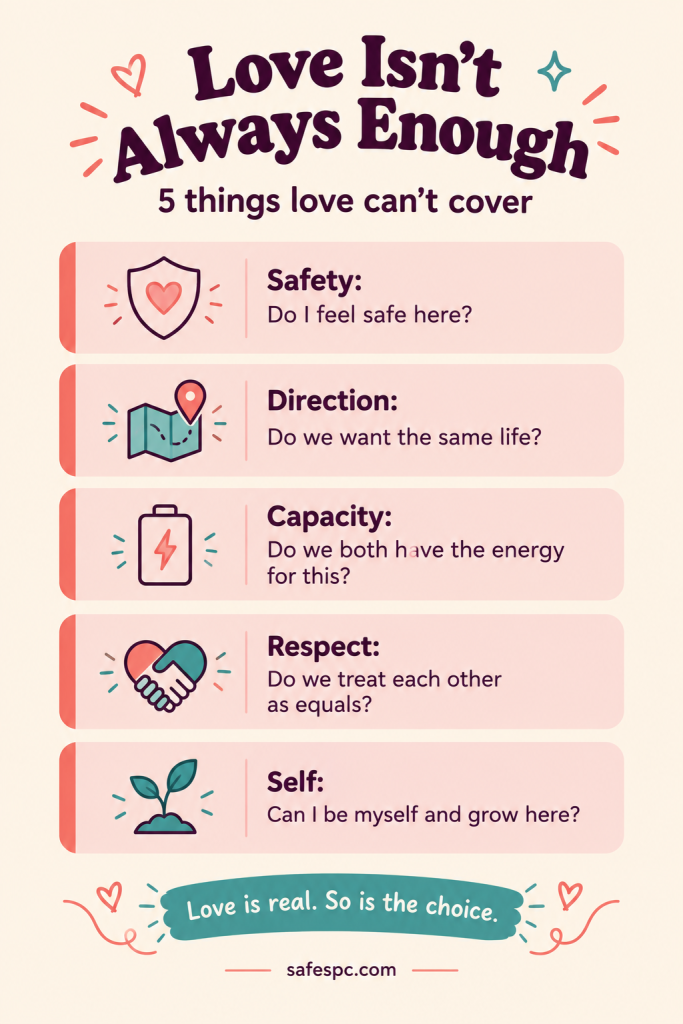
How to use it?
Go through the five and mark each one honestly: present, shaky, or missing. Love tends to cover a lot of shakiness. It does not cover a missing Safety. It rarely covers a missing Direction. It cannot manufacture Capacity or Self.
If two or more are missing and have been for a long time despite real effort, the love is probably not the problem, and it is not going to be the solution either. That is usually the moment people realize they can love someone and still leave them.
Where Safety changes everything?
If Safety is the missing piece, because you are afraid of your partner, controlled, or hurt, this is not a “love versus leaving” dilemma. Your safety comes first. Reach out to a trusted person or a local support service and make a plan for leaving safely.
Is it time to leave? Rough patch or real ending?
Almost every relationship hits hard stretches. The skill is telling a season from a conclusion.
Signs it may be a rough patch
- The problem has a cause you can name, such as a job loss, a new baby, grief, or a long-distance stretch.
- You still have good moments and you both want more of them.
- Both people are willing to talk and to change something.
- You can imagine the problem improving with time or help.
Signs it may be an ending
- The same painful pattern has returned for a long time despite honest effort.
- You want fundamentally different futures, and neither of you can bend without breaking.
- One person has done most of the giving, fixing, or waiting for a long time.
- You feel relief more than grief when you picture leaving.
- You have stopped believing change is possible, and so has your partner.
- Safety, respect, or your sense of self has been missing for a long time.
Eight questions to ask yourself
Take your time and write the answers down.
- If nothing about this relationship changed for the next five years, would I be okay?
- When did I last feel truly like myself here?
- Have I said clearly what I need, and was there a real response?
- Am I staying because I want to, or because I am afraid of hurting them?
- Is my love for them stronger than my love for this version of the relationship?
- What would my closest friend say I deserve?
- What am I most afraid of if I leave? If I stay?
- Is this a problem we can both work on, or only one of us?
If you find yourself repeating the same hard conversations, our guide to how to know when to end a situationship offers a useful way to test this for less formal relationships too.
Before you leave: what to try first
Leaving should not be a reflex. If the situation is safe, a few honest attempts give you clarity, and they mean you can leave without wondering “what if.”
Say it plainly
Many couples drift into endings without ever saying the real thing out loud. Choose a calm moment and state what you need and what is missing. “I love you, and I am not okay in how we are living” is clearer than ten hints. Conversation prompts can help here, and our 100 couple conversation cards make the harder topics easier to open.
Set a clear experiment
A vague “let’s try harder” rarely works. Try a defined window, for example three months, with specific changes: a weekly check-in, couples counseling, a shared plan about the big decision you disagree on. At the end, ask honestly whether anything shifted.
Get outside help
A couples therapist or individual therapist can help you see whether the pattern is fixable and whether you are staying or leaving for the right reasons. Therapy is not an admission of failure. Sometimes it helps you leave with more clarity and less damage.
Check your own patterns
Sometimes the urge to leave comes from an old habit, such as pulling away when things get close. If that sounds familiar, read why you push people away when you like them and how to stop being scared of intimacy.
On the other side, if you are the one who feels you give and give while they cannot take it in, our guide on how to love someone who doesn’t know how to receive love may help.
Know when trying is over
If you have tried honestly and nothing has changed, or if safety is at risk, you do not owe the relationship endless attempts. You are allowed to decide.
How to leave someone who still loves you?
This is the hardest part. A kind ending is not a painless one, but it can be a clear and respectful one. Based on the practical guidance in BetterHelp’s advice, here is a step-by-step approach for when you love someone and still leave them. If you have any reason to fear your partner’s reaction, skip to the safety note at the end of this section.
Step 1: Be sure, then be clear
Before you speak, decide whether this is final. If it is, say so plainly. Mixed signals (“maybe in a few months”) keep the other person in limbo and feed false hope. If you are not sure, say that honestly instead, and talk about a break or a time-limited experiment.
Step 2: Choose a calm time and place
In person is usually kinder than text. Pick a private moment when neither of you is exhausted, rushed, or drinking. Do not do it right before a big event or a holiday if you can avoid it.
Step 3: Start with your truth, not their faults
Speak about your own feelings and needs. “I have realized I cannot build the life I need in this relationship” is easier to hear than “you are not good enough.” Blame invites a debate and you do not need to win one.
Step 4: Acknowledge what was real
You can name what you valued without softening the decision. “You have been important to me and I am grateful for what we shared. I have still decided to end this.”
Step 5: Do not argue the decision
They may cry, plead, bargain, or get angry. Listen with care, and keep the message steady. You can say, “I hear how painful this is. My decision has not changed.”
Step 6: Agree on practical next steps
Talk about housing, belongings, shared accounts, pets, and who tells whom. Keep this brief on the first day. If you share a child, see the section below.
Scripts you can adapt
- Opening: “I need to tell you something hard, and I want to say it with respect. Can we sit down?”
- The decision: “I love you, and I have come to see that we cannot build the future I need together. I am ending our relationship.”
- When they ask ‘if you love me, why leave?’: “Love is real here, and it is not enough for me to be well in this relationship. I am not saying you are a bad person.”
- When they ask for another chance: “I have thought about this for a long time, and I do not want to give you false hope. My answer is no.”
- Closing: “I wish you well, and I hope you are kind to yourself in the days ahead.”
A safety note
If your partner has been controlling, threatening, or violent, an in-person conversation may not be safe. Plan with a trusted person, consider contacting a local domestic violence service, and choose a method of leaving that protects you.
Mistakes that make leaving crueler
- Ghosting. Disappearing without explanation is a quiet cruelty, especially to someone who loves you. Even a short, clear message is kinder.
- Leaving slowly by neglect. Pulling away bit by bit so they end it for you leaves both of you confused. Say the thing.
- Blaming them to make it easier. Turning them into the villain eases your guilt and damages their dignity. You can leave without a case against them.
- Giving mixed signals. Late-night texts, “just checking in,” and affection after the breakup keep them hoping.
- Staying out of guilt. If the only reason you stay is that you cannot bear their pain, the relationship will carry that weight too, and they will feel it.
- Rushing to friendship. “Let’s stay friends” can be a way to dodge the grief. Give both of you time before deciding what shape contact will take.
- Leaving it to the last moment. Waiting for the perfect time can mean years. There is rarely a perfect time, only a clear and caring one.
If you are ending something less formal, our guide on how to end a situationship with scripts and texts offers wording for those conversations.
When a child or shared life is involved?
Svitolina said her daughter remains the priority and that she wants to preserve “our family.” That sentence names something many separating parents work toward: ending the romantic relationship without ending the family.
Keep the child’s world steady
Children do best when routines, caregivers, and the message stay consistent. Tell them together if you can, in simple age-appropriate words, and make clear it is not their fault and that both parents still love them.
Separate the roles
You are no longer partners, but you are still co-parents. Treat that as a working relationship: clear communication, predictable schedules, and respect in front of the child. Avoid using your child as a messenger or comparing homes.
Plan the practical side
Shared homes, finances, and legal arrangements are easier to handle with help. Talk to a family mediator or lawyer where appropriate, and keep a calm tone in written messages.
Take care of the adults
Parents who are grieving still have to function. Lean on friends, family, or a therapist, and give yourself room to feel the loss while staying steady for the child.
Without a child
Even without children, a shared life can be tangled: a lease, a business, a friend group. The same principle holds. Be clear, be practical, and be fair.
If you are the one being left
Being left by someone who says they still love you can feel confusing, even insulting. If you are in that place, you deserve gentleness too.
Let yourself grieve
“They love me but are leaving” can feel like a contradiction. It is not. It is a loss, and grief is the right response. Expect waves.
Do not argue them out of it
It is natural to want to convince them. But if they have decided after long thought, bargaining usually deepens the pain. You can state what you feel, once, and then let the answer stand.
Be careful with the story you tell yourself
“If they really loved me, they would stay” can become a harsh verdict on your worth. Staying or leaving is a decision about fit, safety, capacity, and direction, and it does not measure how lovable you are.
If you tend to hear rejection as proof you are unlovable, our guide on signs your partner has abandonment issues and our attachment guide on anxious vs avoidant attachment can help you understand the patterns involved.
Get support
Talk to friends and family and consider a therapist. If the relationship was not clearly defined, why situationships hurt more than breakups explains the particular ache of an unclear ending.
After the split: grief and staying friends
Grief after a loving split is real
Leaving someone you love, or being left by them, can bring grief that looks like any other loss: tiredness, disrupted sleep, sudden tears, a kind of homesickness. BetterHelp’s guidance notes that lingering love is normal and that journaling, new routines, and therapy can help you process it.
The first weeks
- Keep routines: sleep, meals, movement.
- Avoid big decisions when you are raw.
- Lean on one or two people instead of broadcasting to everyone.
- Decide how much contact you can handle, and set that boundary kindly.
Should you stay friends?
Sometimes yes, but later. Friendship tends to work when both people have moved on and the contact does not reopen the wound. No contact is a valid choice, and it is often the safest after a controlling or unsafe relationship. If you share children, full no contact may not be possible, and then the goal is respectful, structured communication.
If it ended without closure
Some endings leave you with no neat explanation. Our guide on how to get over a situationship without closure offers a way to build your own closure when you do not get one.
Hope without waiting
Healing does not mean you stop caring. It means the loss stops running your life. Many people find that after some time, they can hold gratitude for what was real while moving toward a life that fits them better.
Five lessons from a tennis power couple’s split
Taking Svitolina’s public words as the starting point, here are the principles that apply to anyone.
- You can love someone and still leave them. Her statement carries gratitude and a decision in the same breath. You do not have to hate someone to end a relationship.
- Your own wellbeing is a valid reason. Needing to “find my way back to myself” is not selfish. A relationship that keeps you from healing is worth questioning.
- How you leave matters. A clear, respectful message, with thanks and without blame, protects both people’s dignity.
- If there is a child, the family can change shape without ending. Parents stay parents even when partners stop being partners.
- A break is not always an ending, and an ending is not always a failure. Relationships change. Some are rebuilt, some are closed, and both can be done with care.
Frequently asked questions
Can you love someone and still leave them?
Yes. Love does not guarantee compatibility, safety, shared goals, or the capacity to build a life together. Leaving does not mean the love was never real.
Why do people leave someone they still love?
Common reasons include different life goals, repeated unresolved conflict, one person feeling drained, growing apart, a fading connection, or a need to heal or grow somewhere else.
How do you know it is time to leave?
Look for long-term patterns despite real effort, missing safety or respect, different futures, relief when you imagine leaving, and a sense that you cannot be yourself. The five things love can’t cover are a good checklist.
Is it selfish to leave someone who loves you?
Not automatically. Staying out of guilt can be unfair to both of you. Leaving with clarity and care is often kinder than staying while resentful.
How do you break up with someone who loves you?
Be sure, be clear, choose a calm and private moment, speak about your own needs, acknowledge what was real, and do not argue the decision. See the steps and scripts above.
Will I regret leaving someone I love?
Some people feel doubt, and that is normal in grief. Doubt after a long, honest decision does not mean the decision was wrong. If you are unsure, consider a time-limited experiment or counseling before deciding.
Can we stay friends afterward?
Sometimes, once both people have moved on. Give it time. If there was control or harm, no contact may be the right choice.
What if we have a child together?
Keep routines steady, tell them together in simple words, and separate your roles as former partners from your role as co-parents.
Can this apply to non-married relationships?
Yes. Dating, long-term partnerships, and even undefined situationships can involve love and still not be the right fit.
Love is real, and so is the choice
You can love someone and still leave them. You can also love someone and stay, if the five things love can’t cover are present. The work is in telling the difference honestly, and in acting on it with as much care as the situation allows.
If you are deciding right now, start with the eight questions above and the five-thing check. Write down your answers. Talk to someone you trust. And if you decide to go, do it clearly and kindly. For more help along the way, browse our guides on how to know when to end a situationship, how to end a situationship, and how to get over one without closure.