
The weekend was one of those. A long breakfast, easy laughter, the kind of conversation where you both forgot to check your phones. They told you they’d never felt this comfortable with anyone. Then Monday came, the replies shrank to one word, then to nothing, and by Wednesday you were dissecting your own last message trying to find what you did wrong.
If you’re searching for how to date someone with avoidant attachment, you’re probably tired of decoding silence and unsure whether you’re being patient or being played. This post answers both: what’s really happening inside them, what to say and do when they pull away, how long to wait, and how to know when it’s time to leave.
Does this sound like who you’re dating?
Avoidant behavior rarely announces itself. It shows up as a pattern:
- They’re warm and fully present, then suddenly distant with no clear reason.
- They feel close after intimacy, then withdraw for days.
- They rarely say what they need, and “I’m fine” or “I’m just busy” is the standard answer.
- They treat independence as a virtue and your needs as a burden.
- They stay vague about labels, future plans, or meeting friends.
- They get irritated or shut down when you ask for reassurance.
- They describe past partners as people who “wanted too much.“
- They pull away most when you’re being vulnerable.
If most of that is familiar, keep reading. If only one or two are, or the distance is really about someone disrespecting you, skip ahead to the section on how to tell the difference.
What avoidant attachment actually is (and isn’t)?
Avoidant attachment usually forms when early caregivers dismissed, discouraged, or were uncomfortable with dependence. The child learns that needing people doesn’t pay off, so they learn to need less. As adults, avoidantly attached people tend to suppress their attachment needs, avoid emotional closeness, and become rigidly self-reliant, and they can turn cold or angry when their autonomy feels threatened, including when they or their partner need support.
What it isn’t: proof they don’t care. Many avoidant people love deeply and feel real distress about their own distance. The love is real. The way they handle closeness is the problem. If you want to see how this compares with the anxious style, anxious vs avoidant attachment lays it out side by side, and fearful avoidant vs dismissive avoidant attachment helps if their behavior swings between wanting you close and fleeing.
Why they run hot and cold?
The pattern usually follows a loop. Things go well, closeness builds, the internal alarm goes off, and they create distance through busyness, flaw-finding, silence, or a picked fight. The pressure drops, they feel relief, and then loneliness pulls them back. You experience this as being pulled in, then dropped, over and over.
From the inside, it feels like a protective reflex rather than a decision. Why do I push people away when I like them walks through that loop from their side. Sharing it with them, if the moment is right, can say what you can’t quite put into words.
First, make sure it’s avoidance
Not every hot-and-cold partner is avoidant. Three lookalikes are worth ruling out:
- They’re simply not that into you: An avoidant partner who cares still shows warmth and effort in between the retreats, and often seems confused or guilty about their own distance. Someone who’s uninterested tends to be consistently lukewarm, not swinging between intense and gone.
- They’re emotionally unavailable for other reasons: Fresh from a breakup, unsure about the relationship, or seeing other people can all look like avoidance. Why am I attracted to emotionally unavailable people covers how to spot the difference and why we sometimes ignore it.
- It’s fear of being left: Some people pull away first so they can’t be abandoned. It looks avoidant but the root is different, and signs your partner has abandonment issues will help you tell them apart.
One rule cuts through all of it: avoidance explains behavior, it never excuses mistreatment. Distance is one thing. Lying, contempt, and disrespect are another.
Why chasing and going cold both backfire?
Most people respond to an avoidant partner’s withdrawal in one of two ways, and neither works.
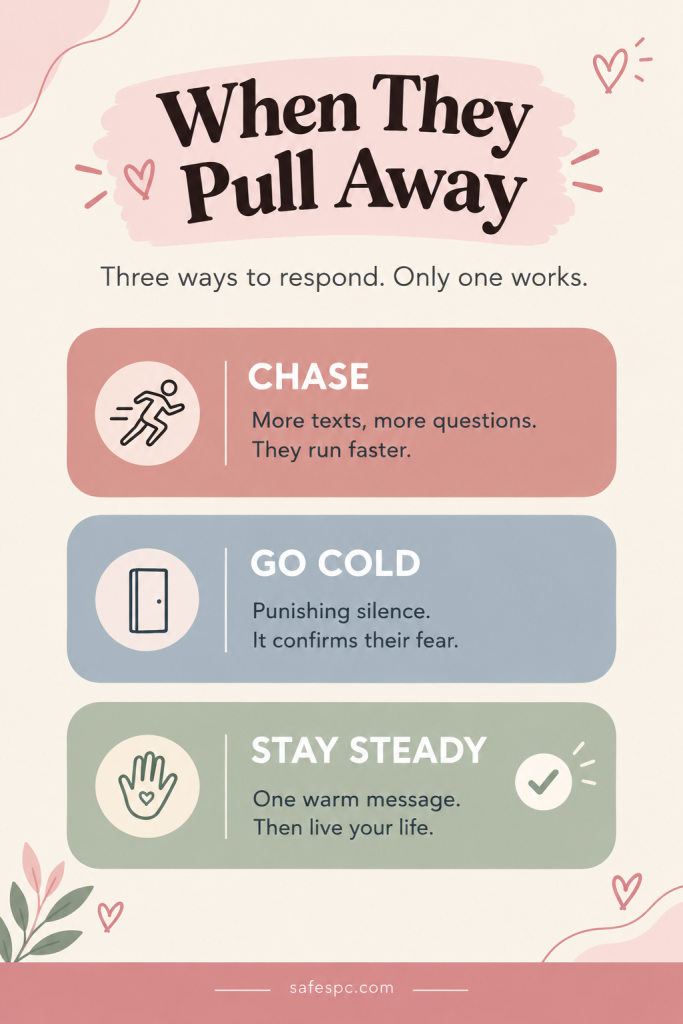
- Chasing: More texts, more questions, more “can we talk?” To an avoidant nervous system, pursuit feels like pressure, which is exactly what triggers the retreat. The harder you chase, the faster they run.
- Going cold: Punishing silence, testing, or pretending not to care so they’ll miss you. This confirms their belief that people withdraw when things get real, or gets read as permission to drift further.
The third response is steadiness: warm, calm, unhurried, honest. Research on couples supports this. Partners can soften avoidant defenses by calming their own anger and steering around withdrawal during conflict rather than escalating it. In practice that means staying open without pursuing.
What to do when they pull away?
1. Give it real time. Not hours. A retreat usually needs days before the alarm settles, and interrupting it early tends to extend it.
2. Send one warm, low-pressure message. Something like: “No pressure to reply. I’m thinking of you, and I’m around whenever you feel like talking.” Then stop. One message is presence. Five is pursuit.
3. Live your life. See friends, keep your routines, protect your sleep. This isn’t a tactic to make them miss you. It’s what keeps you from becoming a full-time detective.
4. When they return, reconnect first. Don’t interrogate, and don’t punish. Let the warmth land, then bring up the pattern later, on a calm day.
5. Name the pattern outside the moment. Never mid-retreat and never mid-argument.
What to say (scripts that actually work)?
Lead with security before the request. An avoidant partner braces for demands, so start by telling them they’re not in trouble.
Naming the pattern:
“I’ve noticed that after we’ve been really close, you tend to go quiet for a few days. I’m not upset, and I’m not going anywhere. I’d love to understand what’s going on for you.”
Asking for what you need (the space signal):
“I don’t need constant contact. I do need to know we’re okay. Could you send me a quick message when you need space, so I’m not left guessing?”
Setting a boundary:
“I’m happy to give you space. I’m not okay with being ignored for days after a disagreement. If you need time, tell me roughly how long.”
The space signal is the single most useful ask in this whole post. It gives them the room they need and gives you the clarity you need.
If you tend toward anxiety yourself
An avoidant and an anxious partner is one of the most common and most painful pairings, because each person’s coping style sets off the other’s. If you notice your own spiraling, how to fix anxious attachment style in a relationship will help you regulate before you react, and why do I overthink every text message is useful for the midnight-phone moments. Your job isn’t to become less caring. It’s to stop outsourcing your sense of safety to their reply time.
How long should you wait for them to change?
There’s no universal timeline, so measure direction, not intensity. One warm week proves nothing. A slow trend over months tells you a lot. It can help to pick a check-in date with yourself, say three months out, and ask honestly what has actually changed.
Signs of real movement:
- They name the pattern themselves, or agree when you name it.
- They start signaling before they withdraw.
- They come back faster over time, or repair without being chased.
- They tolerate a little more closeness or vulnerability than before.
- Their actions match what they say they want.
Signs of no movement:
- They deny the pattern and treat your needs as the problem.
- The cycle repeats at the same intensity, with the same excuses.
- Every conversation about it ends with you apologizing.
When to walk away?
Loving someone doesn’t obligate you to build a life with them. Consider leaving if:
- They deny the pattern exists and consistently frame your needs as too much.
- Distance or silence is used to punish you.
- You feel anxious most days, and it’s affecting your sleep, work, or health.
- Beyond distance, there’s dishonesty, contempt, or disrespect.
- You’ve asked clearly, given real time, and nothing has moved.
- You’ve stopped being yourself to keep the peace.
Leaving isn’t failing. It can be the most self-respecting choice available, and it doesn’t mean they’re a bad person, only that this dynamic isn’t sustainable for you. If your safety ever feels at risk, reach out to someone you trust or a local support service.
If the deflection is really about receiving love
Some avoidant partners aren’t so much withdrawing as struggling to take in care at all: deflecting compliments, minimizing their needs, bracing when things go well. If that sounds like your partner, how to love someone who struggles to receive love covers that side with real warmth.
Common mistakes
- Trying to become the perfect partner. You can’t earn your way out of someone else’s defense system.
- Diagnosing them. Using terms as accusations (“you’re just avoidant”) makes them shut down faster. Describe behaviors instead.
- Sending long emotional messages. Walls of text can feel overwhelming to an avoidant partner. Short and warm works better.
- Taking it personally every time. Their retreat is usually about their nervous system, not your worth.
- Giving unlimited access, hoping love will change them. Consistency matters, but so do your own boundaries.
When to seek support?
If you keep landing in this dynamic, or it’s costing you your peace, individual therapy can help you understand your own part in the pattern. Couples therapy, especially Emotionally Focused Therapy, works directly on this pursue-and-withdraw cycle when both people are willing.
Frequently Asked Questions
Can someone with avoidant attachment change?
Yes, many do, especially with self-awareness, a patient and consistent partner, and often therapy. It usually happens gradually, and only if they want to.
Do avoidant people actually love their partners?
Often, yes, deeply. Avoidance is about how they handle closeness, not whether they feel it.
Should I ignore an avoidant partner to make them miss me?
No. Strategic silence tends to backfire. Calm, steady presence with your own boundaries works better than games.
How do I know if they’re avoidant or just not interested?
Look for warmth and effort between the retreats, plus visible confusion or guilt about their distance. Consistent lukewarmth points more toward disinterest.
How do I stop feeling anxious around an avoidant partner?
Build your own regulation habits, keep your life full, ask for the space signal, and check whether your anxiety is responding to a real pattern of inconsistency.
The bottom line
Learning how to date someone with avoidant attachment comes down to staying warm without chasing, asking for clarity without pressure, and measuring change over months, not moments. You can be patient and still have limits. The goal isn’t to fix them. It’s to find out whether the two of you can build something steady, and to leave with your self-respect intact if you can’t.
1 thought on “How To Date Someone With Avoidant Attachment (And When To Walk Away)”