Is It Normal to Date Multiple People at Once? The Short Answer
Yes, it is normal to date multiple people at once in the early stages of dating, as long as nobody has agreed to be exclusive and everyone is treated honestly. It stops being normal, and starts being unfair, the moment one person believes you are exclusive while the other is quietly keeping options open.
That single sentence answers most of what people search for, but it does not answer the part that actually keeps you up at night. If you are the one wondering, you probably want to know three things.
- How do I know whether they are seeing other people?
- Is it okay to ask?
- And what do I do with the answer?
This guide walks through all of it. You will get a:
- Simple framework I call the Exclusivity Line, a stage-by-stage look at what each person is entitled to know, word-for-word scripts for the conversation,
- An honest guide for anyone who is dating around, and a clear way to decide whether to stay, talk or walk away when you learn they are seeing someone else.
Whether you are the person asking or the person being asked, you will leave knowing exactly what to say and what to expect.
When Dating Multiple People Is Normal, and When It Is Not
Dating is a sorting process. Most people use the early weeks to find out who they click with, and that often means going out with more than one person. Nothing in that is shady on its own. The trouble starts when two people have different ideas of what stage they are in.
What Counts as Normal
In the first few dates, with no conversation about exclusivity, it is widely accepted that either of you may be seeing others. The same goes for the talking stage, where you are still chatting and getting to know each other. If you are not sure where you stand, our guide to talking stage vs situationship vs relationship breaks down what each one usually means.
It is also normal for the opposite to be true. Plenty of people prefer to focus on one person from the first date, and they are not being intense. They simply know how they like to date. Neither style is wrong. The problem is assuming yours is the default.
What Stops Being Normal
- You have agreed, in words, to be exclusive, and one of you keeps seeing others.
- One person acts like a partner (daily texts, weekend plans, meeting friends) while quietly dating around.
- Someone lies when asked directly.
- Dating around is hidden because the person knows the other would object.
- You are sleeping together and one of you never mentions that there are other partners, which also affects sexual health and trust.
The test is not how many people someone sees. The test is whether the people involved have the same information. Honesty makes dating around fair. Secrecy makes it deceptive, even when the number of dates is exactly the same.
Why the Confusion Happens?
Apps and modern dating culture have blurred the old milestones. Without a clear “going steady” moment, couples drift from casual to serious without ever saying so. That drift is how many people end up in a situationship vs relationship mismatch, where one person feels committed and the other thinks nothing was ever promised.
The Exclusivity Line: What You Are Entitled to Know at Each Stage
Here is the framework I use to keep this simple. Picture a line running across your dating timeline. Before the line, dating around is fair game. After it, it is not.
The only thing that moves a couple across that line is a conversation. Time alone never does it, and neither does sleeping together, sharing a streaming login or getting a good-morning text.
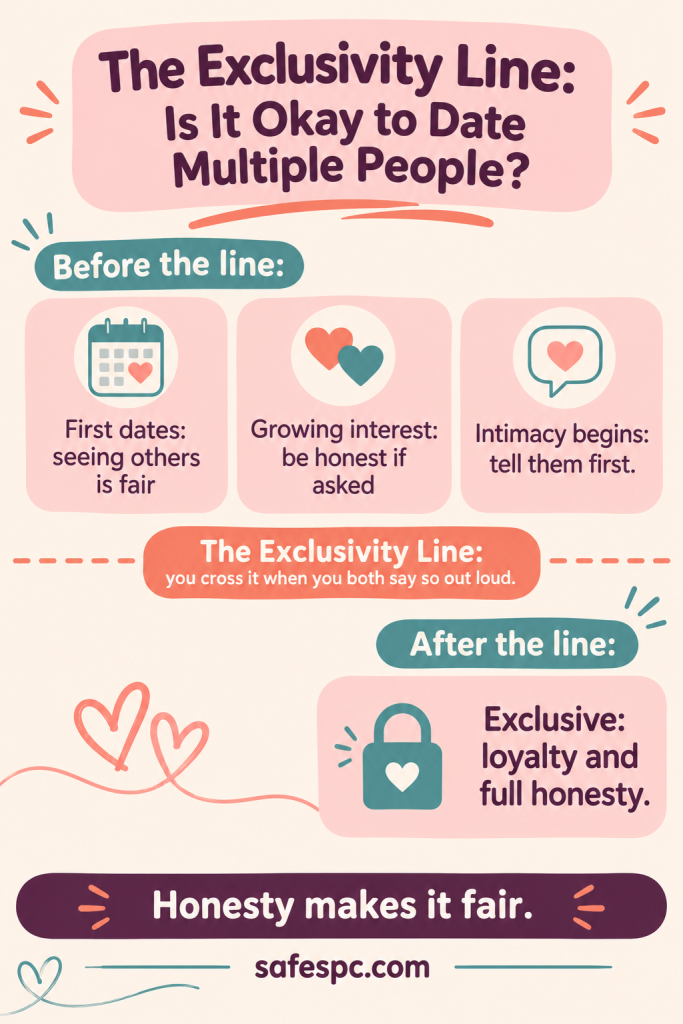
The line has one rule: you cross it when both people say so out loud, and not before.
But crossing is not a single moment. Honesty has levels, and what each of you owes the other grows as the connection does. Here is how I map it. These are my own rules of thumb, not research, so adjust them to your situation.
| Stage | Before or after the line | What is fair | What you owe each other |
|---|---|---|---|
| Matching and first dates | Before | Seeing others freely | Nothing yet, but do not lie if asked |
| Several dates, growing interest | Before | Still fair, but talk is needed soon | Honest answers if they ask |
| Intimacy begins | Before, but closer | Fair only if both know | Be open about other partners and protection |
| The “what are we” talk | The line | Decide together | A clear yes or no |
| Exclusive | After | Not fair to see others | Full honesty and loyalty |
Notice the third row. When physical intimacy begins, being quiet about other partners goes from a social issue to a health and trust issue. Even if you have not crossed the line, the other person deserves to know what they are stepping into.
The Three Questions That Tell You Where You Stand
If you are unsure whether you have crossed the line, ask yourself:
- Have we said it? Has either of you used a word like exclusive, together, boyfriend, girlfriend or partner, and did the other agree?
- Do we act the same way? Do both of you behave as though this is a committed relationship, or does one of you hold back?
- Could I say it out loud? Could you comfortably tell them, “I would like us to be the only people we are seeing”? If the idea makes you panic, you may not be ready, or you may suspect the answer.
If any answer is no, you are probably still before the line, no matter how much it feels otherwise. The most common source of heartbreak in modern dating is one person living on one side of the line while the other lives on the opposite side. For a deeper look at how that gap forms, see our guide to the stages of dating.
Why People Date Multiple People (and What It Does and Does Not Mean)
If you have just found out someone is seeing other people, your mind may race to the worst conclusion. Before you decide what it means, it helps to know the common reasons behind it. These are patterns I see often, not a diagnosis of any one person.
Healthy reasons
- They are still choosing. Some people honestly need more time to know who fits them.
- They are new to dating or just out of a long relationship. Dating several people can feel safer than going all in.
- They have not met anyone who made them want to stop. This is the one that stings, but it is information, not an insult.
- They never agreed to anything else. Without a conversation, they may genuinely believe it is still open.
Less healthy reasons
- Fear of commitment. They keep several people close so no one gets too close. Our guide on how to date someone with avoidant attachment explains this pattern.
- Needing validation. Attention from many people can feel like proof of being wanted.
- Keeping a backup. Holding you in reserve while they look for someone “better.”
- Wanting benefits without responsibility. If this feels familiar, read about situationship rules for protecting your feelings.
What It Does Not Automatically Mean
Someone seeing other people does not mean you are not good enough. It does not mean they are a bad person. It does not mean you misread everything. It often means you are in the sorting stage and have not yet been chosen, or chosen each other. That is a fact about the stage, not about your worth.
What it does reveal is whether the two of you want the same thing right now. That is what you need to find out.
How to Tell If They Are Seeing Other People?
You cannot read minds, and you should not play detective. Snooping through a phone or reading into a single like usually creates anxiety without giving you answers. A better approach is to notice patterns and then ask a direct question.
Patterns Worth Noticing
- Their availability is uneven. They are free some days and unreachable others, with vague explanations.
- Plans are last minute. You are rarely the person they plan ahead for.
- The dating apps are still active. This alone does not prove much if you have not agreed to be exclusive, but it is context.
- Their language stays casual. They say “we hung out” instead of “we went on a date,” and avoid labels.
- They deflect future talk. Anything beyond the next few weeks gets a joke or a change of subject.
- They are secretive about their phone or schedule. Not private, secretive. There is a difference.
One pattern on its own means little. Several together are a reason to ask. If you are caught in the loop of overanalyzing their messages, our post on why you overthink every text message can help you step out of it.
Why Asking Directly Works Best?
Checking their profiles, asking mutual friends or testing them with jealousy only teaches you how to be a detective. Asking teaches you how they respond to honesty. Someone who gets defensive, dodges the question or turns it into an attack on you has told you something important, even without a straight answer.
Asking also helps you learn whether you can talk about hard topics at all. If you cannot ask a basic question about where things stand, that is a sign for what the relationship might feel like later.
When to Ask?
A fair rule of thumb: ask when your own behavior has started to shift. If you have stopped seeing other people, you are making space in your schedule, or you are imagining a future, you have earned the right to ask where you stand. If you are still casually dating several people yourself, it is more fair to ask when you feel your interest becoming real, and to expect the same of them.
What to Say: Scripts for the Exclusivity Conversation
The words matter less than the tone. Be calm, be curious and be ready to hear an answer you may not love. Here are scripts for the most common situations. Adapt them to sound like you.
If you want to ask where things stand:
“I am really enjoying getting to know you. I would like to know how you see this going. Are you seeing other people, or is it more focused on us?”
If you want to say you are ready to be exclusive:
“I have realized I am not interested in dating anyone else. I would like us to be exclusive. How do you feel about that?”
If you are not ready to be exclusive but want to be honest:
“I like spending time with you, and I want to be upfront. I am still seeing a couple of other people and I am not ready to stop yet. If that is not what you want, I understand.”
If they say they are seeing other people:
“Thanks for telling me. I appreciate the honesty. Can I take a day to think about whether that works for me?”
If they say they are not seeing anyone but will not commit:
“I hear that you are not seeing others. I am looking for something clear, and I want to understand what is holding you back.”
If you find out they lied:
“I found out you are seeing someone else, and you told me you were not. I need honesty to keep dating. I would like to understand what happened.”
If you want to end it kindly:
“I have enjoyed this, but I want exclusivity and you are not there. I would rather be honest now than hope for something that is not going to happen.”
Three Rules for These Conversations
- Ask in person or on a call when you can. Text strips out tone, and serious questions deserve more than an emoji reply.
- Pick a calm moment. Not after an argument, not late at night when you are anxious, and not while one of you is rushing out the door.
- Decide beforehand what you will do with each answer. If you already know that “I am seeing others” means you walk away, you will not freeze when you hear it.
If You Are the One Dating Multiple People: How to Do It Honestly
There is a way to date around without hurting anyone, and it is mostly about honesty and pace. If you are the one keeping your options open, these habits keep you fair and keep your conscience clear.
- Be clear early. You do not need a speech, just a simple line: “I am still meeting people, so I am not looking for anything exclusive yet.” People can handle clear. They struggle with unclear.
- Do not act like a partner. If you want to keep things open, avoid the behaviors that imply commitment: daily good-morning texts, meeting parents, and talking about future trips. Mixed signals do the most damage.
- Protect health. If you are sleeping with more than one person, use protection, get tested regularly and tell partners. This is not optional.
- Do not keep someone on a string. If you know you are not going to choose them, let them go. Months of “let’s see” for someone you have already decided against is unkind.
- Answer honestly when asked. If they ask whether you are seeing others, tell the truth, even if it is awkward.
- Check your own reasons. Are you dating around because you honestly have not decided, or because you are afraid of being tied down? If it is the second, it is worth understanding why. Our post on why you push people away when you like them is a good place to start.
- Notice when your interest changes. When one person starts to pull ahead of the others, tell the rest. Holding several people in limbo while you make up your mind is the most common way people get hurt.
A Note on Ethical Non-Monogamy
Some people are in open relationships or practice ethical non-monogamy, where all partners know and agree. That is a different thing from dating around while someone assumes they are exclusive. The difference is consent.
If everyone involved knows and agrees, it is a valid choice. If someone is being kept in the dark, it is not. This guide is about people who are still in the dating stage, but the same principle applies to every relationship style: honesty is what makes it ethical.
If They Are Seeing Other People: Stay, Talk or Walk Away?
Once you know, you have three real options. None is the “right” one for everyone. The right one is the one that matches what you actually want.
Option 1: Stay and Keep Dating Casually
This works only if you are genuinely fine with it. Not “fine for now, hoping they will change,” but fine. Ask yourself honestly: if nothing about this changes for three months, will I be okay? If yes, you can enjoy it, see other people too and keep the stakes low. If your answer is “I am only okay because I hope they will choose me,” that is the signal to choose a different option.
Option 2: Talk and Set a Timeline
This works when you like them and want to see if they are heading your way. Tell them what you want, then give it a fair window.
For example: “I would like something exclusive. If you are not there yet, that is okay, but I do not want to wait indefinitely. Let’s check in after a few more dates.”
A window protects you from drifting for months. If you want a clear, structured way to decide, our guide on how to turn a situationship into a relationship covers this in detail.
Option 3: Walk Away
This is the right choice when:
- You want exclusivity and they have said they do not.
- They lied about seeing others.
- You feel anxious, small or constantly competing.
- You have given a fair window and nothing has changed.
Walking away is not a failure and it is not a punishment. It is a way of choosing yourself. If you are unsure how to do it gracefully, see our scripts for ending a situationship.
Questions to Help You Decide
- Do I feel calm or anxious when I am with them?
- Am I being honest about what I want?
- Would I give this advice to a close friend in the same situation?
- If they told me tomorrow that they were choosing someone else, would I be heartbroken or relieved?
- What would I do if I knew nothing would change?
Your answers are more reliable than any list of signs. If you want help recognizing when it is time to leave, read how to know when to end a situationship.
Not sure if they are choosing you?
If you keep going back and forth on whether to stay, talk or walk away, a clear process beats another night of overthinking. The 7-Day Situationship Exit Plan starts with a scorecard that shows where you really stand, then walks you step by step to a decision you can live with, in about 20 minutes a day.
Green Flags and Red Flags When Someone Is Dating Around
How a person handles dating multiple people tells you more than the fact that they are doing it.
| Green flags | Red flags |
|---|---|
| They told you before you asked | You found out from a friend or an app |
| They answer questions directly | They get defensive or change the subject |
| Their words and actions match | They act like a partner but say they are single |
| They respect your pace and your no | They pressure you for intimacy |
| They say clearly what they want | They stay vague so they can never be wrong |
| They tell you when things change | They let you assume |
| They protect your health and feelings | They dismiss your concerns |
The Pattern That Matters Most
Look at consistency over time. A single awkward conversation is normal. A repeated pattern of vagueness, secrecy and excuses is not. If every honest question gets a different story, believe the pattern, not the story.
For a wider look at what healthy behavior looks like, our guide to green flags vs red flags in a relationship goes deeper. And if the vagueness feels like a hot and cold pattern, you may be dealing with something closer to breadcrumbing.
FAQ: Dating Multiple People at Once
Is it normal to date multiple people at once?
Yes, in the early stages of dating, before anyone has agreed to be exclusive. It becomes unfair when someone believes the relationship is exclusive and the other person is hiding that they are seeing others.
How many dates before you should be exclusive?
There is no set number. Many people begin talking about exclusivity after several weeks of regular dating, but what matters is that both of you say it out loud and agree. Time alone does not make a relationship exclusive.
Is it okay to ask if someone is seeing other people?
Yes. It is a fair, adult question, especially once you have been dating regularly or become physically intimate. Ask calmly and be ready to share your own answer too.
Should I tell someone I am dating other people?
Yes, if they ask, and ideally before things become intimate. Telling them lets them decide whether that works for them. Hiding it takes that choice away.
Is dating multiple people cheating?
Not if you have not agreed to be exclusive. It is cheating only when there is an agreement of exclusivity and one person breaks it.
What if I find out they are dating other people?
Take a breath before you react. Decide whether you want to stay casual, ask for exclusivity with a timeline, or walk away. Then have a direct conversation instead of guessing.
Is she seeing someone else, or am I overthinking?
Look for patterns such as uneven availability, vague plans and deflected future talk, not single moments. If several are present, ask directly. A calm question gives you more information than hours of guessing.
Can you date multiple people and still fall in love?
Yes, and many people do. The key is to be honest when your feelings change, so no one is left in limbo.
Why do some people refuse to be exclusive?
Reasons range from not being sure about you, to fear of commitment, to wanting to keep things casual. You cannot change their reason, but you can decide whether to wait for it to change.
How long should I wait for someone to decide?
There is no universal answer, but open-ended waiting rarely works. A fair window of a few weeks, agreed in conversation, protects you from drifting.
Final Thoughts: Clarity Is Kinder Than Hope
It is normal to date multiple people while you are still getting to know each other. What is not okay is letting someone believe something that is not true. The Exclusivity Line gives you a simple way to see where you stand: you cross it when both of you say so, and not before.
- If you are the one asking, ask early and calmly, and decide ahead of time what you will do with each answer.
- If you are the one dating around, be honest, protect health and let people go when you know you will not choose them.
- And if you find out they are seeing others, remember that the question is not “what is wrong with me?” The question is “does this match what I want?”
Do not spend months hoping a vague situation turns into a clear one. A short, honest conversation will tell you more than any amount of watching and waiting. For more on spotting where you are in the dating process, read our guides to the 72 hour intimacy rule and the 3-3-3 rule of dating.
Ready to stop guessing?
If you are tired of wondering where you stand, The 7-Day Situationship Exit Plan gives you a clear decision in about 20 minutes a day. It is a 50-page workbook with ready-made scripts and a 60-day guarantee.
A practical workbook, not therapy.