
If you are wondering when to post your partner on social media, here is the honest short answer: post them when the relationship is clear, they are fine with it, and you are not doing it to prove something. For most couples that lands somewhere between two and four months in, after you have agreed you are exclusive. But there is no official clock, and the people who treat it like one usually end up posting for the wrong reasons.
This guide gives you more than a number. You will learn the difference between a soft launch and a hard launch, what the viral couple photo rule actually says, a five-rung timeline I call the Posting Ladder, a three-question test to run before you hit share, and word-for-word scripts for talking to your partner about it. We will also cover what to do when they will not post you, because that question quietly worries more people than they admit.
If you have ever stared at a photo of the two of you with your thumb hovering over the share button, you are in the right place. Let’s make it simple.
Soft Launch vs Hard Launch (and Every Step in Between)
These two terms came out of social media marketing, where a soft launch is a quiet release before the big announcement. Dating borrowed them, and they now describe how openly you reveal a partner online.
Soft launch:
A subtle hint that you are seeing someone, without saying it outright. The Conversation describes it as a photo or video and caption that suggests romance without stating it, with clasped hands as a classic example. The Knot adds familiar examples: two drinks on a table, a partner’s back as they walk ahead of you, your feet together on a beach, or a kiss where only the back of a head shows.
Hard launch:
A clear, explicit announcement that leaves nothing to guess. Think a kiss, a face, a caption that names the relationship, or a tag. The Conversation points to a couple kissing in a post as the standard example.
Here is how they compare in real life:
| Soft launch | Hard launch | |
|---|---|---|
| What people see | A hint: hands, drinks, a silhouette | Faces, a kiss, a caption, a tag |
| What it says | “Something might be happening” | “This is my person” |
| Best for | New or uncertain stages | Settled, exclusive stages |
| Risk if it goes wrong | Low, easy to quietly remove | Higher, more explaining to do |
| Where it usually lives | Stories, Close Friends, a photo dump | The main feed, a tagged post |
The In-Between Steps Nobody Names
Real life is not two boxes. Most couples move through several smaller steps, and knowing them helps you pick the right one:
- Story only. The post disappears in 24 hours, which makes it low stakes.
- Close Friends. A small, trusted audience sees you together first.
- The photo dump. One or two couple photos tucked into a carousel of other life moments.
- The shared hobby post. You both appear because you were doing something together, not because you are announcing anything.
- Likes and comments first. Engaging with their posts publicly before appearing in your own.
- Going Instagram official. The moment the relationship is clearly visible: a tagged feed post, a relationship status, or a caption that says it.
If you want to understand where these steps sit on the broader map of dating, our guides on the stages of dating and modern dating terms and their meanings fill in the rest.
Is a Soft Launch Dishonest?
Not by itself. A soft launch can be a healthy way to protect something new from outside opinions and unwanted messages, and The Knot notes it can help people ease back into dating after a long relationship. It becomes a problem only when it is a way to keep your options open while your partner thinks you are all in. If you are hinting because you want privacy, that is fine. If you are hinting because you are not sure about them, that is a conversation to have with yourself first.
The Couple Photo Rule: What It Is and Whether It Is Fair?
The couple photo rule has been going around online in a few versions, but the core idea is simple: you do not take or post couple photos until you are actually a couple. One widely shared story, covered by the Daily Dot, is about a woman who holds this line with a man she has dated for about six weeks, and he cannot decide whether it is smart or sad. I could not open the full article, so I am going by that headline and the way the rule is generally discussed rather than quoting it.
The Case For the Rule
- Photos create a story. A tagged couple photo tells everyone you are together, so it should match reality.
- It protects you from a feed full of someone who turned out to be a situationship. If that fear sounds familiar, read our piece on situationship vs relationship.
- It filters for clarity. Someone who will not stand next to you in a photo may not be ready to stand next to you in a relationship.
The Case Against the Rule
- A photo is not a contract. Taking one at dinner does not commit either of you to anything.
- Rigid rules can feel like a test. If your partner senses a trap, they may pull back.
- Posting and taking are different. Plenty of people happily take photos but keep them off the internet.
My Take: Split the Rule in Two
The version I trust separates two things people mash together. Taking a photo together is a private, low-stakes act, and refusing it can feel cold. Posting it is a public statement. So a fairer couple photo rule is this: take the photos whenever the moment feels natural, and post them only when the relationship is clear. That keeps the memory and protects the message.
It also fits what the women in an Elite Daily roundup said. None of the seven gave a set number of weeks or months. Their guideposts were things like feeling settled, being ready, asking the partner first, and examining your own motives.
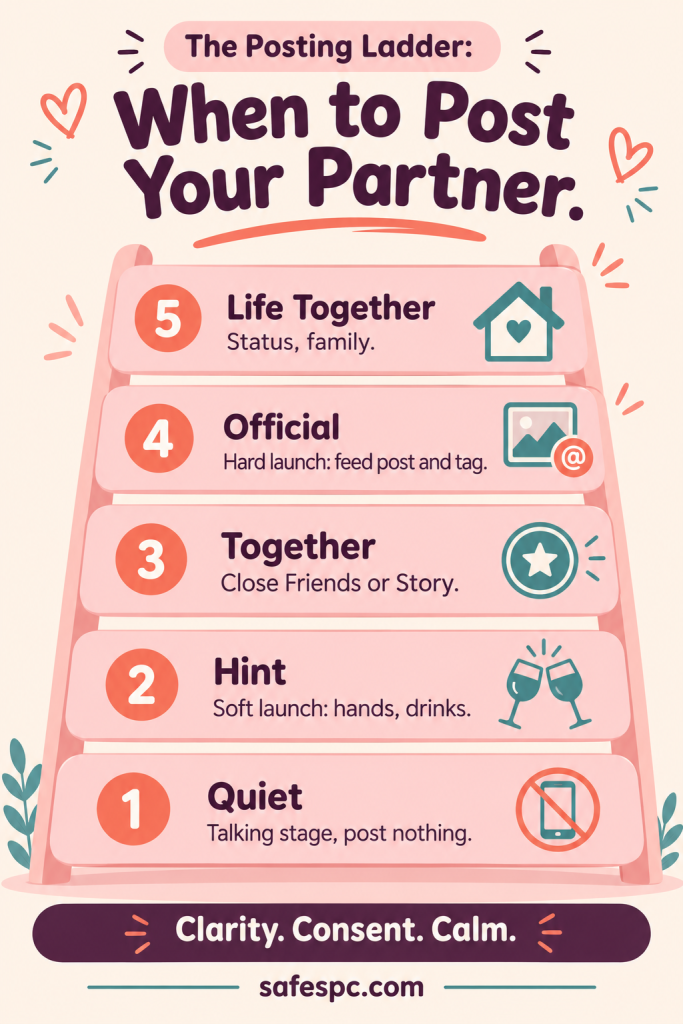
The Posting Ladder: How Long to Wait at Each Stage
Here is the framework I use. Think of it as a ladder with five rungs. You do not have to climb every one, and you can stop anywhere, but you should not skip rungs just because your thumb is itchy. The timings are my own rules of thumb from common patterns, not research, so treat them as a guide.
Rung 1: Quiet (the talking stage). Nothing posted. You are still finding out who this person is. If you are not sure what stage you are in, our guide to talking stage vs situationship vs relationship will help. Typical window: the first few weeks.
Rung 2: Hint (soft launch). A hand, a drink, a shadow. You have been on several dates and the energy is consistent, but you have not had the exclusivity talk. Typical window: around weeks three to eight.
Rung 3: Together (Close Friends or Story). Faces visible, but to a small audience. You have talked about where this is going and agreed you are both in. Typical window: around the first two months.
Rung 4: Official (hard launch). A feed post, a tag, a caption. You are exclusive, you have met each other’s friends, and you have the “yes, we are a couple” conversation behind you. Typical window: about two to four months.
Rung 5: Life together. Relationship status, regular tagged posts, family and holidays. This is for serious, settled couples, often well past the six month mark.
| Rung | What you post | What you need first |
|---|---|---|
| 1. Quiet | Nothing | Time and information |
| 2. Hint | Hands, drinks, silhouettes | Consistent effort from both |
| 3. Together | Close Friends or Story | An honest talk about where this is going |
| 4. Official | Feed post, tag, caption | Exclusivity and mutual agreement |
| 5. Life together | Status, tags, family | Real commitment |
Notice the pattern. Each rung needs clarity before it needs time. A couple that has talked honestly can reach Rung 4 faster than a couple drifting in an undefined situation for a year. If you are stuck on Rung 1 or 2 with someone and the “what are we” conversation keeps getting dodged, our guide to turning a situationship into a relationship walks you through it.
The Three Lights Test: Are You Ready to Post?
Before you share, run this quick check. If all three lights are green, post with confidence. If one is red, wait a little.
- Clarity. Do you both know what you are? Have you had the conversation, and is the answer the same on both sides? If you would hesitate to call them your boyfriend, girlfriend or partner out loud, the post is early.
- Consent. Does your partner know you want to post, and are they comfortable? Asking first is one of the most common things the women in the Elite Daily roundup mentioned. A photo that surprises them can feel like pressure.
- Calm. Why are you posting? If the honest answer is “to prove we are real,” “to make an ex jealous,” or “to make them commit,” the light is red. Posting should add to a good thing, not repair a shaky one. One of the women interviewed said she waits until the relationship feels settled, especially if her posts would be driven by jealousy.
A bonus check: imagine the relationship ended next month. Would you be comfortable with the post still existing, or deleting it? If the thought makes your stomach drop, you may want to wait or choose a softer rung of the ladder.
Reasons to Wait and Reasons to Post
Neither choice is automatically right. It helps to see the real tradeoffs side by side.
Good reasons to wait
- You are still unsure about them, and you want room to change your mind quietly.
- Your partner prefers privacy, or is not out to their family, as one woman in the Elite Daily roundup explained about her own situation.
- You are protecting a new relationship from opinions and unwanted messages.
- You have just left a long relationship and are easing back in.
- Work, family or culture makes a public relationship complicated.
Good reasons to post
- You are proud of them and want to share your life honestly.
- You are exclusive, and hiding them has started to feel awkward.
- Both of you want to, and it feels natural rather than strategic.
- It prevents confusion, such as friends trying to set you up.
- It marks a real milestone, like a trip, a birthday or meeting family.
One caution: neither list measures how good your relationship is. Plenty of strong relationships have almost no online footprint, and plenty of flashy feeds hide a very unhappy couple. Posting is a style choice, not a scorecard. Our guide to green flags vs red flags in a relationship is a better measure of how things are really going.
How to Bring It Up: Scripts That Do Not Sound Needy
The hardest part is often the conversation, not the photo. Here are scripts you can adapt, depending on what you need.
If you want to post them and are not sure they will like it:
“I really like this photo of us. Would you be okay if I posted it? If you would rather keep things private for now, that is fine too, I just want to check first.”
If you want them to post you:
“I noticed you have not shared anything with us in it. I am not asking for a big announcement, I am just curious how you feel about posting. What is your thinking?”
If you want to agree on a pace together:
“Let’s figure out what feels comfortable for both of us. Some people love sharing, some prefer privacy. Where do you land?”
If you want to soft launch first:
“I was thinking of posting something small, like our drinks or a shot of us from behind, nothing with your face. How does that sound?”
If they say no or not yet:
“Thanks for being honest. Can I ask what feels off about it? I want to understand, not push.”
A few rules that make these land well. Ask in a calm moment, not right after an argument. Ask a question instead of making a demand. And listen to the answer, including the part you do not love. If you tend to spiral after a text like this, why you overthink every text message may be worth a read first.
When They Will Not Post You: Normal Reasons vs Red Flags
This is the part many people search for in private. You are in a relationship, they do not post you, and you wonder whether that means something. Sometimes it does. Often it does not. The difference is in the pattern around it.
Normal reasons someone does not post
- They barely post anything at all, about anyone.
- They are private by nature or by profession.
- They had a painful public breakup and want to protect this one.
- They are not out to family, or their culture or workplace makes it complicated.
- They simply do not think of it. Some people forget to post for months.
Red flags worth taking seriously
- They post constantly about everything else, but you never appear.
- They hide you from friends, family and coworkers too, not just social media.
- They keep your relationship secret and get defensive when you ask.
- Their profile still presents them as single and they flirt publicly with others.
- You have asked kindly more than once and they brush it off or mock you.
The key question is not “why won’t they post me?” It is “do they treat me like a partner everywhere else?” Someone who meets your friends, introduces you, makes plans with you and shows up consistently is rarely hiding you. Someone who keeps you in the shadows in every part of life may be keeping their options open. Our post on whether he is really busy or just not interested shows how to read these patterns without driving yourself crazy.
If you feel stuck in a confusing situation and want a guided way through it, The 7-Day Situationship Exit Plan takes you from confusion to a clear decision in about 20 minutes a day.
Privacy, Safety and Consent: Posting Someone Else’s Face
A photo of your partner is not only your content. It is their face, their location and their privacy. A little care goes a long way.
- Ask before you post. This is basic respect, and it avoids a lot of arguments.
- Check what the photo reveals. Street signs, workplace badges, school logos and tagged locations can expose where someone lives or works.
- Mind live location and check-ins. Posting where you are in real time tells strangers where to find you both.
- Respect different comfort levels. Some people are private because of a past stalker, an ex or a sensitive job. That is a safety reason, not a lack of love.
- Think about the kids. If either of you has children, ask before posting their faces, and check with the other parent when appropriate.
- Know how to take it back. If your partner asks you to remove a photo, remove it without a fight. How you respond to that request tells them a lot about you.
If your partner is the one asking you not to post, believe them the first time. Privacy is a boundary, and boundaries are a green flag when they are stated clearly and respected.
Platform Differences: Instagram, TikTok, Facebook and Snapchat
The same photo says different things on different apps, so match the platform to the rung.
- Instagram. The home of the soft launch and the hard launch. Stories and Close Friends suit early rungs. The feed and tags suit Rung 4 and up. Going Instagram official here usually means a tagged feed post or a clear caption.
- TikTok. Couple content is more performative and more public. Videos can travel far beyond your followers, so be extra sure your partner agrees before posting.
- Facebook. Older relatives and coworkers are often watching. The relationship status setting still carries weight for some people, and changing it can feel like a big announcement.
- Snapchat. Casual and private by design. It is a low-stakes place to share couple moments with close friends, though screenshots exist.
- Private or secondary accounts. Some people keep a second account for close friends. This is a fair choice, especially when family does not know yet.
A simple rule: the wider the audience and the longer the post lasts, the more certain you should be.
Common Mistakes and What to Do After a Breakup
Mistakes to avoid
- Posting to force a commitment. A public post does not create a relationship that is not there.
- Reading too much into their feed. Not being posted is not proof of anything alone.
- Posting too soon, then deleting. It invites questions and can feel embarrassing for both of you.
- Comparing your timeline to strangers. Their highlight reel has nothing to do with your reality.
- Posting during a fight. Or posting to make your partner jealous. Both backfire.
- Skipping the conversation. Surprise tags can feel like pressure, especially for private people.
If the relationship ends
Breakups and photos are a tricky mix. Wait until the first wave of emotion passes before deleting or archiving anything, and do it for yourself, not as a message to them. Archiving is a gentler middle step than deleting. Unfollowing or muting can protect your peace. If you feel stuck, our guides on getting over a situationship without closure and loving someone and still leaving may help.
One of the women in the Elite Daily roundup said she waits until engagement so she never has photos of an ex on her feed. You do not need to go that far, but it is a reminder that what goes up can be hard to take down emotionally.
FAQ: When to Post Your Partner on Social Media
How long should you wait before posting your partner?
There is no rule, but many couples wait until they are exclusive, often around two to four months. Clarity and consent matter more than the calendar.
What is the difference between a soft launch and a hard launch?
A soft launch hints at a relationship with a partial photo, like hands or two drinks. A hard launch openly shows the partner, such as a kiss or a tagged feed post.
What does it mean to go Instagram official?
It means making the relationship clearly visible on Instagram, usually with a tagged photo, a caption, or a relationship status.
What is the couple photo rule?
It is the idea that you do not take or post couple photos until you are actually a couple. A fairer version is to take photos freely but post only when the relationship is clear.
Is it a red flag if my boyfriend or girlfriend never posts me?
Not by itself. Look at the whole pattern. If they hide you from friends and family too, that matters. If they simply do not post anyone, it is likely their style.
Should I ask before posting my partner?
Yes. Asking first protects trust, and it was a common theme among the women in the Elite Daily roundup.
Is it okay to soft launch someone I am not sure about?
It can be, if you are being honest with them and yourself. It becomes unfair when it keeps them hopeful while you keep your options open.
How soon is too soon to post your partner?
If you have not had the exclusivity conversation, or your partner has not agreed, it is probably too soon.
Does posting make a relationship stronger?
Not on its own. Trust, honesty and consistent effort do that. A post is a message to others, not a foundation.
Final Thoughts: Post When It Is True, Not When It Is Tested
The best answer to when to post your partner on social media is a quiet one: when it is clear, when it is mutual, and when it comes from joy rather than worry. Whether you soft launch with two drinks and a shadow or hard launch with a kiss and a caption, the timing that works is the one you both feel good about.
If you are still unsure where you stand, do not let a feed answer the question for you. Have the real conversation, watch how they treat you offline, and let the posts follow the relationship rather than lead it. For more on reading the signs, start with our guides to the 72 hour intimacy rule and the 3-3-3 rule of dating.
No timeline is correct. Your relationship is not on a stage. It is a private life that you are allowed to share on your own terms.