Talking stage vs situationship vs relationship isn’t really three separate categories. It’s one continuous line, with most confusion happening at the blurry points in between. Situationship vs relationship covers the deeper differences between those two stages. This piece focuses on the part people struggle with more, figuring out exactly where they currently sit.
Think of it as a spectrum, not three boxes
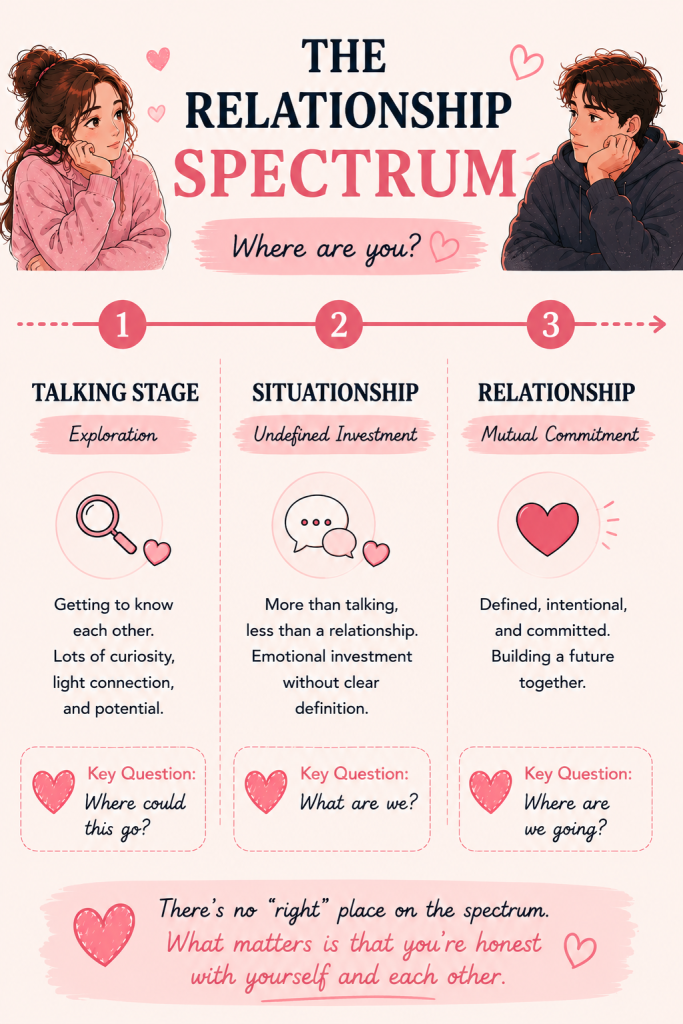
Picture a line. On the far left, two strangers just matched on an app. On the far right, a fully committed couple planning a future together. These three stages aren’t separate rooms, they’re points along that same line. People often slide back and forth before settling anywhere.
This framing matters because it explains why the confusion feels so slippery. You’re not failing to identify a fixed category. You’re trying to pin a moving position on a continuum. It shifts week to week, based on effort, consistency, and communication.
The talking stage, early and exploratory
The talking stage is the getting to know you phase, usually short, usually low stakes. Conversation happens often, but nothing is assumed yet. Neither person has invested enough to feel entitled to consistency from the other.
This stage is defined by curiosity more than attachment. You’re gathering information, compatibility, chemistry, values, without emotional weight riding on the outcome yet. Ending a talking stage rarely causes real heartbreak, since nothing was established to lose.
The situationship, deeper but still undefined
A situationship picks up where the talking stage leaves off. This usually happens after physical intimacy, repeated hangouts, or enough time that real feelings start forming. The key shift is emotional investment without matching structure. You care now, but nothing has been agreed on.
This is where real confusion sets in, because a situationship can feel identical to a relationship day to day. Consistent contact, real conversations, physical closeness, sometimes even meeting friends. What’s missing isn’t the behavior of a relationship, it’s the mutual, spoken agreement underneath it.
The relationship, defined and mutual
A relationship is what happens when both people actually name what they’re building, out loud, together. Exclusivity is confirmed, not assumed. Both people have agreed to invest in a shared future, even if the details are still being worked out.
This clarity changes how conflict gets handled too. In a relationship, disagreement gets addressed because both people are committed to working through it. In a situationship, disagreement often becomes an exit, since neither person has agreed to stay and fix anything.
How to tell exactly where you are right now
1. Check the label question. Have you ever directly asked, or been asked, what this is. If not, you’re likely stuck in the talking stage vs situationship vs relationship gray zone.
2. Check the exclusivity question. Do you know, for certain, whether you’re seeing other people or they are. Uncertainty here almost always means situationship, not relationship.
3. Check the future question. Are you included in plans more than a few weeks out. Talking stage rarely involves future planning at all. Situationships stay present focused. Relationships extend naturally into the future.
4. Check the consistency question. Is contact reliable, or does it swing between intense and silent. Inconsistency is a strong situationship marker, since relationships tend to stabilize once both people commit.
5. Check the conflict question. Has a disagreement ever actually been resolved together, rather than one of you just disappearing. Real conflict resolution is one of the clearest signs you’ve crossed into relationship territory.
What to do once you know where you stand?
If you’re in the talking stage and want it to deepen, keep investing lightly without over attaching yet. It’s too early for definition conversations, but not too early to notice consistency, or the lack of it.
If you’re in a situationship and want more, that conversation needs a real approach. How to turn a situationship into a relationship walks through exactly how, without pressure or apology.
If you’re already in a relationship but it doesn’t feel fully secure yet, that’s worth naming honestly too. Definition alone doesn’t guarantee security, consistent follow through does.
Movement in either direction is normal
People don’t move neatly from talking stage to situationship to relationship in a straight line. Sometimes a relationship slides backward into situationship territory after a big life change. Sometimes a situationship jumps straight to relationship after one honest conversation. The spectrum moves both ways. Noticing that movement matters more than judging yourself for where you currently sit.
The bottom line
Talking stage vs situationship vs relationship comes down to two things increasing together, emotional investment and mutual clarity. When those two move at the same pace, things tend to progress healthily. When investment outpaces clarity, that’s usually where the pain lives.